
Introduction
Choosing a hospital for surgery abroad is one of the most important decisions an international patient can make. While treatment costs, surgeon experience, travel convenience, and medical technology all play important roles, hospital quality and patient safety should remain the highest priorities.
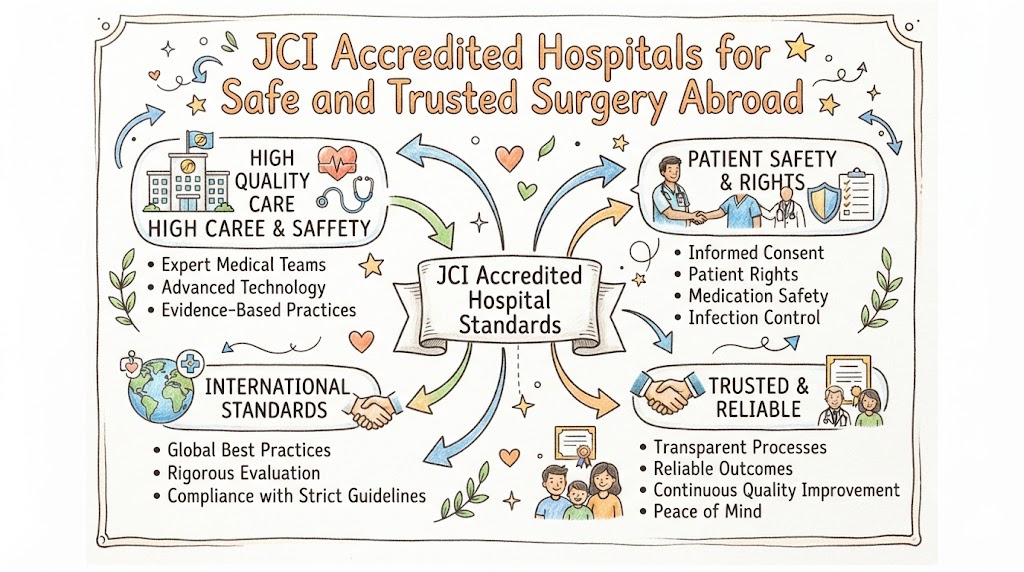
Many international patients specifically search for JCI accredited hospitals for surgery abroad because Joint Commission International (JCI) accreditation is widely recognized as an independent assessment of hospital quality and patient safety systems. JCI evaluates hospitals against internationally recognized standards covering patient care, infection prevention, medication safety, leadership, communication, and continuous quality improvement. However, accreditation does not guarantee a successful outcome, and patients should also evaluate the treating surgeon, procedure-specific experience, emergency facilities, and follow-up care.
Whether you are planning orthopedic surgery, heart surgery, cancer treatment, IVF, cosmetic procedures, spine surgery, bariatric surgery, dental implants, or organ transplant evaluation, understanding hospital accreditation can help you make a more informed decision.
SurgeryPlanet helps international patients compare hospitals, treatment destinations, estimated surgery costs, medical tourism packages, and hospital accreditation information to support confident healthcare decisions.
What Is JCI Accreditation?
Joint Commission International (JCI) is an independent, non-profit organization that accredits healthcare organizations around the world. Hospitals voluntarily undergo a detailed external evaluation to demonstrate that they meet internationally recognized standards for patient safety and healthcare quality. JCI describes its accreditation as an objective assessment of quality achievement and patient care systems.
JCI accreditation evaluates areas such as:
- Patient safety
- Quality improvement
- Infection prevention and control
- Medication management
- Surgical safety
- Patient rights
- Clinical communication
- Leadership and governance
- Staff qualifications
- Facility management
- Emergency preparedness
- Continuous performance improvement
Hospitals must continue maintaining these standards to retain accreditation.
Why JCI Accreditation Matters for Medical Tourists
Patients traveling abroad often have limited knowledge of local healthcare systems. Accreditation provides an additional level of confidence that a hospital has been independently assessed against internationally recognized standards.
Benefits include:
- Structured patient-safety procedures
- Standardized clinical protocols
- Improved infection-control systems
- Medication verification processes
- Better communication between healthcare teams
- Continuous quality monitoring
- Focus on patient rights and informed consent
- Ongoing performance improvement
Research has shown that international accreditation programs are widely used to improve healthcare quality and patient-safety systems, particularly in countries serving medical tourists.
What JCI Accreditation Does Not Guarantee
Although JCI accreditation is valuable, it should never be the only reason for choosing a hospital.
Accreditation does not guarantee:
- Perfect surgical outcomes
- Zero complications
- The best surgeon for every procedure
- The lowest infection rates
- The lowest prices
- Shortest recovery
- Suitability for every patient
Patients should also compare:
- Surgeon experience
- Hospital specialization
- Procedure volume
- Intensive care facilities
- Rehabilitation services
- Emergency support
- Patient reviews
- Cost transparency
- Follow-up arrangements
Accreditation should be viewed as one important quality indicator rather than a guarantee of treatment success.
What Does JCI Evaluate?
JCI standards cover many aspects of healthcare delivery.
Patient Identification
Hospitals must have reliable systems to correctly identify patients before tests, medication administration, surgery, and other treatments.
Surgical Safety
Hospitals are expected to use standardized surgical safety procedures, including verification of the patient, procedure, and surgical site before an operation.
Medication Safety
Hospitals must have systems to reduce medication errors through proper storage, labeling, prescribing, dispensing, and administration.
Infection Prevention
Accredited hospitals are expected to implement infection-prevention measures such as:
- Sterilization protocols
- Hand hygiene
- Isolation procedures
- Environmental cleaning
- Surgical-site infection prevention
- Monitoring and reporting
Patient Rights
Hospitals must respect patient dignity, privacy, confidentiality, informed consent, and communication needs.
Staff Qualifications
Healthcare professionals should have appropriate qualifications, licensing, training, and ongoing competency evaluation.
Emergency Preparedness
Hospitals must be prepared to respond to medical emergencies, equipment failures, disasters, and other unexpected situations.
Why Patients Choose JCI Accredited Hospitals
Many international patients prefer accredited hospitals because they often provide:
- International patient departments
- Multilingual coordinators
- Transparent treatment planning
- Better communication
- Comprehensive documentation
- Structured discharge planning
- Organized follow-up services
- Higher confidence in institutional quality
Many accredited hospitals also have dedicated teams that assist with visas, airport transfers, accommodation, interpreters, and medical travel coordination.
Countries with JCI Accredited Hospitals
Many popular medical tourism destinations have hospitals accredited by JCI.
These include:
- India
- Turkey
- Thailand
- Singapore
- United Arab Emirates
- South Korea
- Saudi Arabia
- Malaysia
- Spain
- Brazil
- Mexico
Patients should always verify the current accreditation status through the official JCI directory because accreditation can change over time.
Common Procedures Performed at JCI Accredited Hospitals
International patients frequently travel for:
- Knee replacement surgery
- Hip replacement surgery
- Heart bypass surgery
- Valve replacement
- Spine surgery
- Cancer treatment
- IVF
- Dental implants
- Cosmetic surgery
- Bariatric surgery
- Neurosurgery
- Organ transplant evaluation
- Eye surgery
- Robotic surgery
Accreditation does not indicate expertise in every specialty, so patients should verify the hospital’s experience with the specific procedure they require.
Questions to Ask Before Choosing a Hospital
Before confirming treatment, patients should ask:
- Is the hospital currently JCI accredited?
- Can accreditation be independently verified?
- Who will perform the surgery?
- How many similar procedures are performed each year?
- What are the surgeon’s qualifications?
- What are the hospital’s infection-control policies?
- Is intensive care available?
- What rehabilitation services are offered?
- What complications are covered?
- Is emergency surgery available if required?
- Will I receive complete medical records?
- How is follow-up care managed?
Additional Factors Beyond Accreditation
Hospital accreditation should be considered together with:
Surgeon Experience
The experience of the operating surgeon often has a major influence on outcomes. Patients should ask about procedure volume, training, and specialization.
Hospital Specialization
A hospital known for orthopedic surgery may not necessarily be the best choice for cardiac surgery or fertility treatment.
Technology
Patients may wish to compare:
- Robotic surgery
- Hybrid operating rooms
- Advanced imaging
- Minimally invasive techniques
- Intensive care facilities
Technology should support clinical care rather than replace clinical expertise.
Cost Transparency
Patients should request written quotations explaining:
- Surgery
- Hospital stay
- Surgeon fees
- Anesthesia
- Medicines
- Medical tests
- Implant costs
- Rehabilitation
- Possible additional charges
Follow-Up Care
Patients should understand:
- Who provides postoperative support?
- Can remote consultations be arranged?
- What happens if complications occur after returning home?
- How are medical records transferred?
Understanding Medical Tourism Packages
Many hospitals offer medical tourism packages that combine healthcare and travel support.
These packages may include:
- Hospital admission
- Surgery
- Nursing care
- Airport transfers
- Interpreter services
- Hotel accommodation
- Local transportation
- Initial follow-up consultation
Patients should also ask about exclusions such as:
- Flights
- Visa costs
- Extended hospitalization
- Blood products
- Intensive care beyond the package
- Treatment of complications
- Long-term rehabilitation
- Return travel
Red Flags to Watch For
Patients should be cautious if a provider:
- Guarantees surgical success
- Refuses to identify the surgeon
- Cannot verify accreditation
- Provides no written treatment plan
- Avoids discussing risks
- Pressures immediate payment
- Offers unusually low prices without explanation
- Provides no follow-up plan
- Cannot explain complication management
Reliable providers encourage informed decision-making rather than high-pressure sales.
How SurgeryPlanet Helps Patients
Planning surgery abroad involves evaluating many factors beyond cost.
SurgeryPlanet helps patients:
- Compare hospitals
- Explore treatment destinations
- Review estimated surgery costs
- Understand medical tourism packages
- Learn about hospital accreditation
- Compare healthcare providers
- Request personalized quotations
- Plan medical travel
- Access educational healthcare resources
By bringing important information together in one place, SurgeryPlanet supports patients throughout their medical tourism journey.
Frequently Asked Questions
1. What does JCI accreditation mean?
JCI accreditation indicates that a hospital has been independently evaluated against internationally recognized standards related to patient safety, quality improvement, and healthcare management.
2. Does JCI accreditation guarantee successful surgery?
No. Accreditation reflects hospital systems and quality processes, but surgical outcomes also depend on the patient’s condition, the surgeon’s expertise, procedure complexity, and postoperative care.
3. How can I verify whether a hospital is JCI accredited?
Patients should confirm accreditation through the official Joint Commission International directory rather than relying only on hospital marketing materials.
4. Are all good hospitals JCI accredited?
No. Many excellent hospitals hold national or regional accreditations instead of JCI accreditation. Patients should evaluate overall quality, clinical expertise, and outcomes in addition to accreditation.
5. Which countries have JCI accredited hospitals?
Countries including India, Turkey, Thailand, Singapore, the UAE, Malaysia, South Korea, Spain, Saudi Arabia, Brazil, and Mexico have hospitals that have achieved JCI accreditation.
6. Should I choose a hospital only because it is JCI accredited?
No. Accreditation should be considered together with surgeon experience, procedure volume, hospital specialization, costs, rehabilitation services, and follow-up support.
7. Do JCI accredited hospitals treat international patients?
Many do. Numerous accredited hospitals have dedicated international patient departments that assist with travel planning, interpreters, accommodation, and medical coordination.
8. Are JCI accredited hospitals more expensive?
Not necessarily. Pricing depends on the country, hospital, procedure, surgeon, and treatment package rather than accreditation alone.
9. Can accredited hospitals still have complications?
Yes. Every surgical procedure carries risks. Accreditation supports strong patient-safety systems but cannot eliminate medical complications.
10. How can SurgeryPlanet help me compare hospitals?
SurgeryPlanet enables patients to compare hospitals, treatment destinations, estimated surgery costs, medical tourism packages, and healthcare providers to support informed treatment planning.
Conclusion
Searching for JCI accredited hospitals for surgery abroad is an excellent starting point when planning international medical treatment. Accreditation demonstrates that a hospital has undergone an independent evaluation of its patient-safety systems, quality-management processes, and organizational standards.
However, accreditation should never be the only factor in your decision. The experience of the surgeon, hospital specialization, clinical outcomes, emergency services, rehabilitation, transparent pricing, and long-term follow-up are equally important. By combining careful research with trusted resources such as SurgeryPlanet, international patients can confidently compare hospitals, understand treatment options, and plan a safer medical journey abroad.

