
Introduction
Modern IT environments run on distributed systems, microservices, cloud-native applications, and hybrid infrastructure. While this architecture enables speed and scalability, it also creates a constant stream of alerts, logs, and events that are difficult to manage manually. Engineering teams often struggle with alert fatigue, delayed root cause identification, and slow incident resolution.
This is where Intelligent Incident Management with AIOps Platforms becomes essential. By combining artificial intelligence, machine learning, and automation, AIOps platforms help organizations detect, correlate, and resolve incidents faster than traditional IT operations tools.
Platforms like AiOpsSchool are helping professionals and enterprises understand how to implement intelligent incident management practices that reduce downtime and improve operational efficiency.
What Is Intelligent Incident Management?
Intelligent Incident Management refers to the use of AI-driven systems to automatically detect, analyze, prioritize, and resolve IT incidents across complex environments.
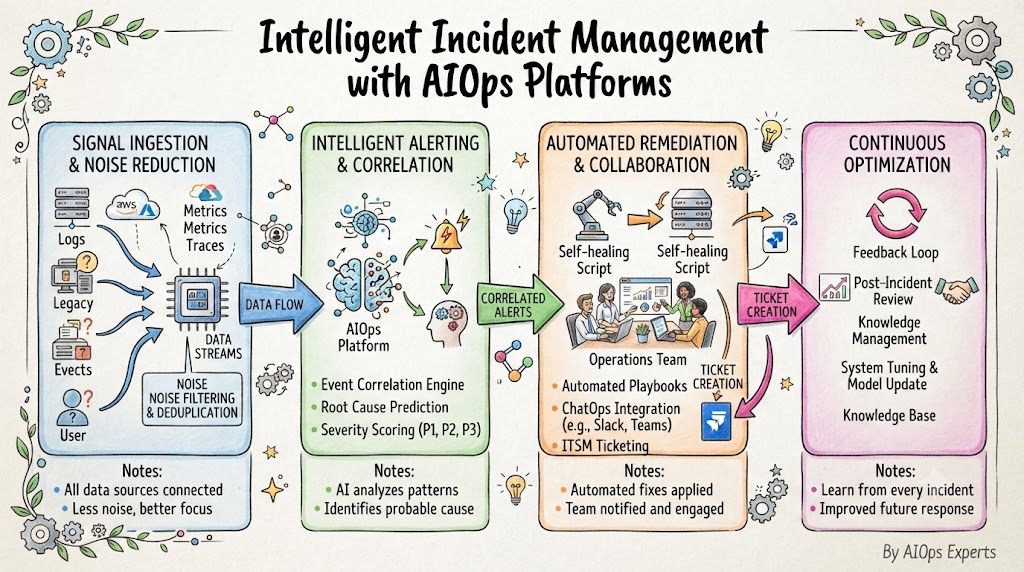
Instead of relying on manual ticketing systems and human-driven escalation processes, AIOps platforms use data-driven intelligence to:
- Identify incidents in real time
- Group related alerts into meaningful events
- Prioritize incidents based on business impact
- Suggest or execute automated remediation actions
This transforms traditional reactive incident handling into a proactive and predictive system.
Role of AIOps Platforms in Incident Management
AIOps Platforms serve as the central intelligence layer for modern IT operations. They collect data from multiple sources such as logs, metrics, traces, and events, and apply machine learning models to generate actionable insights.
Key capabilities include:
- Real-time anomaly detection
- Event correlation across systems
- Noise reduction from redundant alerts
- Root cause analysis automation
- Workflow-based incident resolution
By integrating these capabilities, AIOps platforms significantly improve operational efficiency and system reliability.
Why Intelligent Incident Management Matters
In traditional IT operations, incidents are often handled manually through ticketing systems and human intervention. This approach becomes inefficient as system complexity increases.
Intelligent incident management helps organizations:
- Reduce mean time to detect (MTTD)
- Lower mean time to resolve (MTTR)
- Eliminate alert fatigue
- Improve system uptime and reliability
- Enable faster decision-making during outages
It ensures that IT teams focus on solving real problems instead of managing noise.
Core Components of AIOps-Based Incident Management
Data Collection and Observability
Logs, metrics, and traces are continuously collected from applications and infrastructure to provide full visibility into system behavior.
Event Correlation Engine
AIOps platforms group related alerts into a single incident, reducing duplication and improving clarity.
Machine Learning Models
AI models detect anomalies, predict failures, and identify patterns that may indicate system degradation.
Automated Root Cause Analysis
Systems analyze dependencies and interactions to identify the exact source of incidents.
Remediation Automation
Predefined workflows or AI-driven actions automatically resolve known issues or trigger corrective measures.
Traditional Incident Management vs Intelligent Incident Management
| Aspect | Traditional Approach | AIOps-Driven Approach |
|---|---|---|
| Detection | Manual monitoring | Real-time AI detection |
| Alert Handling | High noise, manual filtering | Intelligent correlation |
| Root Cause Analysis | Human-driven investigation | Automated RCA |
| Response Time | Slow and reactive | Fast and predictive |
| Scalability | Limited | Highly scalable |
The shift from traditional systems to AIOps platforms represents a major transformation in IT operations maturity.
Benefits of Intelligent Incident Management with AIOps Platforms
Organizations adopting Intelligent Incident Management with AIOps Platforms experience:
- Faster incident detection and resolution
- Reduced operational noise and alert fatigue
- Improved collaboration between DevOps and SRE teams
- Higher system availability and reliability
- Lower operational costs through automation
- Better customer experience and service continuity
These benefits directly impact business performance and digital resilience.
Real-World Example of Intelligent Incident Management
A global streaming platform experienced frequent buffering issues during peak usage hours.
Initially, thousands of alerts were generated across multiple monitoring tools, making it difficult to identify the root cause. Manual investigation delayed resolution, impacting user experience.
After implementing an AIOps platform:
- The system detected abnormal latency in video delivery services
- It correlated network congestion with CDN performance issues
- Machine learning models identified regional traffic spikes
- Automated workflows rerouted traffic to healthy nodes
The incident was resolved in minutes instead of hours, significantly improving platform reliability.
AIOps Platforms in Modern IT Operations
Modern AIOps Platforms integrate seamlessly with cloud-native environments and DevOps pipelines. They support:
- Kubernetes and containerized workloads
- Multi-cloud and hybrid infrastructure
- Continuous integration and deployment pipelines
- Real-time observability frameworks
By acting as a central intelligence layer, they unify fragmented operational data into actionable insights.
AIOps Tools That Enable Incident Management
Some widely used tools and ecosystems include:
- Observability platforms: Datadog, Dynatrace, New Relic
- Log management: Splunk, ELK Stack
- Cloud monitoring: AWS CloudWatch, Azure Monitor
- OpenTelemetry for standardized data collection
- ITSM tools like ServiceNow for incident workflows
These tools work together to power intelligent incident management workflows.
Challenges in Implementing AIOps-Based Incident Management
Despite its advantages, organizations face several challenges:
Data Quality Issues
Incomplete or inconsistent data reduces the accuracy of AI models.
Integration Complexity
Combining multiple legacy and modern systems can be difficult.
Cultural Resistance
Teams may resist automation due to lack of trust in AI-driven decisions.
Skill Gaps
Lack of expertise in AIOps and observability slows adoption.
Structured AIOps Training programs help address these challenges effectively.
AIOps for SRE and DevOps Teams
AIOps for SRE and DevOps teams plays a critical role in improving system reliability and deployment stability.
For SRE teams, it helps reduce MTTD and MTTR while improving SLO compliance. For DevOps teams, it enhances monitoring during continuous deployment cycles and reduces production incidents.
Together, they create a unified operational model that is both proactive and automated.
Career Opportunities in Intelligent Incident Management
As enterprises adopt AIOps platforms, demand for skilled professionals is growing rapidly in areas such as:
- AIOps engineering
- SRE architecture
- DevOps automation
- Cloud observability
- Incident response engineering
Professionals can build strong careers by pursuing structured learning through AIOps Course, AIOps Training, and certification programs.
Why Intelligent Incident Management Is the Future
The future of IT operations lies in automation, intelligence, and predictive systems. Manual incident management cannot scale with modern distributed architectures.
AIOps platforms enable organizations to move from reactive firefighting to proactive and self-healing systems. This shift not only improves operational efficiency but also enhances business continuity and customer satisfaction.
Final Thoughts
Intelligent incident management powered by AIOps platforms is transforming how organizations handle IT operations. By combining automation, machine learning, and real-time observability, enterprises can detect issues faster, resolve them efficiently, and prevent future disruptions.
As digital systems continue to grow in complexity, adopting Intelligent Incident Management with AIOps Platforms will become essential for maintaining reliability and performance.
Building expertise through AIOps Training, structured courses, and certification programs ensures professionals are prepared for this new era of intelligent operations, where speed, accuracy, and automation define success.

