
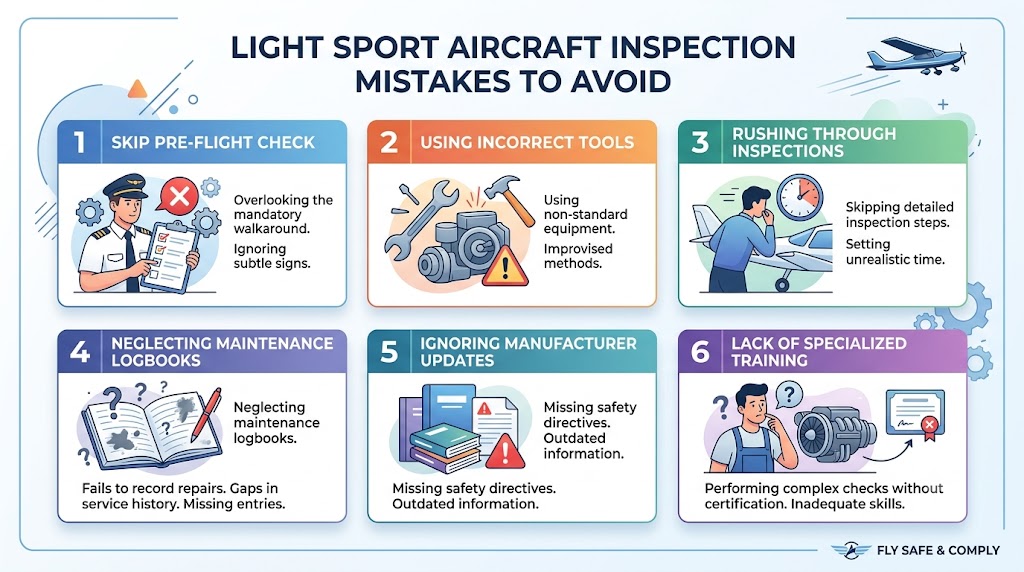
Introduction
Light sport aircraft can be relatively simple compared with many larger aircraft, but that simplicity can create a dangerous assumption: that inspection is also simple. It is not. A light sport aircraft still depends on the condition of its structure, flight controls, landing gear, propulsion system, fuel system, electrical equipment, fasteners, and documentation being properly understood and maintained.
A sound inspection is more than looking for obvious damage. It is a disciplined process of determining whether the aircraft is in a condition for safe operation while accounting for its maintenance history, manufacturer instructions, operating limitations, modifications, recurring requirements, and known problem areas.
The most serious inspection mistakes are often not dramatic. They are small process failures: relying on memory instead of current maintenance data, overlooking previous repairs, treating paperwork as secondary, accepting an unexplained modification, rushing an inspection because the aircraft appears clean, or allowing someone without the appropriate qualifications to perform work or approve it.
Why Light Sport Aircraft Inspections Require Careful Judgment
A light sport aircraft may have fewer systems than a complex aircraft, but every major system still has a role in keeping the aircraft airworthy.
An inspection can involve consideration of:
- Airframe structure
- Flight controls
- Control linkages
- Landing gear
- Wheels and brakes
- Propeller
- Engine or other propulsion system
- Fuel system
- Electrical system
- Instruments and avionics
- Battery installation
- Fasteners and attachment points
- Seats and restraints
- Canopy, doors, and windows
- Tires
- Corrosion
- Fluid leaks
- Previous repairs
- Modifications and alterations
- Maintenance records
- Manufacturer inspection requirements
- Applicable safety directives or other mandatory requirements
- Aircraft-specific operating limitations
The inspection should therefore be treated as a structured airworthiness assessment rather than a visual walk-around.
The FAA describes light-sport aircraft as aircraft certificated under specific light-sport provisions and emphasizes the importance of the aircraft being in a condition for safe operation. Current FAA guidance also distinguishes different light-sport repairman privileges and their associated limitations.
1. Treating Every Light Sport Aircraft as the Same
One of the most common mistakes is assuming that a generic light-sport inspection checklist applies equally to every aircraft.
It does not.
Aircraft can differ substantially in:
- Construction materials
- Propulsion systems
- Flight-control arrangements
- Landing gear configuration
- Electrical architecture
- Composite construction
- Fabric construction
- Manufacturer inspection requirements
- Certification category
- Operating limitations
- Approved or accepted modification data
Two aircraft that look similar externally may have very different inspection requirements.
Why this mistake matters
A generic checklist can identify broad inspection areas, but it cannot replace aircraft-specific maintenance information.
The aircraft’s documentation should establish what inspection program, maintenance instructions, limitations, and recurring requirements apply to that particular aircraft.
Better approach
Use a hierarchy of information:
- Applicable regulations
- Aircraft airworthiness and operating documents
- Manufacturer maintenance and inspection information
- Applicable safety information and mandatory requirements
- Aircraft maintenance records
- A structured inspection checklist
The checklist should support the inspection rather than become the source of authority.
2. Starting the Inspection Without Reviewing the Records
Another common mistake is beginning with the physical aircraft while ignoring its history.
Records can reveal problems that are not obvious during a visual inspection.
Before evaluating the aircraft, the inspection process should account for relevant information such as:
- Previous inspection findings
- Recurring discrepancies
- Component replacement history
- Major repairs
- Modifications
- Alterations
- Engine or propulsion maintenance
- Propeller history
- Landing gear work
- Known defects
- Deferred items where legally applicable
- Service information
- Previous unusual events
- Hours or cycles where applicable
Why records matter
An aircraft with a recurring problem requires a different level of attention from an aircraft with a clean and well-documented history.
For example, a previous record might reveal that a particular component has repeatedly required adjustment. That history is valuable context even if the component appears acceptable during the current inspection.
A good inspection therefore connects current condition with historical evidence.
3. Relying on a Clean Appearance
A clean aircraft can still have significant maintenance issues.
Paint, polished surfaces, recently cleaned engine compartments, and a generally well-presented cabin can create a false sense of condition.
Visual presentation is not evidence of mechanical integrity.
An inspection should consider areas where problems may be less visible, including:
- Attachment points
- Hinges
- Control-system connections
- Wiring
- Fluid lines
- Fasteners
- Structural interfaces
- Landing gear components
- Engine accessories
- Battery installations
- Areas affected by vibration
- Areas susceptible to moisture or corrosion
The lesson
Cosmetic condition and airworthiness are different things.
A well-maintained aircraft should look good, but appearance should never substitute for evidence.
4. Inspecting Without Current Manufacturer Information
Aircraft manufacturers may publish maintenance manuals, inspection programs, service information, safety notices, and other technical material relevant to continued operation.
Using outdated information is a significant inspection risk.
This is especially important when an aircraft has:
- Updated components
- Revised maintenance procedures
- Manufacturer modifications
- Updated inspection intervals
- Recurring inspection requirements
- Known component-specific concerns
- Changed documentation
The FAA’s current light-sport guidance emphasizes the importance of understanding the manufacturer’s current instructions and maintenance information for applicable work.
Better practice
Before inspection work begins, establish which revision of the applicable maintenance information is current and whether relevant manufacturer information has been incorporated into the aircraft’s maintenance records.
5. Assuming the Inspection Interval Is the Only Requirement
An annual or recurring condition inspection is not necessarily the entire maintenance picture.
Aircraft can have additional requirements associated with:
- Particular components
- Manufacturer instructions
- Operating limitations
- Propulsion systems
- Safety directives
- Airworthiness requirements
- Installed equipment
- Special modifications
- Life-limited components
FAA guidance specifically notes that additional mandatory maintenance requirements can exist beyond the annual condition inspection for applicable aircraft.
The mistake
An owner may think:
“The annual inspection is complete, so everything else is automatically current.”
That assumption can be incorrect.
Better question
Instead ask:
“What recurring and mandatory requirements apply to this particular aircraft and its installed equipment?”
6. Focusing on the Engine and Ignoring the Airframe
Engine condition naturally receives considerable attention because propulsion problems can have serious consequences.
But an inspection that concentrates heavily on the engine can underemphasize other critical areas.
Important inspection considerations can include:
- Primary structure
- Control-system integrity
- Control-surface attachment
- Landing gear
- Wheels and brakes
- Fuel-system condition
- Electrical wiring
- Battery installation
- Propeller condition
- Structural attachment points
- Cabin and restraint systems
The correct balance depends on aircraft design and the applicable inspection program.
The key principle is simple:
A good engine does not compensate for a compromised airframe or flight-control system.
7. Overlooking Flight-Control System Condition
Flight-control systems deserve careful attention because relatively small defects can affect aircraft controllability.
Potential inspection concerns can include:
- Loose connections
- Abnormal wear
- Damaged components
- Improper routing
- Interference
- Corrosion
- Unusual friction
- Security of attachment
- Evidence of previous incorrect adjustment
The exact inspection method depends on the aircraft design and applicable maintenance information.
The important mistake to avoid is treating the control system as something that only needs attention when the pilot reports a problem.
8. Treating Fasteners as Minor Details
Fasteners can look insignificant compared with major structural components, but their condition and installation can matter greatly.
Inspection concerns may include:
- Missing fasteners
- Incorrect hardware
- Loose hardware
- Damaged fasteners
- Improper locking arrangements
- Evidence of movement
- Previous rework
- Corrosion
- Incorrect installation
A recurring problem in maintenance is not necessarily that a component is completely missing. It may be that something was installed incorrectly during earlier work.
This is why inspection should consider installation quality, not merely component presence.
9. Ignoring Corrosion Because the Aircraft Is Used in a Dry Environment
Corrosion risk varies with aircraft location, storage conditions, materials, operating environment, and exposure history.
A dry climate does not automatically eliminate corrosion concerns.
Potential contributors include:
- Moisture
- Condensation
- Coastal exposure
- Poor storage conditions
- Trapped moisture
- Dissimilar materials
- Damaged protective coatings
- Previous contamination
Corrosion can also develop in places that are difficult to see without appropriate access.
Practical lesson
Do not ask only:
“Does the aircraft operate in a dry climate?”
Also ask:
“Where could moisture or contamination accumulate on this particular aircraft?”
10. Neglecting Composite or Fabric Structures
Light sport aircraft can use different construction techniques, including composite and fabric structures.
Each requires appropriate inspection knowledge.
Composite aircraft
Inspection considerations may include:
- Surface damage
- Impact evidence
- Delamination indicators
- Bonded areas
- Attachment points
- Previous repairs
- Structural interfaces
Fabric aircraft
Inspection considerations may include:
- Fabric condition
- Stitching where applicable
- Attachment areas
- Coating condition
- Damage
- Deterioration
- Previous repairs
The mistake is applying metal-aircraft inspection habits to construction methods that require different knowledge.
11. Assuming Previous Repairs Were Done Correctly
A previous repair should not automatically be treated as correct simply because it appears in the maintenance records.
The current inspection should consider whether the repair:
- Is properly documented
- Is consistent with applicable requirements
- Matches the aircraft’s maintenance information
- Has introduced other problems
- Shows evidence of deterioration
- Interacts correctly with surrounding components
A repair can solve one problem while unintentionally creating another.
For this reason, previous repairs deserve context rather than blind acceptance.
12. Treating Modifications as Cosmetic Changes
Modifications can affect more than appearance.
Examples can include changes to:
- Avionics
- Electrical systems
- Lighting
- Propulsion components
- Instruments
- Interior equipment
- Control systems
- Fuel systems
- Structural components
A modification should raise questions about:
- What was changed?
- Who performed the work?
- What data supported it?
- Is the documentation complete?
- Does it affect other systems?
- Does it introduce new inspection requirements?
- Does it comply with the aircraft’s certification basis and operating limitations?
The FAA’s light-sport framework includes specific requirements and guidance concerning maintenance and alterations, and the applicable rules depend on the aircraft’s certification and circumstances.
13. Assuming the Person Performing the Inspection Is Automatically Authorized
Qualifications matter.
Not every person who can work on an aircraft is automatically authorized to perform every inspection or approve every type of maintenance.
The FAA’s current light-sport repairman framework distinguishes between inspection and maintenance ratings and places specific limitations on their privileges. For example, an inspection-rated light-sport repairman has defined aircraft and ownership limitations, while maintenance-rated privileges have their own qualification and task limitations.
The important question
Before relying on an inspection or maintenance sign-off, confirm:
- What certification does the person hold?
- What rating applies?
- Does the rating cover this aircraft category/class?
- Does the person’s privilege cover the specific task?
- Do the aircraft’s operating limitations impose additional restrictions?
This is both a compliance issue and a safety issue.
14. Confusing Maintenance Authority With Inspection Authority
A person may be permitted to perform certain maintenance tasks without automatically having authority to perform a particular condition inspection.
These are separate questions.
The FAA specifically distinguishes inspection and maintenance ratings for light-sport repairmen.
A responsible owner should therefore avoid asking only:
“Can this person work on my aircraft?”
Instead ask:
“Is this person authorized and qualified to perform this specific inspection or maintenance task on this specific aircraft?”
That distinction prevents a common administrative and technical mistake.
15. Failing to Understand the Aircraft’s Certification Basis
“Light sport” is not a complete description of an aircraft’s certification status.
Aircraft can have different certification histories and operating limitations.
This can affect:
- Who may perform maintenance
- Who may perform condition inspections
- What maintenance standards apply
- What documentation is required
- What alterations are permitted
- What operating limitations apply
The FAA’s current light-sport material distinguishes several certification pathways and has updated the framework through the MOSAIC rulemaking.
Better practice
Before determining what inspection process applies, identify the aircraft’s:
- Certification category
- Airworthiness certificate
- Operating limitations
- Manufacturer information
- Maintenance records
- Applicable regulatory framework
16. Skipping the Logbook Review After Finding a Discrepancy
Suppose an inspector discovers an unusual component condition.
One mistake is to inspect only the component and immediately correct it.
The better question is:
Why did this condition occur?
The history might reveal:
- Repeated repairs
- Previous adjustment
- Component replacement
- Improper installation
- Vibration
- Environmental exposure
- Recurring wear
A recurring discrepancy is often more valuable than an isolated discrepancy because it may indicate an underlying problem.
17. Treating Recurring Problems as Normal
A recurring issue should never become invisible simply because everyone has become accustomed to it.
Examples might include repeated:
- Fastener loosening
- Fluid leakage
- Electrical faults
- Component wear
- Control-system adjustment
- Tire problems
- Brake issues
- Engine-related discrepancies
The fact that a problem has been “fixed before” does not prove that its root cause has been addressed.
Better approach
When a discrepancy repeats, shift from:
repair the symptom
to:
understand the cause.
18. Rushing the Inspection
Time pressure is a major inspection risk.
Rushing can encourage:
- Skipping documentation review
- Incomplete access
- Superficial visual checks
- Poor recordkeeping
- Failure to investigate unusual findings
- Premature closure
The inspection should have enough time for findings to be investigated rather than simply recorded.
A good inspection is not a race to produce a sign-off.
19. Treating Documentation as Administrative Paperwork
Maintenance records are part of the aircraft’s technical history.
Good records help establish:
- What work was performed
- What components were replaced
- What inspections occurred
- What discrepancies were identified
- What repairs were completed
- Who performed the work
- What information supported the work
FAA maintenance-record guidance recognizes recordkeeping as an important part of aircraft maintenance and return-to-service processes.
Poor documentation creates future problems
Incomplete records can make it harder to determine:
- Component history
- Inspection status
- Modification history
- Recurring requirements
- Previous corrective action
In other words, poor documentation can become a maintenance problem later.
20. Assuming a Previous Sign-Off Guarantees Current Condition
An inspection sign-off describes a particular inspection or maintenance event.
It does not mean the aircraft remains unchanged forever.
Between inspections, the aircraft can experience:
- New wear
- Environmental deterioration
- Component failure
- Damage
- Improper maintenance
- Modification
- Operational events
The next inspection should therefore evaluate the aircraft’s present condition, not simply rely on its previous status.
21. Ignoring Environmental and Storage History
An aircraft’s storage environment can tell an inspector a great deal.
Relevant questions may include:
- Is it stored indoors or outdoors?
- Is it exposed to humidity?
- Has it been stored for an extended period?
- Has it been transported frequently?
- Has it operated near saltwater?
- Has it experienced extreme temperatures?
- Has it been exposed to contaminants?
Storage history can influence corrosion, seals, batteries, tires, fluids, fabric, composites, and other components.
22. Forgetting the Battery and Electrical System
Electrical systems are sometimes treated as secondary because the aircraft’s primary function is flight.
That is a mistake.
Inspection should account for the aircraft’s applicable electrical equipment and installation, including considerations such as:
- Battery condition
- Mounting
- Wiring
- Connections
- Protection
- Chafing
- Evidence of overheating
- Corrosion
- Previous modifications
The exact requirements depend on aircraft design and applicable maintenance information.
23. Ignoring Evidence of Chafing, Vibration, or Movement
Some problems are created not by a single failure but by repeated movement.
Potential warning signs include:
- Rub marks
- Worn protective material
- Damaged wiring insulation
- Contact marks
- Unusual wear
- Loose hardware
- Surface damage
These findings can indicate that something is moving, vibrating, rubbing, or incorrectly routed.
The important inspection mindset is to investigate why the wear exists, rather than simply replacing the visibly worn item.
24. Failing to Investigate Unusual Findings
An inspector should not become overly dependent on binary thinking:
good / bad
Real aircraft condition often falls into a third category:
needs further investigation.
Examples include:
- Unexpected wear
- Unknown modification
- Unclear documentation
- Unusual vibration evidence
- Repeated discrepancy
- Unexpected corrosion
- Unknown component history
When the available evidence is insufficient, stopping to obtain appropriate technical information is usually more responsible than guessing.
25. Using an Incomplete Checklist
A checklist can improve consistency, but a poor checklist can create false confidence.
A checklist should not encourage the inspector to simply mark boxes without understanding the aircraft.
A useful inspection framework should connect:
requirement → inspection item → finding → corrective action → verification → documentation
This creates traceability.
The FAA notes that applicable condition inspections for certain experimental light-sport and related aircraft must cover the required scope and detail, while manufacturer inspection programs can be used when they meet the applicable requirements.
26. Treating Every Finding as Equally Important
Not every discrepancy has the same significance.
An experienced inspection process distinguishes between:
Immediate safety concern
A condition that requires resolution before the aircraft can safely be operated.
Significant maintenance finding
A condition requiring corrective action or further evaluation.
Documentation issue
A problem with records, configuration history, or evidence.
Advisory observation
A condition worth tracking even though it does not currently constitute the same level of concern.
This classification helps prevent both underreaction and overreaction.
27. Failing to Establish a Clear Finding-to-Action Process
Finding a defect is only one part of inspection.
A mature process should answer:
- What was found?
- How significant is it?
- What information governs the corrective action?
- Who is qualified to perform that work?
- What evidence confirms the correction?
- What record documents the result?
This approach reduces the chance that an aircraft will move from inspection to operation with unresolved uncertainty.
28. Assuming More Maintenance Is Always Better
Over-maintenance can also create problems.
Unnecessary disassembly can introduce:
- Installation errors
- Damaged fasteners
- Contamination
- Incorrect reassembly
- New discrepancies
The objective is not to dismantle everything.
The objective is to perform an appropriate inspection using sound judgment, applicable information, suitable access, and qualified personnel.
Good maintenance is purposeful maintenance.
29. Failing to Recognize Personal Knowledge Limits
One of the strongest professional habits in aircraft maintenance is knowing when not to guess.
An unfamiliar system may require:
- Manufacturer documentation
- Additional training
- Consultation with an appropriately qualified person
- Direct supervision
- Specialized inspection capability
FAA guidance for light-sport repairmen explicitly addresses the importance of competence with the specific task and encourages additional training or qualified supervision when unfamiliar aircraft, systems, or technologies are involved.
That principle is particularly important as light-sport aircraft incorporate increasingly varied propulsion and system designs.
30. Relying on Online Advice Instead of Aircraft-Specific Information
Online forums, videos, social media posts, and general articles can be useful for learning.
They should not replace:
- Applicable regulations
- Aircraft manuals
- Manufacturer instructions
- Operating limitations
- Approved or otherwise applicable technical data
- Qualified maintenance expertise
A procedure that is appropriate for one aircraft may be unsuitable for another.
The more aircraft-specific the problem, the more important aircraft-specific information becomes.
A Better Light Sport Aircraft Inspection Framework
A disciplined inspection can be organized into several phases.
Phase 1: Establish the Aircraft Baseline
Confirm:
- Aircraft identity
- Certification status
- Applicable operating limitations
- Manufacturer and model
- Relevant maintenance documentation
- Current configuration
- Maintenance history
Phase 2: Review the Documentation
Look for:
- Previous inspection records
- Major repairs
- Modifications
- Recurring discrepancies
- Component history
- Applicable inspection requirements
- Manufacturer information
- Relevant safety information
Do not begin technical conclusions before understanding the aircraft’s documented history.
Phase 3: Identify Known Risk Areas
Use the aircraft’s:
- Design
- Operating environment
- Maintenance history
- Previous discrepancies
- Modification history
to determine where additional attention may be warranted.
This makes the inspection more intelligent than simply following a generic sequence.
Phase 4: Perform the Applicable Inspection
Use the appropriate inspection program and aircraft-specific information.
The inspection should consider the applicable:
- Structure
- Flight controls
- Landing gear
- Propulsion system
- Fuel system
- Electrical system
- Instruments and equipment
- Cabin and restraints
- External surfaces
- Installed modifications
The exact scope should come from the applicable regulatory and aircraft-specific requirements.
Phase 5: Investigate Findings
Do not immediately close unusual findings.
For each significant discrepancy, establish:
- What is wrong?
- How was it identified?
- What could have caused it?
- Is it recurring?
- What technical information applies?
- Who is qualified to address it?
- What verification is required?
Phase 6: Correct and Verify
Corrective work should be performed by an appropriately qualified person using applicable information.
After corrective action, verify that:
- The original discrepancy has been addressed.
- No secondary problem was introduced.
- Required inspections or tests have been completed.
- Documentation accurately reflects the work.
Phase 7: Complete the Records
The final record should provide enough information to establish what inspection or maintenance activity occurred and what was determined.
Good records make the next inspection easier and improve the aircraft’s long-term maintenance history.
Inspection Mistakes: Quick Reference
| Mistake | Why It Matters | Better Practice |
|---|---|---|
| Using only a generic checklist | Aircraft-specific requirements can be missed | Use applicable aircraft documentation |
| Ignoring maintenance history | Recurring problems may remain hidden | Review records before inspection |
| Relying on appearance | Clean aircraft can still have defects | Evaluate condition systematically |
| Using outdated manuals | Technical information may have changed | Confirm current applicable information |
| Ignoring modifications | Configuration changes can introduce risks | Review modification history |
| Assuming anyone can sign off work | Authorization depends on qualifications and privileges | Verify the person’s authority |
| Treating recurring problems as normal | Root causes may remain unresolved | Investigate repeated discrepancies |
| Rushing | Important findings may be overlooked | Allow adequate inspection time |
| Poor documentation | Future maintenance decisions become harder | Maintain clear, traceable records |
| Ignoring unfamiliar systems | Incorrect assumptions can create risk | Obtain qualified technical assistance |
| Treating every finding equally | Significant issues can be lost among minor ones | Classify and prioritize findings |
| Over-maintaining | Unnecessary work can introduce new problems | Perform justified, targeted maintenance |
How Aircraft Owners Can Reduce Inspection Risk
Owners do not need to become maintenance experts to improve inspection quality.
They can improve the process by keeping the aircraft’s documentation organized and making the relevant records available to qualified personnel.
Useful owner habits include:
- Maintain an organized maintenance history.
- Keep aircraft manuals and applicable technical information accessible.
- Record modifications clearly.
- Preserve documentation for replaced components where appropriate.
- Report unusual behavior rather than waiting for the next scheduled inspection.
- Tell maintenance personnel about recurring issues.
- Avoid undocumented modifications.
- Do not pressure inspectors to complete work quickly.
- Ask questions when a finding is unclear.
- Use qualified personnel for work outside the owner’s authority or competence.
- Confirm that inspection and maintenance sign-offs are performed by appropriately authorized individuals.
The owner is an important part of the aircraft’s continuing airworthiness process.
What a Good Inspection Looks Like
A high-quality inspection has several recognizable characteristics.
It is evidence-based
Conclusions come from the aircraft, its records, applicable technical information, and qualified professional judgment.
It is aircraft-specific
The inspection accounts for the particular design and configuration.
It is traceable
Findings can be connected to corrective action and documentation.
It is skeptical without being careless
The inspector does not assume everything is wrong, but also does not assume everything is correct.
It respects limitations
When a task is outside the inspector’s knowledge or authorization, appropriate expertise is obtained.
It investigates patterns
Repeated discrepancies receive additional attention.
It values documentation
Records are treated as technical evidence rather than paperwork.
A Practical Pre-Inspection Checklist for Owners
Before presenting a light sport aircraft for inspection, an owner can organize:
- Aircraft identification information
- Airworthiness documentation
- Operating limitations
- Maintenance records
- Previous inspection records
- Modification records
- Repair documentation
- Manufacturer maintenance information
- Known discrepancies
- Recent unusual events
- Component history where relevant
- Relevant recurring inspection information
This preparation does not replace the inspection.
It makes the inspection more efficient and gives the inspector better information.
Warning Signs That Deserve Extra Attention
Certain circumstances should prompt a more careful review rather than a routine assumption that everything is normal.
Examples include:
- Recently purchased aircraft with incomplete history
- Aircraft with significant modification history
- Repeated discrepancies
- Unknown previous repairs
- Long periods of storage
- Evidence of corrosion
- Unexplained vibration
- Recurring fluid leakage
- Damaged wiring
- Unusual wear
- Missing or inconsistent documentation
- Recent major maintenance
- Unfamiliar propulsion or electrical technology
None of these automatically means an aircraft is unsafe.
They indicate that the available evidence deserves closer evaluation.
The Most Important Inspection Principle
The most useful mindset is:
Do not inspect only for defects. Inspect for evidence that the aircraft is properly maintained, correctly configured, adequately documented, and in a condition appropriate for safe operation.
That distinction matters.
A defect-focused inspection can find visible problems.
A condition-focused inspection also considers history, configuration, maintenance practices, documentation, recurring discrepancies, and the quality of previous work.
That broader perspective is what makes an inspection useful.
Final Takeaway
Light sport aircraft inspections should never become a box-checking exercise. The strongest inspection process combines aircraft-specific knowledge, current technical information, maintenance history, careful physical examination, qualified judgment, and accurate records. The most common mistakes are often process failures rather than dramatic mechanical failures: incomplete records, outdated information, unreviewed modifications, rushed inspections, and unclear maintenance authority. Owners can reduce risk by preparing complete documentation and using appropriately qualified personnel. Inspectors can improve reliability by investigating unusual findings, recognizing recurring patterns, and resisting assumptions based on appearance alone. Ultimately, a good inspection is not about finding the largest number of defects—it is about making a well-supported determination of the aircraft’s condition and documenting that determination responsibly.

