
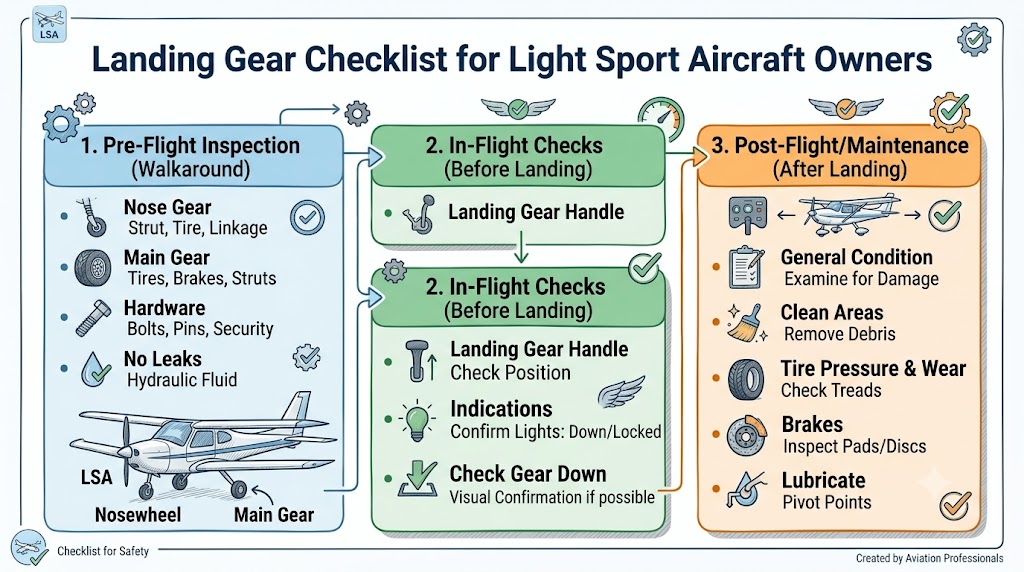
Landing gear plays a critical role in every Light Sport Aircraft (LSA), supporting the aircraft during taxiing, takeoff, landing, and ground operations. Because the landing gear experiences repeated loads, vibration, braking forces, and exposure to weather and runway conditions, owners should pay close attention to its visible condition.
A consistent inspection routine can help owners notice signs of wear or damage early. However, an owner checklist should complement—not replace—the aircraft manufacturer’s approved documentation, inspection program, and qualified maintenance support.
Why Landing Gear Checks Matter on Light Sport Aircraft
Landing gear operates during some of the most demanding phases of flight. Even a small problem involving a tire, wheel, brake component, strut, attachment area, or steering system can affect ground handling.
Regular attention can help owners:
- Notice visible damage or unusual wear.
- Identify changes in tire condition.
- Spot potential brake-related concerns.
- Detect corrosion or loose-looking components.
- Recognize changes in steering or ground handling.
- Keep better maintenance records.
- Communicate problems clearly to qualified maintenance personnel.
The exact landing gear arrangement differs between aircraft. Some LSAs use tricycle landing gear, while others use tailwheel configurations. Some systems also use different shock-absorbing and braking arrangements.
For that reason, the aircraft-specific maintenance documentation should always take priority over a generic checklist.
Understanding the Main Landing Gear Components
Before using a checklist, owners should understand the major areas they may encounter.
1. Tires
Aircraft tires support the aircraft during ground movement and landing. Owners can look for obvious signs of:
- Abnormal wear
- Visible damage
- Cuts or deterioration
- Foreign objects
- Unusual appearance
- Conditions that differ noticeably from the aircraft documentation
Tire specifications and acceptable condition limits vary by aircraft.
2. Wheels
Wheels work with the tires and landing gear assembly to support ground operations. During a visual inspection, owners should pay attention to obvious damage, corrosion, contamination, or other unusual conditions.
If anything looks different from normal, the aircraft documentation or qualified maintenance personnel should determine whether further inspection is necessary.
3. Brake System
Brakes allow the aircraft to slow and stop during ground operations. Depending on the aircraft, the braking arrangement can vary considerably.
Owners should pay attention to:
- Visible fluid contamination or leakage
- Unusual brake behavior
- Uneven braking
- Changes noticed during normal operation
- Visible damage around accessible components
Owners should not assume that a brake system is serviceable simply because the aircraft can still move or stop.
4. Struts and Shock-Absorbing Components
Landing gear may use different methods to absorb landing and taxi loads. These can include struts, springs, elastomeric components, or other designs.
Look for obvious signs of:
- Damage
- Leakage where applicable
- Corrosion
- Unusual displacement
- Deformation
- Anything that differs from the aircraft’s normal appearance
Specific inspection criteria depend on the landing gear design.
5. Axles and Attachment Areas
Axles and attachment points experience significant loads. Owners should visually check accessible areas for obvious damage, corrosion, missing-looking hardware, or anything that appears abnormal.
Do not attempt to tighten, remove, or adjust safety-critical hardware unless the aircraft’s approved maintenance procedures specifically authorize the work for the person performing it.
Light Sport Aircraft Landing Gear Checklist
The following checklist provides a general awareness framework rather than an aircraft-specific maintenance procedure.
| Inspection Area | What to Look For | Action if Something Seems Wrong |
|---|---|---|
| Tires | Damage, unusual wear, deterioration | Consult aircraft documentation and qualified maintenance personnel |
| Wheels | Visible damage or corrosion | Seek appropriate inspection |
| Brakes | Leakage, unusual operation, visible damage | Do not ignore the condition |
| Struts | Damage, leakage where applicable, unusual appearance | Request qualified inspection |
| Axles | Obvious damage or abnormal condition | Have the condition evaluated |
| Fasteners | Missing-looking or visibly abnormal hardware | Do not fly until the issue is properly assessed |
| Gear attachments | Cracks, damage, corrosion, unusual movement | Seek professional inspection |
| Nose gear | Abnormal condition or steering changes | Have the aircraft evaluated |
| Tailwheel | Damage, unusual wear, steering concerns | Follow aircraft-specific procedures |
| Steering | Changes in normal ground handling | Report the change |
| General condition | Anything noticeably different from normal | Investigate before further operation |
Pre-Flight Landing Gear Checks
A pre-flight inspection should follow the aircraft manufacturer’s approved checklist.
From an owner-awareness perspective, pay attention to the overall condition and anything that appears different from normal.
Tires
Check for obvious:
- Damage
- Excessive or unusual wear
- Foreign objects
- Deterioration
- Abnormal appearance
Do not rely on visual appearance alone when the aircraft documentation specifies particular inspection requirements.
Wheels
Look around accessible wheel areas for obvious:
- Cracks or damage
- Corrosion
- Abnormal contamination
- Other changes from the aircraft’s normal condition
Brakes
Observe the brake system for obvious signs of:
- Leakage
- Damage
- Abnormal condition
If braking behavior has changed compared with normal operation, treat the change seriously.
Nose Gear or Tailwheel
The configuration determines which assembly applies.
For nose-wheel aircraft, pay attention to the general condition of the nose gear and any unusual steering behavior.
For tailwheel aircraft, pay attention to the general condition of the tailwheel assembly and any changes in normal ground handling.
Routine Owner Observations
Not every landing gear concern appears as obvious physical damage. Changes in aircraft behavior can also provide useful information.
Owners should pay attention to changes such as:
- Unusual vibration during taxiing.
- Changes in steering response.
- Unusual braking behavior.
- A noticeable change in ground handling.
- Unusual sounds.
- Repeated tire problems.
- New fluid contamination around relevant components.
- Changes in the aircraft’s normal stance or appearance.
A change does not automatically identify a particular mechanical fault. Instead, it provides a reason to consult the aircraft documentation and qualified maintenance personnel.
Landing Gear Warning Signs You Should Not Ignore
Some observations deserve immediate attention rather than continued operation.
Visible Damage
Cracks, deformation, significant corrosion, or other obvious structural concerns require appropriate evaluation.
Unusual Leakage
Fluid appearing around a component where leakage is not expected can indicate a problem that needs professional assessment.
Sudden Handling Changes
A noticeable change in steering, braking, taxi behavior, or ground handling should not be dismissed simply because the aircraft remains operational.
Unusual Vibration
New or unexplained vibration during ground operations deserves attention, particularly when it differs from the aircraft’s established normal behavior.
Abnormal Tire Wear
Repeated or unusual tire wear can have several possible causes. A qualified person should determine the underlying reason rather than relying on assumptions.
Landing Gear Checklist Before Every Flight
Use the aircraft-specific checklist first. As a general awareness reminder, owners can consider:
- Review the approved pre-flight checklist.
- Observe tire condition and overall appearance.
- Check accessible wheel areas for obvious abnormalities.
- Look for visible signs of leakage or contamination.
- Observe the general condition of the landing gear.
- Pay attention to unusual steering or braking behavior.
- Look for anything that differs from the aircraft’s normal condition.
- Report questionable conditions before continuing operation.
The manufacturer’s checklist remains the controlling reference for the aircraft.
Routine Landing Gear Maintenance Awareness
Landing gear requires more than a quick visual check. Aircraft-specific inspection programs may address components and conditions that an owner cannot reliably evaluate through a basic external inspection.
Depending on the aircraft, maintenance attention may involve areas such as:
- Wheel assemblies
- Brake components
- Bearings
- Axles
- Landing gear attachments
- Shock-absorbing components
- Steering components
- Structural areas
- Hardware and safety-related components
The exact requirements vary significantly between aircraft.
Owners should therefore avoid creating their own maintenance intervals or component limits when the aircraft manufacturer already specifies them.
Landing Gear Maintenance Mistakes to Avoid
1. Using a Generic Checklist Instead of the Aircraft Checklist
A generic checklist can support awareness, but it cannot replace the aircraft’s approved inspection documentation.
2. Ignoring Small Changes
A minor change in tire condition, braking, steering, vibration, or ground handling can provide useful information about developing maintenance concerns.
3. Assuming Everything Is Fine Because the Aircraft Still Operates
An aircraft may remain operational while developing a condition that requires attention. Normal operation does not automatically confirm serviceability.
4. Performing Unapproved Adjustments
Landing gear includes safety-critical components. Owners should not improvise repairs, adjustments, or hardware changes.
5. Forgetting Maintenance Records
Good records help establish what was inspected, what concerns appeared, and what maintenance actions professionals performed.
6. Relying Only on Visual Inspection
Some landing gear conditions cannot be identified reliably through casual observation. Aircraft-specific inspections may require qualified personnel and appropriate procedures.
How to Keep Better Landing Gear Records
Good documentation can make maintenance discussions more efficient.
A useful record can include:
- Date of observation
- Aircraft identification
- Component or area involved
- What appeared unusual
- Relevant operating circumstances
- Whether the condition was reported
- Maintenance action taken
- Follow-up information
Avoid recording guesses as confirmed mechanical diagnoses. Instead of writing that a specific component has failed, describe the actual observation and allow qualified personnel to determine the cause.
When Should an LSA Owner Seek Professional Inspection?
Owners should involve qualified aviation maintenance personnel whenever they identify a condition they cannot confidently evaluate using the aircraft’s approved documentation.
Professional attention becomes particularly important when there is:
- Visible structural damage
- A significant crack or deformation
- Unexpected leakage
- Unusual braking
- Abnormal steering
- New vibration
- Repeated tire or wheel concerns
- Missing or questionable hardware
- Significant corrosion
- Any unexplained change in landing gear behavior
When in doubt, the safest approach is to pause operation and obtain an appropriate evaluation rather than assuming the aircraft is acceptable.
Aircraft-Specific Documentation Comes First
No generic landing gear checklist can cover every Light Sport Aircraft.
Owners should refer to the documentation applicable to their specific aircraft, which may include:
- Pilot’s Operating Handbook (POH)
- Aircraft Flight Manual (AFM), where applicable
- Manufacturer maintenance documentation
- Inspection program
- Component documentation
- Applicable aviation regulations
- Instructions from qualified maintenance personnel
Inspection intervals, allowable conditions, component limits, servicing requirements, and maintenance responsibilities can vary.
This distinction matters because a checklist intended for general awareness should never override aircraft-specific requirements.
A Simple Landing Gear Inspection Workflow
A practical approach can follow this sequence:
Step 1: Start With the Approved Checklist
Use the aircraft’s required pre-flight or inspection checklist as the primary reference.
Step 2: Establish What Looks Normal
Knowing the aircraft’s normal appearance and ground-handling characteristics makes unusual changes easier to recognize.
Step 3: Observe the Landing Gear
Look at the tires, wheels, accessible gear components, and surrounding areas for obvious abnormalities.
Step 4: Pay Attention to Changes
Note new vibration, steering changes, unusual braking, sounds, or other differences.
Step 5: Document Concerns
Record meaningful observations rather than assumptions about the cause.
Step 6: Escalate When Necessary
Ask qualified maintenance personnel to evaluate questionable conditions before further operation.
Why Consistency Matters More Than Complexity
An effective landing gear inspection does not need to become unnecessarily complicated. The most important habit is consistent attention to the aircraft’s approved inspection process.
Owners who regularly observe their aircraft can become more familiar with its normal condition. That familiarity can make unusual changes easier to recognize and report.
The goal is not for an owner to diagnose every landing gear problem. The goal is to recognize potential concerns early and make sure the right person evaluates them.
Frequently Asked Questions
Q1. Why is landing gear inspection important for Light Sport Aircraft?
Landing gear supports the aircraft during taxiing, takeoff, landing, and ground operations. Regular inspection helps owners identify visible problems or changes that may require professional attention.
Q2. What should I check on LSA landing gear before a flight?
Follow the aircraft’s approved pre-flight checklist. General awareness areas include tire condition, wheels, accessible landing gear components, visible leakage, and unusual changes in steering or ground handling.
Q3. Can an LSA owner perform all landing gear maintenance?
Not necessarily. Maintenance authority and procedures depend on the aircraft, applicable regulations, approved documentation, and the qualifications of the person performing the work.
Q4. What are common landing gear warning signs?
Warning signs can include visible damage, unusual tire wear, leakage, abnormal vibration, unusual braking, steering changes, corrosion, or other changes from the aircraft’s normal condition.
Q5. Should I fly if I notice something unusual with the landing gear?
A questionable condition should not be ignored. Follow the aircraft’s approved procedures and obtain appropriate professional evaluation when necessary before continuing operation.
Q6. Does every Light Sport Aircraft use the same landing gear system?
No. Landing gear designs and configurations vary among aircraft. Tricycle and tailwheel arrangements are examples of different configurations.
Q7. How often should LSA landing gear receive maintenance?
Inspection and maintenance intervals depend on the specific aircraft and its applicable documentation and requirements. Owners should follow the manufacturer’s approved information rather than a generic interval.
Q8. Why should owners maintain landing gear inspection records?
Records help owners and maintenance professionals understand previous observations, recurring concerns, and maintenance actions.
Q9. Can a visual inspection identify every landing gear problem?
No. Some conditions require inspections, measurements, testing, or maintenance procedures that go beyond a basic visual check.
Q10. What should I do when I am unsure about a landing gear condition?
Use the aircraft’s approved documentation and consult qualified aviation maintenance personnel. Avoid guessing about the condition of a safety-critical component.
Conclusion
Landing gear deserves consistent attention because it supports essential ground operations throughout every flight. A practical checklist helps owners notice visible damage, unusual wear, leakage, and changes in normal aircraft behavior. However, generic checks should always complement the aircraft’s approved documentation and inspection program. Owners should document questionable conditions and involve qualified maintenance personnel when appropriate. Good inspection habits can support better maintenance awareness and more informed decisions about aircraft condition. The key is simple: know what normal looks like, notice meaningful changes, and address concerns properly.

