
Introduction
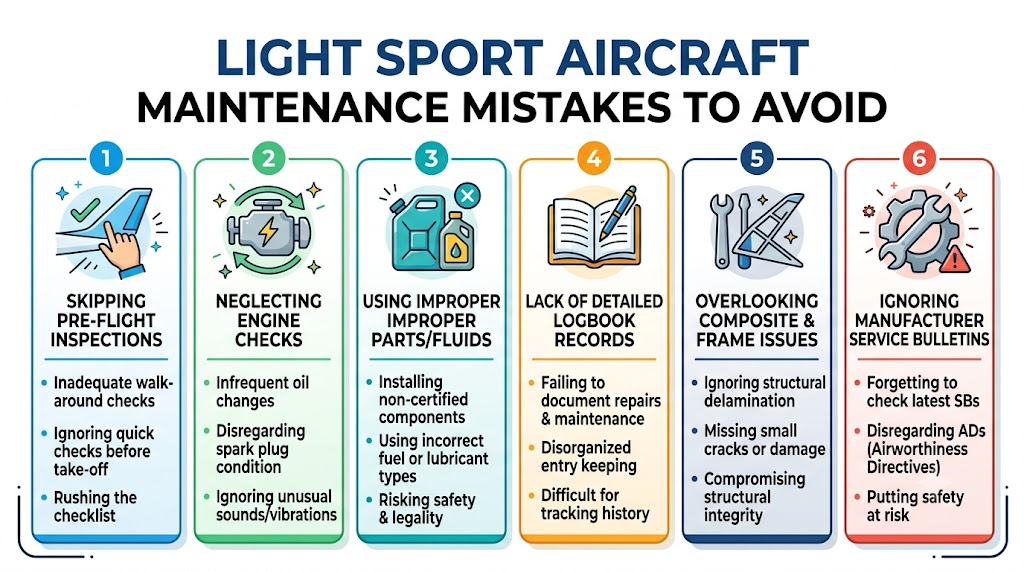
Light Sport Aircraft (LSA) are often viewed as relatively simple aircraft, but simplicity should never be confused with low maintenance risk. Small aircraft still depend on correctly maintained flight controls, landing gear, propulsion systems, fuel systems, electrical equipment, structural components, and safety-critical hardware.
The most serious maintenance problems are often not caused by one dramatic failure. They develop through small oversights: incomplete inspections, outdated maintenance information, poor documentation, deferred defects, incorrect parts, misunderstood inspection privileges, or assumptions that a lightweight aircraft does not require the same level of discipline as other aircraft.
LSA maintenance also requires attention to the aircraft’s specific certification category, operating limitations, manufacturer’s maintenance information, applicable airworthiness requirements, and the qualifications of the person performing or approving the work. FAA guidance specifically emphasizes continued airworthiness and the importance of using appropriate maintenance and inspection procedures for the aircraft.
This guide explains the most common maintenance mistakes and, more importantly, how owners can build a safer and more disciplined maintenance process.
Why LSA Maintenance Requires Discipline
An LSA may have a relatively uncomplicated design compared with larger aircraft, but several characteristics can increase the importance of careful maintenance:
- Lightweight structures can make damage or deterioration significant.
- Composite construction can conceal certain forms of damage.
- Rotax and other specialized propulsion systems may have manufacturer-specific maintenance requirements.
- Flight-control systems require precise inspection and correct adjustment.
- Fabric, composite, aluminum, or mixed structures can have different inspection considerations.
- Avionics and electrical modifications can introduce new failure points.
- Aircraft may have unique operating limitations.
- Maintenance privileges depend on the aircraft’s certification and the individual’s qualifications.
The FAA recognizes several categories of light-sport aircraft and has specific requirements surrounding certification, maintenance, repair, inspection, and continued airworthiness.
The practical lesson is simple:
Treat an LSA as an aircraft first and a simple aircraft second.
1. Treating the Aircraft as “Simple” and Therefore Easy to Maintain
One of the most dangerous assumptions is that a small aircraft does not require the same maintenance discipline as a larger aircraft.
A smaller aircraft still has components whose failure can affect controllability, propulsion, structural integrity, or landing safety.
Why this mistake happens
Owners may see:
- fewer systems
- smaller engines
- simpler cockpits
- lighter structures
- lower operating costs
and assume maintenance can be informal.
Better approach
Use a formal maintenance mindset:
- Follow applicable maintenance information.
- Respect inspection intervals.
- Record completed work.
- Investigate abnormal conditions.
- Use qualified personnel where required.
- Verify that the aircraft is approved for return to service when applicable.
- Do not substitute personal judgment for approved or applicable maintenance information.
The objective is not to make maintenance unnecessarily complicated. It is to make important decisions repeatable and defensible.
2. Ignoring the Aircraft’s Certification and Operating Limitations
Not every aircraft that looks like an LSA is maintained under exactly the same framework.
This is an area where owners can make expensive and potentially unsafe assumptions.
The FAA’s light-sport framework includes different certification pathways, including special airworthiness certification and experimental light-sport aircraft. Operating limitations and applicable regulations can determine who may perform certain inspections or maintenance.
Common mistake
An owner may assume:
“It’s an LSA, so any mechanic who works on small aircraft can perform everything.”
That is not a safe assumption.
Better approach
Before maintenance begins, establish:
- The aircraft’s certification category.
- Applicable operating limitations.
- Required inspection interval.
- Manufacturer maintenance requirements.
- Applicable FAA requirements.
- Who is legally and technically qualified to perform the work.
- Who is authorized to approve the aircraft for return to service.
This basic classification step prevents many downstream mistakes.
3. Using Outdated Maintenance Information
Aircraft maintenance information changes.
Manufacturers may issue:
- maintenance manual revisions
- service instructions
- service bulletins
- safety information
- inspection updates
- component replacement recommendations
- revised procedures
The FAA also maintains current regulatory and airworthiness information that can affect aircraft owners and operators. FAA guidance emphasizes reviewing current manufacturer information and ensuring that maintenance personnel are competent for the particular task.
The mistake
Keeping a printed manual in the hangar and assuming it is automatically current.
Better practice
Before significant maintenance:
- confirm the applicable aircraft documentation
- verify revision status
- check applicable manufacturer communications
- check relevant FAA requirements
- confirm whether installed equipment has separate maintenance information
Documentation should be treated as part of the aircraft’s maintenance system—not as paperwork that can be ignored.
4. Failing to Understand Who Is Qualified to Perform the Work
Maintenance qualification is not simply a matter of owning tools or having aviation experience.
The FAA’s light-sport repairman framework includes specific inspection and maintenance privileges and limitations. The scope of those privileges depends on the certificate, rating, aircraft category, and circumstances.
Common mistake
An owner may think:
“I have worked on cars, motorcycles, or machinery, so I can handle this aircraft maintenance task.”
Mechanical familiarity can be useful, but aircraft maintenance involves different safety, documentation, inspection, and return-to-service requirements.
Better approach
Know the difference between:
- owner-permitted activities
- preventive maintenance
- maintenance
- inspection
- condition inspection
- specialized maintenance
- work requiring qualified personnel
- approval for return to service
When uncertain, involve an appropriately qualified aviation professional rather than guessing.
5. Treating the Annual Condition Inspection as a Paperwork Exercise
A condition inspection is not simply an administrative renewal.
It is intended to establish whether the aircraft is in a condition for safe operation under the applicable requirements.
FAA guidance for LSA maintenance specifically addresses condition inspections and the qualifications of people permitted to perform them.
Poor approach
Rush through the inspection because:
- the aircraft “has been flying fine”
- there have been no recent problems
- the aircraft has low utilization
- everything looks clean
Better approach
Use the inspection as an opportunity to identify:
- deterioration
- loose or damaged components
- abnormal wear
- corrosion
- fluid leaks
- structural concerns
- control-system issues
- electrical problems
- undocumented modifications
- recurring defects
A good inspection is about finding developing problems before they become operational problems.
6. Assuming Low Flight Hours Mean Low Maintenance Risk
Flight hours are only one measure of aircraft exposure.
An aircraft can deteriorate while sitting unused.
Potential concerns include:
- corrosion
- aging seals
- battery condition
- moisture
- fuel-system issues
- tire deterioration
- storage-related damage
- environmental exposure
- animal or insect intrusion
An aircraft that has flown very little is not automatically an aircraft that requires little attention.
Practical principle
Low utilization changes the maintenance profile; it does not eliminate maintenance.
Owners should consider both:
time-based requirements and usage-based requirements.
7. Neglecting Corrosion
Corrosion is easy to underestimate because early signs may appear minor.
Depending on the aircraft design, corrosion can affect:
- structural components
- fasteners
- fittings
- landing gear
- control components
- electrical connections
- engine-related components
Environmental exposure matters considerably.
Aircraft stored in humid, coastal, poorly ventilated, or contaminated environments can face different corrosion risks from aircraft stored in controlled conditions.
Better approach
Make environmental exposure part of the maintenance strategy.
Pay particular attention to:
- storage conditions
- moisture
- drainage
- cleanliness
- areas where dissimilar materials meet
- locations where inspection access is limited
Do not assume that a clean exterior means corrosion risk is absent.
8. Overlooking Composite and Fabric Structures
LSA construction varies significantly.
Some aircraft use:
- aluminum
- composites
- fabric
- steel
- wood
- mixed construction
Each material presents different inspection considerations.
Composite mistake
Assuming a surface that looks normal cannot contain meaningful damage.
Fabric mistake
Treating fabric condition as purely cosmetic.
Better approach
Use the inspection methods and criteria appropriate to the aircraft’s construction and manufacturer guidance.
When damage is suspected, avoid improvising a repair method simply because the material appears familiar.
9. Making Unapproved Modifications
Owners sometimes add or modify:
- avionics
- lights
- radios
- antennas
- electrical equipment
- instrumentation
- interior components
- accessories
- brackets
- wiring
A modification may appear harmless while changing:
- weight
- balance
- electrical loading
- structural loading
- cooling
- interference
- system reliability
- operating limitations
The classic mistake
“If it fits, it must be okay.”
It isn’t.
Every modification should be evaluated against the aircraft’s applicable certification, maintenance, installation, and documentation requirements.
The FAA’s current LSA framework also distinguishes between different types of repairs and alterations and the applicable requirements for them.
10. Using the Wrong Parts
An aircraft part is not automatically acceptable because it:
- looks identical
- has the same dimensions
- costs less
- comes from another aircraft
- is available immediately
- has a similar part number
Compatibility involves more than physical fit.
Consider:
- specification
- material
- rating
- application
- manufacturer requirements
- approved or acceptable installation basis
- traceability where required
- environmental suitability
Better principle
Verify before installing.
When there is uncertainty about a safety-critical component, stop and obtain appropriate technical guidance.
11. Ignoring Small Leaks, Unusual Noises, and Changes in Aircraft Behavior
Experienced maintenance personnel often pay attention to changes rather than waiting for obvious failures.
Examples include:
- a new vibration
- unusual engine behavior
- changed control feel
- unexpected electrical behavior
- fluid residue
- new noises
- abnormal temperature indications
- unusual tire wear
- changes in starting behavior
A single observation may not prove a serious problem, but it deserves investigation.
A useful maintenance mindset
Ask:
What changed?
Then ask:
What could explain that change?
This is often more productive than waiting for a component to fail completely.
12. Poor Maintenance Recordkeeping
Maintenance records are part of the aircraft’s operational history.
Poor records can create problems with:
- determining what work was completed
- tracking recurring defects
- proving inspection status
- identifying component history
- determining upcoming maintenance
- aircraft resale
- establishing configuration
- understanding modifications
Common documentation mistakes
- vague descriptions
- missing dates
- incomplete component identification
- missing inspection information
- undocumented modifications
- lost supporting documents
- inconsistent aircraft time
Better approach
Create a disciplined recordkeeping system.
A useful maintenance history should allow another qualified person to understand:
what was done, why it was done, what information supported the work, and who performed or approved it.
13. Forgetting to Track Recurring Defects
One-off defects are easy to remember.
Recurring defects are more dangerous because they can become normalized.
For example:
“It always does that.”
That sentence should trigger investigation rather than acceptance.
Repeated problems can indicate:
- underlying component deterioration
- installation problems
- vibration
- electrical issues
- incorrect adjustment
- environmental effects
- inadequate previous repairs
Better approach
Maintain a recurring-defect log.
Track:
| Item | What to Record |
|---|---|
| Date | When the issue appeared |
| Aircraft hours | Operating context |
| Symptom | What was observed |
| Action | What was investigated or corrected |
| Result | Whether the symptom returned |
| Follow-up | Additional inspection required |
Patterns become much easier to recognize when they are documented.
14. Failing to Inspect After Long Storage
Aircraft returning to service after extended inactivity deserve deliberate attention.
Storage can create risks that normal flying does not.
Before returning an aircraft to regular operation, owners should ensure that the applicable inspection and maintenance requirements have been satisfied and that the aircraft is suitable for safe operation.
Do not treat the first flight after prolonged storage as an ordinary flight simply because the aircraft was serviceable when it was parked.
15. Ignoring Electrical System Changes
Modern LSAs can contain sophisticated electrical systems despite their small size.
Problems can arise from:
- poorly supported wiring
- inappropriate routing
- damaged insulation
- loose connections
- inadequate protection
- excessive electrical load
- undocumented additions
- poorly executed avionics installations
Electrical modifications should be approached as aircraft-system changes, not casual accessory installations.
16. Neglecting the Human-Factors Side of Maintenance
Many maintenance errors are not caused by lack of technical knowledge.
They result from:
- rushing
- interruptions
- fatigue
- poor lighting
- inadequate documentation
- unfamiliar aircraft
- unclear task ownership
- assumptions
- failure to verify completed work
A strong maintenance environment encourages:
- deliberate work
- clear documentation
- independent verification where appropriate
- clean work areas
- proper tool control
- clear communication
- stopping when something does not make sense
A technician or owner who says “I am not sure” and seeks qualified guidance is demonstrating good judgment, not weakness.
17. Assuming a Previous Owner’s Maintenance Was Correct
Buying an aircraft with a complete-looking logbook does not guarantee that every previous maintenance action was correct.
A pre-owned LSA may have:
- undocumented modifications
- incomplete records
- incorrect components
- recurring defects
- outdated equipment
- maintenance performed without appropriate authorization
- discrepancies between records and aircraft configuration
Better approach
When acquiring an aircraft, treat its maintenance history as something to understand—not merely something to file away.
A qualified pre-purchase inspection can be particularly valuable.
18. Failing to Check Airworthiness Directives and Applicable Safety Information
Owners should not assume that manufacturer information and regulatory information are interchangeable.
FAA airworthiness directives can apply to light-sport aircraft and aircraft products, and applicable AD requirements must be complied with. FAA guidance also discusses manufacturer-issued safety directives and the relationship between safety information and continued airworthiness.
Better practice
Establish a repeatable process for checking:
- applicable ADs
- manufacturer maintenance information
- safety directives
- service information
- component-specific requirements
Do not rely solely on memory.
19. Performing Work Without Understanding the Aircraft-Specific System
A generic aviation maintenance technique is not necessarily sufficient for every LSA.
Aircraft may differ in:
- propulsion systems
- control architecture
- landing gear
- fuel systems
- composite structures
- electrical systems
- avionics
- instrumentation
FAA guidance specifically notes that a repairman should have appropriate competence with the specific task before approving work for return to service, and recommends additional training or supervision when unfamiliar systems are involved.
Better approach
If the aircraft or system is unfamiliar:
- Stop.
- Obtain the applicable technical information.
- Confirm qualification requirements.
- Seek appropriate training or supervision.
- Have qualified personnel perform or approve the work where required.
20. Treating Preventive Maintenance as a Shortcut Around Professional Maintenance
Preventive maintenance exists to allow certain permitted maintenance activities under defined conditions. It should not be interpreted as permission to perform any task simply because the owner feels capable.
The key questions are:
- Is the task actually permitted?
- Is the person authorized?
- Does the aircraft’s certification category allow it?
- Is the task within the person’s competence?
- Are the required records being completed?
- Does the work require additional inspection or approval?
When any answer is unclear, obtain qualified advice before proceeding.
Common LSA Maintenance Mistakes at a Glance
| Mistake | Why It Matters | Better Practice |
|---|---|---|
| Treating LSA as maintenance-free | Small aircraft still have safety-critical systems | Use structured maintenance |
| Ignoring certification category | Rules and privileges can differ | Verify aircraft status first |
| Using outdated manuals | Old information may no longer apply | Confirm current information |
| Using unqualified personnel | Work may exceed legal or technical privileges | Verify qualifications |
| Rushing condition inspections | Defects can be missed | Use a systematic inspection |
| Ignoring low-use aircraft | Storage can cause deterioration | Consider time and environment |
| Using incorrect parts | Physical fit does not prove suitability | Verify applicability |
| Making casual modifications | Can affect safety and compliance | Evaluate modifications properly |
| Poor recordkeeping | Maintenance history becomes unreliable | Maintain complete records |
| Accepting recurring defects | Small problems can become systemic | Track and investigate patterns |
| Ignoring corrosion | Deterioration may progress unnoticed | Inspect based on environment |
| Assuming previous work was correct | Historical errors can remain hidden | Conduct thorough evaluation |
A Better LSA Maintenance Management Framework
Rather than thinking about maintenance as a series of isolated tasks, use five connected layers.
1. Compliance
Know:
- certification category
- operating limitations
- inspection requirements
- applicable regulations
- applicable ADs
- applicable manufacturer requirements
2. Condition
Understand the actual physical state of:
- structure
- propulsion
- controls
- landing gear
- electrical systems
- avionics
- fuel systems
- other installed equipment
3. Configuration
Know exactly what is installed.
This includes:
- original equipment
- replacement components
- modifications
- avionics
- accessories
- structural changes
4. Competence
Match each task with someone who is:
- legally permitted
- appropriately trained
- familiar with the aircraft
- competent for the specific work
5. Documentation
Record maintenance so that another qualified person can reconstruct the aircraft’s maintenance history.
This five-layer approach is considerably stronger than simply asking whether the aircraft “had its inspection.”
How to Reduce Maintenance Risk
A practical maintenance program should establish a few basic habits.
Maintain a current aircraft information package
Keep relevant:
- aircraft documentation
- maintenance information
- operating limitations
- inspection records
- component records
- modification documentation
Establish a defect reporting habit
Every abnormality should be recorded rather than relying on memory.
Track recurring issues
Repeated symptoms deserve additional attention.
Plan maintenance before it becomes urgent
Last-minute maintenance creates pressure, and pressure creates mistakes.
Use qualified professionals for unfamiliar work
Expertise is especially valuable when dealing with unfamiliar aircraft systems or unusual defects.
Review the aircraft’s configuration periodically
The aircraft should match its documentation and records.
What Owners Should Ask Before Approving Maintenance
Before accepting completed maintenance, ask:
- What problem was being addressed?
- What information was used to perform the work?
- Was the person performing the work appropriately qualified?
- Were any additional discrepancies discovered?
- Was the aircraft configuration changed?
- Were the required records completed?
- Is any follow-up inspection required?
- Are there recurring symptoms that still need investigation?
- Has the aircraft been appropriately approved for return to service where required?
- Is there anything the owner or pilot should monitor?
These questions encourage better communication between owners, pilots, mechanics, and inspectors.
Maintenance Decision Matrix
| Situation | Recommended Response |
|---|---|
| Routine task clearly within authorized scope | Follow applicable maintenance information and documentation requirements |
| Unfamiliar aircraft system | Obtain qualified technical guidance |
| Suspected structural damage | Do not guess at the repair; involve appropriate expertise |
| Unknown component history | Establish applicability and required documentation |
| Repeated unexplained defect | Investigate the underlying cause |
| Missing maintenance records | Reconstruct the history using appropriate records and qualified assistance |
| Proposed modification | Establish the applicable approval and documentation path before installation |
| Unclear inspection authority | Verify the applicable certification and qualification requirements |
| Aircraft returning from long storage | Confirm required inspections and suitability before regular operation |
| Safety-critical uncertainty | Stop and obtain qualified aviation guidance |
LSA Maintenance Checklist
Documentation
- Aircraft certification category confirmed
- Operating limitations available
- Current maintenance information identified
- Maintenance records organized
- Component and modification records available
- Applicable regulatory information reviewed
Inspection
- Required inspection completed
- Structural condition evaluated
- Control systems evaluated
- Propulsion system evaluated
- Landing gear evaluated
- Electrical systems evaluated
- Fuel system evaluated
- Corrosion risks considered
- Storage/environmental exposure considered
Maintenance Personnel
- Person performing work is appropriately qualified
- Task is within the person’s privileges
- Aircraft-specific competence confirmed
- Specialist assistance obtained when necessary
- Required approval or return-to-service action completed
Configuration
- Modifications identified
- Installed equipment documented
- Replacement parts verified
- Aircraft configuration matches records
Follow-Up
- Recurring defects reviewed
- Open discrepancies identified
- Future maintenance requirements recorded
- Owner/pilot briefed on relevant follow-up items
Final Recommendation
The biggest LSA maintenance mistake is not necessarily forgetting one particular inspection item. It is developing a casual attitude toward aircraft maintenance because the aircraft is small, inexpensive, or mechanically simple.
A safer approach is systematic: know the aircraft’s certification status, use current technical information, respect maintenance qualifications, investigate abnormalities, control modifications, maintain accurate records, and treat uncertainty as a reason to seek qualified guidance.
The goal is not simply to keep the aircraft flying. The goal is to maintain it in a condition where its safety, configuration, maintenance history, and continued airworthiness can be confidently understood.
For U.S.-registered aircraft, always verify the applicable FAA requirements and the aircraft manufacturer’s current instructions because maintenance privileges and requirements can depend on the aircraft’s certification and operating limitations.
FAQs
Q1. Are Light Sport Aircraft easier to maintain than larger aircraft?
They can have simpler systems, but that does not eliminate safety-critical maintenance requirements. Small aircraft still require disciplined inspection, documentation, and qualified maintenance.
Q2. Can an LSA owner perform maintenance themselves?
Some maintenance activities may be permitted for an owner, depending on the aircraft, task, certification category, and applicable rules. Owners should verify that the specific task is within their permitted scope rather than assuming all maintenance is allowed.
Q3. Does low aircraft usage reduce maintenance requirements?
No. Aircraft can experience deterioration while parked, including environmental and storage-related issues. Time-based requirements remain important.
Q4. Why are maintenance records so important?
They provide evidence of maintenance history, inspections, modifications, component changes, and recurring problems. Good records also help future maintenance personnel understand the aircraft.
Q5. Should every unusual aircraft symptom be treated as a major problem?
Not necessarily, but unexplained changes should not simply be normalized. A new vibration, noise, leak, or system behavior deserves appropriate evaluation.
Q6. Can any aircraft mechanic maintain an LSA?
Not automatically. The applicable aircraft certification, task, mechanic or repairman privileges, and manufacturer requirements must be considered.
Q7. What is one of the most important maintenance habits for an LSA owner?
Maintain a strong connection between the aircraft, its current technical information, its maintenance records, and the qualified people maintaining it. That combination prevents many avoidable errors.
Q8. What should an owner do when unsure about a maintenance task?
Stop before taking action that could affect safety or airworthiness and consult appropriately qualified aviation maintenance personnel with the aircraft-specific information available.
Conclusion
Good LSA maintenance is built on discipline rather than complexity.
Owners should understand their aircraft’s certification, limitations, maintenance requirements, and configuration.
Current technical information and qualified personnel should guide safety-critical decisions.
Small abnormalities, recurring defects, and undocumented modifications should never become accepted as normal.
Accurate records turn maintenance history into a useful safety tool rather than paperwork.
Most importantly, when something is uncertain, pause and obtain qualified guidance instead of guessing.

