
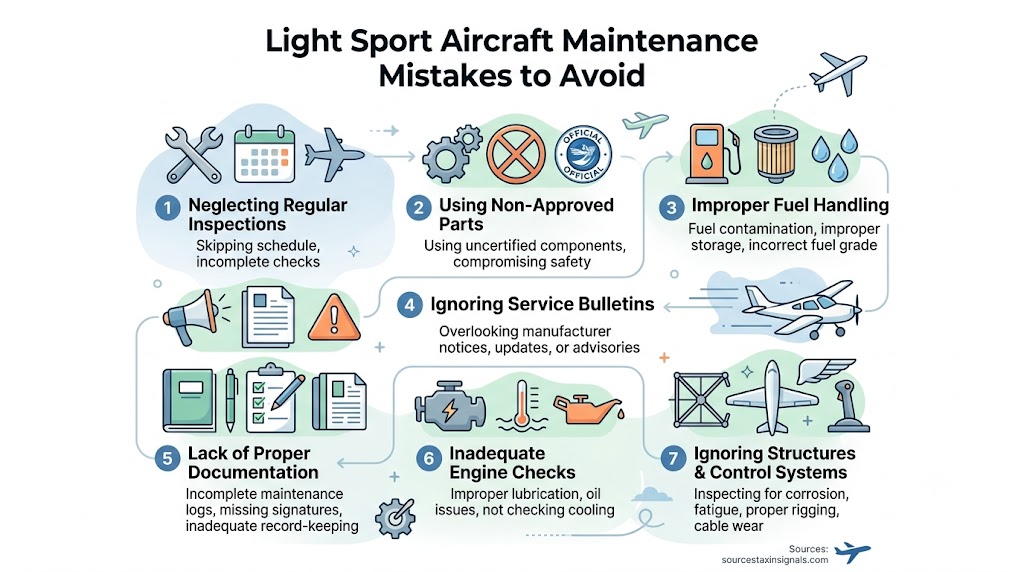
Light sport aircraft can offer relatively simple operation and ownership compared with many larger aircraft, but that simplicity should never be mistaken for low maintenance risk. A light aircraft still depends on the coordinated condition of its airframe, engine or propulsion system, flight controls, landing gear, electrical system, fuel system, instruments, and safety equipment.
Maintenance mistakes often begin with something that appears minor: an incomplete inspection, an outdated maintenance document, an undocumented repair, an overlooked component limitation, or an assumption that a familiar aircraft does not require careful attention. The consequences can become much more serious once the aircraft returns to service.
The safest maintenance approach is therefore systematic rather than improvised. Owners and operators should understand the aircraft’s certification basis, maintenance requirements, manufacturer instructions, inspection responsibilities, maintenance records, and the qualifications required for particular work.
FAA guidance emphasizes that light-sport aircraft maintenance must be performed within the applicable regulatory framework and that repairman, mechanic, and inspection privileges have specific limitations. The FAA’s current light-sport maintenance framework also reflects the changes introduced through the Modernization of Special Airworthiness Certification rules.
Why Light Sport Aircraft Maintenance Requires Discipline
A light sport aircraft may have fewer systems than a complex aircraft, but that does not eliminate the need for disciplined maintenance.
Several characteristics can make maintenance management particularly important:
- Lightweight structures can require careful inspection for damage and deterioration.
- Some aircraft rely heavily on manufacturer-specific maintenance information.
- Composite, fabric, metal, or mixed construction can have different inspection considerations.
- Engine and propeller systems may have specific operating and inspection limitations.
- Electrical and avionics installations can be sensitive to poor maintenance practices.
- Aircraft may be operated frequently, seasonally, or intermittently, creating different forms of wear.
- Maintenance responsibility can be shared between owners, repairmen, mechanics, and maintenance organizations.
- Aircraft documentation can be just as important as the physical inspection.
The central principle is simple:
An aircraft should not be considered airworthy merely because it looks serviceable.
Airworthiness depends on the aircraft’s condition, applicable requirements, maintenance status, records, and compliance with the conditions under which it is authorized to operate.
1. Treating a Light Sport Aircraft Like a Simple Hobby Machine
One of the most common mistakes is assuming that a smaller aircraft can be maintained with the same casual approach used for recreational equipment.
An aircraft operates in an environment where component failure can have immediate consequences. Even apparently small issues can affect controllability, propulsion, structural integrity, or the reliability of critical systems.
Why this mistake happens
Owners may become comfortable with their aircraft after repeated flights. Familiarity can create the impression that:
- “It has always worked.”
- “The problem is probably minor.”
- “It only needs a quick check.”
- “Nothing has changed since the last inspection.”
Those assumptions are dangerous substitutes for documented maintenance practices.
Better approach
Treat every maintenance decision as an airworthiness decision.
That means using:
- current aircraft documentation
- applicable inspection requirements
- appropriate maintenance personnel
- accurate records
- manufacturer information
- required compliance information
The aircraft’s simplicity should make good maintenance easier to manage—not make maintenance less important.
2. Ignoring the Aircraft’s Certification and Maintenance Basis
Not every light sport aircraft has exactly the same maintenance requirements.
The aircraft’s certification status, configuration, manufacturer documentation, operating limitations, and applicable regulations can affect who may perform maintenance or inspections and what information must be followed.
The FAA identifies light-sport aircraft certification and maintenance requirements separately from general assumptions about small aircraft. Current FAA guidance also recognizes different privileges for light-sport repairmen with maintenance and inspection ratings.
The mistake
An owner assumes:
“Because this is an LSA, the same maintenance rules apply to every LSA.”
That is an oversimplification.
Better approach
Before maintenance begins, establish:
- What certification category the aircraft holds.
- What maintenance documentation applies.
- What inspection program applies.
- Who is authorized to perform the intended work.
- What records must be created.
- Whether the aircraft has additional operating limitations or manufacturer requirements.
This basic identification step prevents many downstream errors.
3. Using Outdated Maintenance Information
Maintenance information changes.
Manufacturers may publish updated maintenance manuals, service information, safety notices, inspection instructions, or other technical information. Regulatory requirements can also change.
The FAA specifically notes that light-sport maintenance personnel need to understand the current manufacturer instructions applicable to the work being performed.
Why outdated information is a problem
An old document may contain:
- superseded inspection intervals
- obsolete component information
- outdated specifications
- previous configuration assumptions
- replaced procedures
- information that no longer matches the aircraft
Better approach
Before maintenance, verify that the documentation being used is:
- applicable to the exact aircraft
- appropriate for the installed configuration
- current
- complete
- consistent with the aircraft’s maintenance records
Do not assume that a document stored in a hangar or downloaded years ago is still the controlling reference.
4. Failing to Understand Who Is Authorized to Perform the Work
This is a particularly important area for light sport aircraft owners.
Maintenance privileges are not simply determined by whether someone is mechanically skilled. They depend on the person’s certification, ratings, applicable regulations, aircraft category, and the type of work involved.
The FAA’s current repairman guidance distinguishes between inspection and maintenance ratings and explains that the privileges associated with those ratings have specific limitations.
The mistake
An owner may assume:
“I own the aircraft, so I can perform any maintenance I want.”
Ownership alone does not automatically provide unrestricted maintenance authority.
Better approach
For each maintenance task, establish:
- who is permitted to perform it
- who may approve the aircraft for return to service
- whether additional qualifications apply
- whether manufacturer instructions must be followed
- whether the work falls within preventive maintenance or another category
When there is uncertainty, the appropriate response is to consult a qualified aviation maintenance professional or the applicable aviation authority rather than guessing.
5. Skipping the Annual or Required Condition Inspection
Inspection timing is one of the easiest maintenance-management items to overlook.
The applicable inspection requirement depends on the aircraft’s certification and regulatory framework. For aircraft subject to a condition-inspection program, the inspection is a formal airworthiness activity rather than a casual owner’s walk-around.
FAA material describes condition-inspection requirements for applicable light-sport aircraft and identifies qualified persons who may perform them.
Common reasons inspections get delayed
- Low annual flight hours
- Aircraft stored for long periods
- Seasonal operation
- Ownership changes
- Poor recordkeeping
- Confusion about inspection dates
- Assuming low utilization means low maintenance requirements
Better approach
Maintain a dedicated maintenance calendar that tracks:
- required inspections
- component limitations
- recurring maintenance
- manufacturer requirements
- applicable safety directives
- inspection sign-offs
- upcoming maintenance events
Low utilization does not automatically mean low maintenance risk.
6. Looking Only for Obvious Damage
A visual inspection is valuable, but aviation maintenance cannot be reduced to looking for something obviously broken.
Aircraft can develop problems involving:
- deterioration
- corrosion
- wear
- looseness
- fluid leakage
- electrical degradation
- structural damage
- control-system issues
- component aging
- installation problems
Some problems may not be obvious during a quick walk-around.
The better mindset
Instead of asking:
“Does everything look okay?”
A qualified maintenance professional should work from an appropriate inspection program and aircraft-specific information.
The difference is significant.
A casual inspection searches for visible problems.
A structured inspection evaluates the aircraft against defined requirements.
7. Neglecting Maintenance Records
Maintenance records are not administrative paperwork that can be completed later when convenient.
They provide the aircraft’s maintenance history and help establish what has been inspected, repaired, replaced, modified, or otherwise maintained.
The FAA maintains specific guidance concerning maintenance records and return-to-service documentation.
Poor records can create problems such as
- uncertainty about component history
- duplicated maintenance
- missed recurring requirements
- difficulty establishing compliance
- confusion during ownership transfer
- difficulty determining what work was previously performed
- questions about the aircraft’s maintenance status
Better approach
Maintain records that are:
- accurate
- legible
- timely
- traceable
- associated with the correct aircraft
- sufficiently detailed for future maintenance decisions
A good maintenance record should help the next qualified person understand what happened without requiring guesswork.
8. Treating Manufacturer Safety Information as Optional
Manufacturer-issued safety information deserves careful attention.
Depending on the aircraft and certification framework, manufacturers may publish information addressing known issues, recommended inspections, component concerns, or safety-related conditions.
FAA guidance recognizes that additional maintenance requirements or manufacturer safety directives can be relevant to applicable light-sport aircraft.
The mistake
An owner may see a manufacturer notice as:
“Just a recommendation.”
That assumption should not be made without determining the document’s status and applicability.
Better approach
For every safety-related notice, determine:
- Is it applicable to this aircraft?
- Is the affected component installed?
- Is compliance required, recommended, or otherwise addressed by the aircraft’s governing documents?
- What documentation supports the determination?
- Has the aircraft already received the relevant inspection or corrective action?
Keep evidence of the determination with the aircraft’s maintenance records when appropriate.
9. Overlooking Corrosion and Environmental Exposure
Aircraft do not need to be flown frequently to experience deterioration.
Storage and operating environments can affect aircraft through:
- moisture
- temperature changes
- humidity
- salt exposure
- dust
- contaminants
- inadequate storage
- prolonged inactivity
An aircraft stored near coastal environments, for example, may face different environmental concerns from one stored in a dry inland environment.
Common mistake
Owners sometimes associate maintenance requirements primarily with flight hours.
That can cause calendar-based deterioration to receive insufficient attention.
Better approach
Consider both:
Usage-related deterioration
and
time/environment-related deterioration.
The appropriate inspection program should account for both.
10. Assuming Low Flight Hours Mean Low Maintenance Risk
An aircraft that flies very little can still develop maintenance issues.
Low utilization can introduce its own challenges, particularly when an aircraft spends extended periods inactive.
Examples include:
- deterioration associated with storage
- battery-related problems
- environmental exposure
- aging components
- stale documentation
- deferred maintenance accumulating between flights
The correct question is not:
“How many hours did the aircraft fly?”
It is:
“What condition is the aircraft actually in, and what maintenance requirements apply?”
11. Ignoring Small Changes in Aircraft Behavior
Pilots are often the first people to notice that an aircraft does not feel exactly as it normally does.
Examples may include:
- unusual vibration
- unexpected instrument indications
- changes in engine behavior
- unusual control feel
- electrical abnormalities
- unfamiliar noises
- changes in starting behavior
- unexplained fluid loss
A small change should not automatically be dismissed because the aircraft remains operational.
Good maintenance culture
Encourages pilots to report abnormalities clearly and promptly.
A useful pilot report describes:
- what happened
- when it happened
- operating conditions
- whether it was intermittent
- whether it repeated
- what indications were observed
This gives maintenance personnel better information for investigation.
12. Making Unauthorized Modifications
Modifications can create maintenance and airworthiness problems when they are made without considering the aircraft’s certification basis and applicable requirements.
Common examples of potentially problematic areas include changes to:
- avionics
- electrical systems
- instruments
- controls
- lighting
- engine-related systems
- propeller installations
- structural components
- interior equipment
The issue is not simply whether the modification “works.”
The question is whether it is appropriately designed, documented, installed, evaluated, and approved under the applicable requirements.
Better approach
Before changing an aircraft, determine:
- Whether the modification is permitted.
- What technical data applies.
- Whether approval is required.
- Who is qualified to perform the work.
- What documentation is required.
- What effect the change may have on other systems.
A modification that appears independent can sometimes affect weight, balance, electrical loading, structural considerations, controls, or other aircraft characteristics.
13. Focusing on Parts Cost Instead of Maintenance Quality
Choosing the cheapest maintenance option can become expensive when the work is incomplete, poorly documented, or performed without sufficient aircraft-specific knowledge.
Cost should certainly be considered, but it should not be the only decision criterion.
A better maintenance decision considers:
| Factor | Question |
|---|---|
| Qualification | Is the person appropriately authorized and qualified? |
| Experience | Does the provider understand this aircraft type? |
| Documentation | Will the work be properly recorded? |
| Technical data | Will applicable manufacturer information be followed? |
| Parts | Are replacement components appropriate for the application? |
| Inspection | Will the completed work receive the required inspection or approval? |
| Communication | Will discrepancies be clearly explained to the owner? |
| Traceability | Can future maintenance personnel understand what was done? |
The lowest invoice does not necessarily represent the lowest ownership cost.
14. Poor Communication Between Owner, Pilot, and Maintenance Provider
Maintenance problems are sometimes caused by communication rather than mechanical knowledge.
An owner may know that something feels unusual but fail to explain it clearly.
A maintenance provider may correct a specific discrepancy without knowing about another symptom the pilot noticed.
A pilot may assume that an item mentioned during maintenance has already been resolved.
Better practice
Use a structured handoff.
Record:
- reported discrepancy
- operating conditions
- observed symptoms
- relevant dates
- previous maintenance
- known modifications
- unresolved questions
After maintenance, the owner should understand what work was performed and whether any items remain open or require future attention.
15. Failing to Review the Aircraft After Maintenance
Returning an aircraft to service should not become a paperwork-only event.
The appropriate post-maintenance process depends on the work performed and applicable requirements. Qualified personnel should determine what inspections, checks, documentation, or operational verification are required.
Owners and pilots should also understand what changed before normal operation resumes.
Important principle
The aircraft should not simply go from:
maintenance complete → normal operation
without the required technical and operational verification.
The exact verification process belongs to appropriately qualified personnel and the applicable aircraft documentation.
16. Ignoring Weight, Balance, and Configuration Changes
Small aircraft can be particularly sensitive to configuration changes.
Installing or removing equipment can affect:
- aircraft weight
- balance
- electrical demand
- available payload
- operating limitations
- equipment configuration
A modification that appears physically small can still have operational consequences.
Better approach
Treat every meaningful configuration change as an aircraft-management issue, not simply an equipment purchase.
Documentation should remain synchronized with the aircraft’s actual configuration.
17. Mixing Maintenance Knowledge With Guesswork
Internet forums, videos, informal advice, and previous experience can be useful for identifying questions.
They should not automatically replace aircraft-specific technical information or qualified maintenance judgment.
A common failure pattern
- Someone sees a similar problem online.
- They assume the aircraft has the same cause.
- They use advice intended for another model or configuration.
- The aircraft receives inappropriate work.
- The resulting maintenance history becomes harder to understand.
Better approach
Use outside information as a starting point for questions—not as automatic authorization or technical approval.
Aircraft-specific documentation and qualified maintenance judgment should remain the foundation.
18. Treating Maintenance as a One-Time Event
Good maintenance is continuous.
A strong ownership process includes:
Before flight
→ Identify abnormalities
During operation
→ Record unusual indications or behavior
After flight
→ Report discrepancies
Between inspections
→ Track recurring requirements
Before scheduled maintenance
→ Review records and outstanding items
During maintenance
→ Use applicable technical information
After maintenance
→ Complete required inspections and documentation
Before return to normal operation
→ Confirm maintenance status
This creates a maintenance feedback loop rather than a series of disconnected repairs.
Maintenance Mistake Prevention Framework
A practical way to reduce errors is to divide maintenance management into five areas.
| Area | Primary Question |
|---|---|
| Airworthiness | Is the aircraft in a condition for safe operation? |
| Compliance | Have applicable requirements been addressed? |
| Technical Data | Is current, applicable information being used? |
| Personnel | Is the work being performed and approved by appropriately qualified people? |
| Records | Can another qualified person understand the aircraft’s maintenance history? |
A weakness in any one of these areas can create unnecessary risk.
A Practical Maintenance Review Checklist
Before relying on an aircraft for continued operation, owners can use the following high-level checklist with qualified maintenance personnel:
Aircraft Status
- Certification status is understood.
- Applicable operating limitations are available.
- Aircraft configuration is accurately documented.
- Required inspections are current.
- Known discrepancies have been addressed appropriately.
Maintenance Information
- Current manufacturer information has been identified.
- Applicable safety information has been reviewed.
- Relevant component limitations are tracked.
- Maintenance documentation matches the aircraft model and configuration.
Personnel
- The person performing the work is appropriately qualified.
- Inspection privileges are understood.
- Return-to-service authority is established.
- Specialized work is assigned to appropriately qualified personnel.
Records
- Maintenance entries are complete.
- Inspection records are current.
- Modifications are documented.
- Component history is traceable where required.
- Outstanding maintenance items are clearly identified.
Operational Feedback
- Pilot-reported discrepancies have been reviewed.
- Recurring abnormalities have been investigated.
- Post-maintenance requirements have been completed.
- The aircraft’s current configuration is understood by the operator.
What Experienced Owners Should Watch Most Closely
Experienced aircraft ownership is less about memorizing every possible failure and more about developing a reliable maintenance-management system.
Five habits make a substantial difference:
1. Never rely on memory alone
Use records, inspection schedules, and documented maintenance history.
2. Never assume every LSA follows identical maintenance rules
Establish the specific aircraft’s certification and maintenance basis.
3. Never allow unclear responsibility
Know who is authorized to perform, inspect, and approve the relevant work.
4. Never dismiss recurring abnormalities
A repeated minor discrepancy can be more informative than a single obvious failure.
5. Never separate maintenance from documentation
If the aircraft’s physical condition and its records disagree, the discrepancy needs to be resolved.
Current Regulatory Context
Light-sport aircraft maintenance requirements are an area where owners should pay particular attention to regulatory changes. The FAA’s Modernization of Special Airworthiness Certification framework changed aspects of light-sport aircraft certification, repairman privileges, and maintenance requirements. The FAA states that the maintenance-related rule changes became effective before the later certification provisions for the expanded light-sport category.
The FAA also maintains current resources covering light-sport aircraft certification, accepted consensus standards, repairman privileges, and maintenance information.
Because aircraft certification categories and individual operating limitations can differ, owners should verify the rules applicable to their specific aircraft rather than relying on generalized descriptions of “LSA maintenance.
FAQs
Q1. How often should a light sport aircraft be inspected?
The required inspection interval depends on the aircraft’s certification and applicable maintenance program. Owners should follow the aircraft’s governing requirements rather than assuming that every light sport aircraft has an identical inspection schedule.
Q2. Can an aircraft owner perform maintenance on a light sport aircraft?
Some maintenance activities may be permitted for owners or appropriately certificated individuals, but privileges and limitations depend on the aircraft and the person’s qualifications. Ownership alone should not be treated as unrestricted maintenance authority.
Q3. Why are maintenance records so important?
Maintenance records establish what work and inspections have been performed and help future maintenance personnel understand the aircraft’s history. Poor records can create uncertainty about compliance, component history, and previous modifications.
Q4. Should manufacturer maintenance information always be followed?
Applicable manufacturer information is an important part of maintaining many light sport aircraft. Owners and maintenance personnel should determine which current documents apply to the specific aircraft and maintenance task.
Q5. Is an aircraft with very few flight hours easier to maintain?
Not necessarily. Low utilization can reduce some forms of wear while creating other concerns associated with storage, environmental exposure, aging, and inactivity.
Q6. What is one of the most common maintenance mistakes?
A major recurring problem is making assumptions instead of verifying the aircraft’s actual maintenance requirements, configuration, documentation, and applicable personnel privileges.
Q7. Why should aircraft modifications be carefully documented?
Modifications can affect configuration, weight, balance, electrical systems, operating characteristics, and maintenance requirements. Proper documentation helps ensure that the aircraft’s records accurately reflect its physical condition.
Q8. What should a pilot do after noticing an unusual aircraft behavior?
The pilot should report the observation clearly and ensure that appropriate qualified maintenance personnel evaluate it before the aircraft is relied upon when the issue could affect safe operation.
Q9. Are informal online maintenance recommendations sufficient?
They can help an owner identify questions, but they should not automatically replace aircraft-specific technical information, applicable regulations, or qualified maintenance judgment.
Q10. What is the best way to prevent maintenance mistakes?
Use a repeatable system: understand the aircraft’s certification basis, track inspections and maintenance requirements, use applicable technical information, involve appropriately qualified personnel, document work accurately, and resolve discrepancies rather than allowing assumptions to become part of the maintenance process.
Final Recommendation
Light sport aircraft maintenance should be managed as a disciplined airworthiness process, not as routine mechanical tinkering. The most avoidable mistakes usually involve assumptions: assuming a task is permitted, assuming old documentation is still current, assuming low flight hours mean low risk, or assuming a small discrepancy is unimportant. A strong maintenance culture combines qualified personnel, aircraft-specific technical information, accurate records, timely inspections, careful configuration management, and clear communication between pilots, owners, and maintenance providers.

