
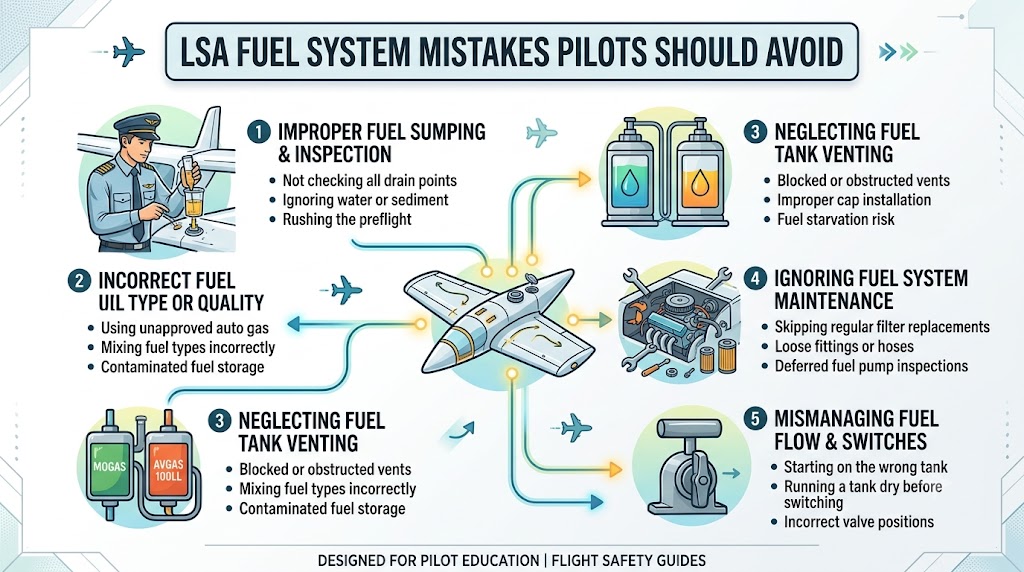
The fuel system is one of the most important systems in any Light-Sport Aircraft (LSA). A problem involving fuel quality, fuel quantity, fuel flow, or a leaking component can affect engine operation and overall flight safety.
For pilots and aircraft owners, understanding common fuel-system mistakes is an important part of responsible aircraft operation. Some checks are part of normal pre-flight procedures, while repairs, troubleshooting, and other maintenance tasks may require qualified aviation maintenance personnel.
LSA designs and fuel systems can differ significantly. Therefore, pilots should always use the aircraft manufacturer’s approved checklist, operating documentation, maintenance instructions, and applicable aviation regulations rather than relying on generic procedures.
Understanding the Basic LSA Fuel System
An LSA fuel system may include several components that work together to deliver fuel to the engine.
Depending on the aircraft and engine configuration, these components can include:
- Fuel tanks
- Fuel lines
- Fuel valves
- Fuel drains
- Fuel filters
- Fuel pumps
- Fuel vents
- Fuel caps
- Fuel quantity indication systems
- Carburetors or fuel-injection systems
Not every LSA uses the same configuration.
The location, design, inspection requirements, and maintenance procedures for these components can vary between aircraft. Pilots should therefore become familiar with the specific fuel system installed on their aircraft.
Why LSA Fuel System Condition Is Important
The engine depends on an appropriate supply of clean and suitable fuel.
Fuel-system problems can potentially contribute to issues such as:
- Fuel contamination
- Restricted fuel flow
- Fuel leakage
- Incorrect fuel quantity
- Fuel starvation
- Engine performance abnormalities
A pilot’s responsibility is not to diagnose every technical problem independently. Instead, pilots should perform the checks required by the aircraft’s approved procedures and recognize conditions that require further attention.
When something appears abnormal, the appropriate response is to follow the aircraft-specific procedures and seek qualified maintenance assistance when necessary.
Common LSA Fuel System Mistakes Pilots Should Avoid
Using the Wrong Fuel
One of the most important fuel-related mistakes is assuming that all aviation fuel is interchangeable.
Fuel requirements can depend on:
- Aircraft design
- Engine type
- Engine manufacturer’s requirements
- Aircraft manufacturer’s documentation
- Applicable approvals and limitations
Pilots should verify the correct fuel specified for their particular aircraft and engine.
They should not rely on memory from another aircraft or assume that a fuel suitable for one aircraft is automatically appropriate for another.
Always follow the aircraft manufacturer’s approved fuel requirements.
Failing to Check for Fuel Contamination
Fuel contamination can be a serious concern.
Potential contaminants can include:
- Water
- Dirt
- Sediment
- Corrosion particles
- Other foreign material
Pilots should follow the aircraft’s approved pre-flight inspection procedures for checking fuel condition.
The exact procedure can differ between aircraft, so generic sampling or handling techniques should not replace the manufacturer’s instructions.
If contamination is suspected, the aircraft should be handled according to the applicable aircraft and maintenance procedures.
Ignoring Water in the Fuel
Water can enter a fuel system through several circumstances, including condensation, contaminated fuel, or exposure of fuel-system openings.
Water contamination can create operational concerns because it is not an appropriate substitute for the required fuel supply to the engine.
Pilots should follow the aircraft-specific procedure for checking for water or other contamination during the pre-flight inspection.
If contamination continues to appear, it should not simply be ignored. Appropriate maintenance attention may be necessary.
Assuming the Fuel Gauge Is Always Accurate
A fuel gauge provides useful information, but pilots should not automatically assume that the indication alone confirms the amount of usable fuel available.
Fuel quantity indications can be affected by aircraft design and system characteristics.
Pilots should follow the aircraft’s approved fuel-management and fuel-verification procedures.
Important considerations include:
- Actual fuel quantity
- Fuel consumption
- Aircraft documentation
- Flight planning
- Applicable fuel requirements
- Any unusual indication
A pilot should not rely on an assumed fuel quantity when the aircraft-specific procedures call for additional verification.
Failing to Inspect Fuel Caps and Seals
Fuel caps and associated seals help keep the fuel system properly closed and protected from contamination.
Before flight, pilots should pay attention to the condition and security of fuel caps as required by the aircraft checklist.
Potential warning signs can include:
- Damaged components
- Improperly secured caps
- Fuel staining
- Visible leakage
- Deteriorated seals
The exact inspection requirements vary by aircraft.
If a cap or seal appears damaged or abnormal, pilots should follow the aircraft’s approved procedures and seek maintenance assistance when required.
Ignoring Fuel Leaks
Fuel leakage should never be casually dismissed.
Possible warning signs include:
- Visible fuel
- Wet areas around fuel-system components
- Fuel staining
- Persistent fuel odor
- Unexpected fuel quantity changes
A suspected fuel-system leak can involve a safety-critical issue.
Pilots should not attempt an improvised repair or continue normal operations simply because the leak appears small. The aircraft should be handled according to approved procedures, with qualified maintenance assistance when required.
Neglecting Fuel Lines and Connections
Fuel lines, fittings, and connections are important parts of the fuel-delivery system.
Potential concerns can include:
- Cracking
- Deterioration
- Chafing
- Loose connections
- Visible damage
- Leakage
Pilots should inspect only those areas and components that their approved checklist identifies as appropriate for pilot inspection.
Detailed fuel-line repair or replacement should be performed according to approved maintenance procedures by appropriately qualified personnel.
Ignoring Fuel Vent Problems
Fuel tanks generally require appropriate venting so that the fuel system can operate as designed.
A problem with a fuel vent can potentially interfere with normal fuel-system operation.
Because fuel-system designs differ, pilots should not attempt to diagnose or correct a suspected vent problem using a generic procedure.
Instead:
- Recognize the abnormal indication or condition.
- Follow the aircraft-specific documentation.
- Report the concern appropriately.
- Seek qualified maintenance assistance when required.
Neglecting Fuel Filters
Fuel filters help prevent unwanted material from reaching components downstream in the fuel system.
Their design and maintenance requirements can vary significantly.
Pilots and owners should understand:
- Which filters are installed
- What the aircraft documentation requires
- Which inspections are pilot responsibilities
- Which maintenance tasks require qualified personnel
Never assume a universal replacement interval applies to every LSA.
The manufacturer’s maintenance documentation should determine applicable inspection and replacement requirements.
Treating Fuel-System Maintenance as a DIY Task
Not every fuel-system task is appropriate for a pilot to perform.
There is an important distinction between routine pilot inspections and maintenance work.
Pilot-Level Responsibilities
Depending on the aircraft and approved checklist, pilots may be expected to check items such as:
- Fuel quantity
- Fuel type
- Fuel condition
- Fuel caps
- Visible leakage
- Other obvious abnormalities
Maintenance-Level Responsibilities
Depending on applicable rules and authorization, qualified maintenance personnel may handle:
- Fuel-line repairs
- Component replacement
- Fuel-pump maintenance
- Detailed fuel-system troubleshooting
- Certain filter-related tasks
- Fuel-system repairs
- Detailed inspections
Exact responsibilities depend on the aircraft, applicable regulations, and the individual’s authorization.
When in doubt, consult qualified maintenance personnel rather than improvising.
Common LSA Fueling Mistakes
Fueling is another area where simple assumptions can create problems.
Common mistakes include:
- Selecting an incorrect fuel type
- Failing to verify fuel labeling
- Assuming another fuel is acceptable
- Allowing contamination
- Leaving fuel caps unsecured
- Ignoring spills or leakage
- Failing to follow aircraft-specific fueling procedures
- Not communicating unusual fuel conditions to appropriate personnel
The correct fuel and fueling procedure should always come from the aircraft’s approved documentation and applicable requirements.
Common LSA Fuel Management Mistakes
Fuel management begins before the aircraft leaves the ground.
Overreliance on the Fuel Gauge
The fuel gauge should be interpreted according to the aircraft’s approved procedures rather than treated as the only source of fuel information.
Poor Pre-Flight Planning
Pilots should use the applicable aircraft documentation and regulations when planning fuel requirements.
Ignoring Fuel Consumption
Unexpected changes in fuel consumption can be important information.
Pilots should understand the aircraft’s normal operating information and investigate significant abnormalities according to appropriate procedures.
Forgetting Fuel Requirements and Reserves
Fuel planning should account for the requirements applicable to the specific flight.
Pilots should use the appropriate aircraft documentation and applicable regulations rather than relying on a generic reserve calculation.
Ignoring Unusual Fuel Quantity Changes
If fuel quantity changes unexpectedly, the issue should not simply be dismissed.
It may require further investigation or maintenance attention.
LSA Fuel System Pre-Flight Inspection Considerations
The exact pre-flight inspection must come from the aircraft’s approved checklist.
At a high level, fuel-related considerations may include:
- Fuel quantity
- Correct fuel type
- Fuel condition
- Possible contamination
- Fuel caps
- Visible leakage
- Accessible fuel-system components
- Fuel drains where applicable
- Fuel-system abnormalities
- Relevant maintenance information
Pilots should never substitute a generic internet checklist for the aircraft manufacturer’s approved checklist.
The aircraft-specific documentation takes priority.
Fuel System Mistakes During Aircraft Storage
Aircraft that remain unused for extended periods can require additional attention before returning to operation.
Potential storage-related concerns can include:
- Condensation
- Fuel degradation
- Contamination
- Corrosion
- Component deterioration
- Improper storage procedures
Storage requirements vary by aircraft and engine.
Owners should follow the manufacturer’s approved storage and return-to-service procedures rather than creating their own generalized process.
Fuel System Checks After Maintenance
Fuel-system maintenance can change the condition or configuration of relevant components.
After maintenance, pilots and owners should review appropriate documentation and understand:
- What work was performed
- Which components were affected
- Whether required inspections were completed
- Whether applicable maintenance documentation was completed
- What manufacturer instructions apply
Any required post-maintenance procedures should be completed according to approved documentation and applicable requirements.
Pilots should not assume that a maintenance task is complete simply because a component looks normal externally.
Warning Signs of Potential LSA Fuel System Problems
Pilots should take unusual fuel-system conditions seriously.
Potential warning signs can include:
Unexplained Fuel Odor
A persistent or unusual fuel odor may require further investigation.
Visible Fuel Leakage
Visible fuel around a fuel-system component should not be ignored.
Unexpected Fuel Quantity Changes
Unexplained changes may indicate a problem requiring attention.
Fuel Contamination
Repeated contamination findings should be appropriately investigated.
Engine Performance Abnormalities
Unexpected engine behavior may have multiple possible causes, including fuel-system issues.
Fuel Pressure Abnormalities
Where an aircraft uses fuel-pressure monitoring, an abnormal indication should be addressed according to the aircraft’s approved procedures.
Damaged Fuel Components
Visible damage to fuel lines, fittings, caps, or other components should receive appropriate attention.
When Pilots Should Seek Qualified Maintenance Support
A pilot should seek qualified assistance when a suspected fuel-system problem exceeds their authorized inspection or maintenance responsibilities.
Examples include:
- Suspected fuel leaks
- Persistent fuel contamination
- Damaged fuel lines
- Fuel-pump problems
- Fuel-filter issues requiring maintenance
- Fuel-vent concerns
- Unexplained fuel pressure abnormalities
- Repeated fuel-related engine problems
- Required component replacement
- Uncertainty about whether an aircraft is suitable for operation
The important principle is simple:
Do not turn uncertainty about a safety-critical fuel system into an experiment.
Use the aircraft’s approved documentation and qualified maintenance support.
Common Misconceptions About LSA Fuel Systems
“If the Fuel Gauge Shows Fuel, the System Is Fine.”
Not necessarily.
A fuel quantity indication does not by itself confirm fuel quality, absence of contamination, or overall fuel-system condition.
“All Aviation Fuel Is Interchangeable.”
Fuel requirements vary between aircraft and engines.
Pilots should use only the fuel specified by the applicable aircraft and engine documentation.
“A Small Fuel Smell Is Normal.”
An unexplained or persistent fuel odor should not automatically be considered normal.
It should be handled according to appropriate aircraft procedures.
“Fuel-System Maintenance Is Simple Enough Without Documentation.”
Fuel-system designs differ.
Maintenance should follow the aircraft manufacturer’s approved documentation and applicable requirements.
“The Same Fuel Procedure Works for Every LSA.”
LSAs can have different fuel tanks, fuel systems, engines, filters, pumps, and inspection requirements.
There is no universal fuel-system procedure that should replace aircraft-specific documentation.
LSA Fuel System Safety Checklist
Before flight, pilots can use their aircraft’s approved checklist to verify relevant fuel-system items.
A high-level checklist may include:
- Confirm the correct fuel type
- Verify fuel quantity
- Follow approved fuel inspection procedures
- Check for contamination
- Check fuel caps
- Look for visible leaks
- Check accessible components as required
- Check fuel drains where applicable
- Review unusual fuel-related indications
- Follow the approved pre-flight checklist
- Review relevant maintenance information
- Report suspected defects
- Seek qualified maintenance assistance when required
Common Fuel System Mistakes vs. Better Practices
| Common Mistake | Better Practice |
|---|---|
| Using an assumed fuel type | Verify the aircraft-specific requirement |
| Ignoring contamination | Follow approved fuel inspection procedures |
| Relying only on the fuel gauge | Follow approved fuel quantity procedures |
| Ignoring fuel odors | Treat unusual conditions appropriately |
| Overlooking fuel-cap condition | Inspect according to the aircraft checklist |
| Ignoring visible leakage | Seek appropriate maintenance assistance |
| Skipping fuel-system checks | Follow the approved pre-flight checklist |
| Performing undocumented repairs | Use qualified maintenance personnel |
| Ignoring maintenance records | Review relevant documentation |
| Using generic procedures | Follow aircraft-specific instructions |
What Pilots Can Check vs. What Requires Maintenance Support
Understanding the boundary between pilot inspection and maintenance work is important.
| Pilot-Level Checks | Maintenance-Level Work |
|---|---|
| Fuel quantity | Fuel-system repairs |
| Correct fuel type | Fuel-line repairs |
| Fuel condition as specified | Component replacement |
| Fuel-cap security | Fuel-pump maintenance |
| Visible leakage | Detailed troubleshooting |
| Obvious abnormalities | Detailed inspections |
| Checklist-required observations | Maintenance-required adjustments |
This is a general distinction, not a universal rule. The actual responsibilities depend on the aircraft, applicable regulations, and the pilot’s or technician’s authorization.
When Should an LSA Pilot Seek Professional Fuel-System Assistance?
Consider obtaining qualified maintenance support when:
- A fuel leak is suspected.
- Fuel contamination persists.
- A fuel-system component appears damaged.
- Fuel pressure is abnormal where applicable.
- An unusual fuel odor continues.
- Fuel consumption changes unexpectedly.
- Maintenance documentation is unclear.
- A repair or component replacement is required.
- The pilot is uncertain whether an issue is acceptable for operation.
When a safety-critical fuel-system problem is suspected, pilots should follow the aircraft’s approved procedures rather than attempting an improvised solution.
Frequently Asked Questions
Q1. Why is the fuel system important in an LSA?
The fuel system delivers fuel to the engine and must function as designed for normal engine operation. Fuel contamination, leakage, incorrect fuel, or other problems can create operational concerns.
Q2. What are common LSA fuel system problems?
Common concerns can include contamination, water, leaks, damaged fuel lines, fuel-cap problems, fuel-filter issues, vent problems, and incorrect fuel selection.
Q3. How can fuel contamination occur?
Contamination can involve water, dirt, sediment, corrosion particles, or other foreign material. Sources can vary and may include fuel handling, storage, or environmental exposure.
Q4. Why should pilots check for water in fuel?
Water contamination can interfere with the intended fuel supply to the engine. Pilots should follow the aircraft-specific procedures for checking fuel condition.
Q5. Can pilots rely entirely on the fuel gauge?
No pilot should assume that a fuel gauge alone provides complete information about fuel-system condition or usable fuel. Pilots should follow the aircraft’s approved fuel-verification procedures.
Q6. What should a pilot do if a fuel leak is suspected?
A suspected fuel leak should be treated seriously. The pilot should follow the aircraft’s approved procedures and seek qualified maintenance assistance as required rather than attempting an improvised repair.
Q7. Why are fuel caps and seals important?
They help keep the fuel system properly closed and reduce the potential for contamination or leakage. Their condition should be checked according to the aircraft’s approved checklist.
Q8. Do all LSAs use the same fuel system?
No. LSA fuel-system designs can vary considerably depending on the aircraft and engine.
Q9. When should an LSA pilot contact a maintenance professional?
Qualified assistance may be needed for suspected leaks, component damage, persistent contamination, fuel-system failures, unusual fuel-related engine problems, or any task outside the pilot’s authorized responsibilities.
Q10. How should an LSA fuel system be inspected before flight?
Pilots should use the aircraft manufacturer’s approved pre-flight checklist and follow its specific fuel-system inspection procedures.
Q11. What fuel should an LSA use?
The correct fuel depends on the particular aircraft and engine. Pilots should use the fuel specified in the applicable aircraft and engine documentation rather than relying on general assumptions.
Q12. Can pilots perform their own LSA fuel-system maintenance?
Some routine inspections may fall within a pilot’s responsibilities, but fuel-system maintenance and repairs can require appropriate qualifications, authorization, and approved procedures. Pilots should consult the aircraft documentation and applicable regulations before performing maintenance.
Conclusion
LSA fuel-system safety begins with using the correct fuel, following the approved pre-flight checklist, and remaining alert to contamination, leaks, and unusual indications. Pilots should avoid relying on assumptions or generic procedures because fuel systems differ between aircraft. Routine pilot inspections should be distinguished from maintenance work that requires qualified personnel. When a fuel-system problem is suspected, the safest approach is to follow aircraft-specific documentation and obtain appropriate maintenance support. Careful fuel management and proper maintenance documentation can help pilots operate their aircraft responsibly.

