
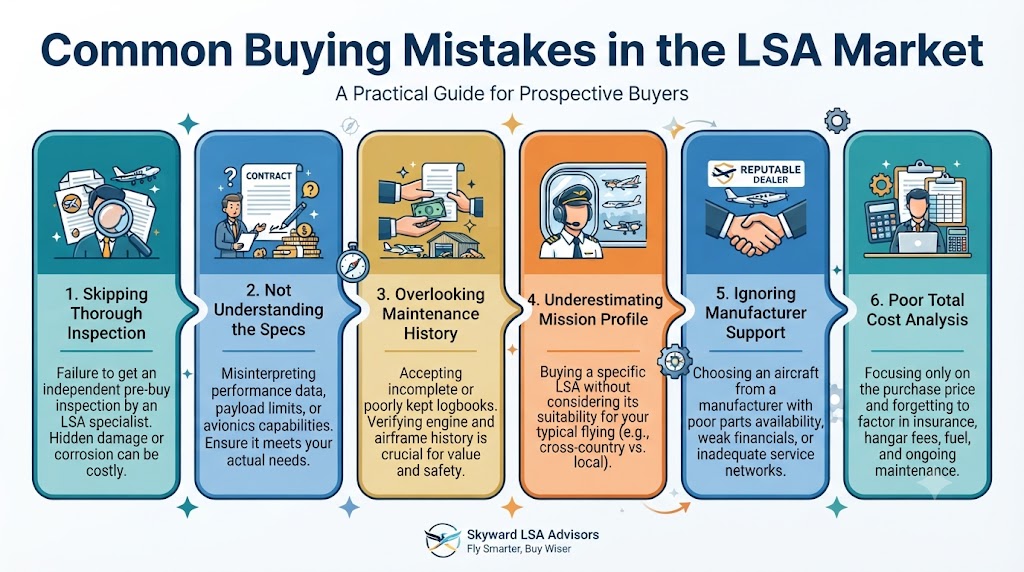
Buying a Light-Sport Aircraft can be an exciting step for recreational pilots, aviation enthusiasts, student pilots, and aircraft owners looking for a practical way to enjoy personal flying. However, purchasing an aircraft is a significant decision, and the advertised price is only one part of the overall picture.
A well-priced LSA may turn out to be expensive to own if it has deferred maintenance, limited parts availability, outdated equipment, incomplete records, or characteristics that do not match the buyer’s intended mission. Conversely, an aircraft with a higher purchase price may offer better value if it has a strong maintenance history, desirable equipment, and good overall condition.
For this reason, successful aircraft buying depends on due diligence.
This guide explores the most common buying mistakes in the LSA market and explains how prospective buyers can approach the process more carefully.
What Is a Light-Sport Aircraft?
A Light-Sport Aircraft, commonly referred to as an LSA, is a category of aircraft subject to specific certification, operating, and eligibility requirements under the applicable aviation regulations.
LSAs can appeal to pilots interested in recreational flying, personal travel, training, and other permitted operations.
However, the rules surrounding aircraft categories, pilot privileges, maintenance, registration, and operating limitations can vary by jurisdiction and may change over time.
Before purchasing an aircraft, buyers should verify its current regulatory status and confirm that it is suitable for their intended use.
Why Buying an LSA Requires Careful Research
An aircraft is not simply a vehicle that can be evaluated by looking at its exterior and checking the asking price.
A proper buying decision involves examining several factors, including:
- Aircraft condition
- Maintenance history
- Engine condition
- Propeller condition
- Avionics
- Documentation
- Regulatory status
- Parts availability
- Insurance
- Storage
- Operating costs
- Intended mission
- Resale considerations
The aircraft that looks best in an online advertisement may not necessarily be the aircraft that provides the best long-term value.
Mistake #1: Buying Based Only on the Purchase Price
One of the most common mistakes in the LSA market is focusing almost entirely on the asking price.
A low purchase price can be attractive, but it may hide future expenses.
Potential ownership costs can include:
- Maintenance
- Insurance
- Fuel
- Hangar or tie-down
- Scheduled inspections
- Engine maintenance
- Propeller maintenance
- Replacement parts
- Avionics upgrades
- Unexpected repairs
For example, two LSAs may have similar purchase prices but very different maintenance histories. One might require relatively little immediate work, while the other may need significant investment after purchase.
Think About Total Cost of Ownership
Instead of asking only, “How much does this aircraft cost?”, ask:
“What is the likely cost of owning and operating this aircraft?”
This broader perspective can produce a much more realistic comparison.
Mistake #2: Skipping the Pre-Purchase Inspection
A pre-purchase inspection is one of the most important steps in buying a used aircraft.
Buyers should consider arranging an independent inspection by an appropriately qualified aviation professional who understands the aircraft type.
Depending on the aircraft and applicable requirements, an inspection may consider areas such as:
- Airframe
- Engine
- Propeller
- Landing gear
- Flight controls
- Electrical systems
- Fuel system
- Avionics
- Brakes and tires
- Corrosion
- Previous repairs
- Visible damage
The goal is not simply to determine whether the aircraft can fly today. The inspection should help the buyer understand its overall condition and identify potential maintenance or repair concerns.
Mistake #3: Ignoring Maintenance Records
Maintenance records can tell an important story about an aircraft.
Buyers should review available documentation carefully rather than relying solely on the seller’s verbal description.
Records may provide information about:
- Routine inspections
- Engine maintenance
- Propeller work
- Component replacements
- Repairs
- Modifications
- Service information
- Previous maintenance findings
- Inspection history
Look for Consistency
Pay attention to whether the records appear consistent with the aircraft’s current condition and claimed history.
Missing or unclear records do not automatically mean an aircraft is unsuitable, but they should prompt further investigation.
If an important part of the aircraft’s history cannot be established, discuss the issue with a qualified aviation professional before proceeding.
Mistake #4: Not Verifying the Aircraft’s Regulatory Status
Regulatory status is an essential part of aircraft ownership.
Before purchasing an LSA, buyers should verify applicable documentation and requirements relating to:
- Registration
- Aircraft records
- Operating limitations
- Inspection requirements
- Maintenance status
- Applicable certification category
- Required equipment
- Intended operation
A buyer should not assume that an aircraft qualifies for a particular operation simply because the seller describes it as an LSA.
Regulations can vary between countries and may change over time. Always verify current requirements with the appropriate aviation authority and qualified professionals.
Mistake #5: Choosing an Aircraft That Does Not Match Your Mission
Not every LSA is designed or configured for the same type of flying.
Before shopping, clearly define how you intend to use the aircraft.
Your mission might involve:
- Local recreational flying
- Weekend trips
- Flight training
- Cross-country travel
- Personal transportation
- Aircraft enjoyment and proficiency flying
Once the mission is defined, evaluate aircraft characteristics such as:
- Range
- Payload
- Cabin configuration
- Baggage capacity
- Performance
- Operating environment
- Avionics
- Comfort
An aircraft that is ideal for short recreational flights may not be the best choice for frequent longer trips.
Mistake #6: Underestimating Payload and Useful Load
Payload is one of the most important considerations when comparing aircraft.
The useful load must account for more than the pilot and passenger.
It can include:
- Fuel
- Baggage
- Equipment
- Pilot
- Passenger
- Other installed or carried items
Always review the actual aircraft’s documentation and current weight information.
Do not rely exclusively on a manufacturer’s brochure or a generic specification from an online advertisement.
Why Payload Matters
An aircraft may technically accommodate two people but offer limited practical flexibility once fuel and baggage are included.
Buyers should evaluate the aircraft based on how they actually plan to use it.
Mistake #7: Ignoring Engine and Propeller Condition
The engine and propeller are major components of an aircraft, and their condition can have a significant effect on ownership planning.
When evaluating an LSA, review available information regarding:
- Engine total time
- Maintenance history
- Inspection history
- Propeller hours
- Propeller maintenance
- Service records
- Upcoming maintenance
- Evidence of leaks or other reported concerns
A lower-time engine is not automatically a guarantee of better value, and a higher-time engine is not necessarily a reason to reject an aircraft.
The complete maintenance history and current condition are more important than a single number.
Mistake #8: Overlooking Avionics and Equipment
Avionics can significantly influence an aircraft’s usability and future upgrade costs.
Depending on the aircraft, buyers may encounter equipment such as:
- GPS
- Radios
- Transponders
- ADS-B equipment where applicable
- Flight instruments
- Autopilot systems
- Engine monitoring equipment
- Emergency equipment
When evaluating avionics, determine whether the installed equipment meets your intended requirements and whether it is compatible with current and expected operations.
An aircraft with inexpensive older avionics may require more investment than expected after purchase.
Mistake #9: Assuming All LSAs Are the Same
The term LSA describes a category, not a single aircraft design.
Different LSAs can vary significantly in:
- Aircraft configuration
- Handling characteristics
- Cabin design
- Payload
- Baggage capacity
- Engine type
- Avionics
- Maintenance requirements
- Parts availability
- Operating costs
Two aircraft in the same general category may provide completely different ownership experiences.
This is why buyers should research specific aircraft models and, ideally, experience the aircraft appropriately before making a purchase decision.
Mistake #10: Forgetting Parts and Maintenance Availability
An aircraft can be attractive on paper but become difficult to own if replacement parts or qualified maintenance support are difficult to find.
Before buying, investigate:
- Manufacturer support
- Parts availability
- Engine support
- Propeller support
- Technical documentation
- Local maintenance expertise
- Availability of replacement components
This is particularly important when considering older or less common aircraft models.
A lower purchase price may not represent good value if basic maintenance requires significant effort or specialized resources.
Mistake #11: Not Considering Insurance and Storage Costs
The purchase price is only the beginning of aircraft ownership expenses.
Before purchasing, research potential costs associated with:
- Aircraft insurance
- Hangar rental
- Tie-down
- Fuel
- Routine maintenance
- Inspections
- Registration
- Repairs
- Replacement parts
Insurance costs can vary according to factors such as pilot experience, aircraft type, intended use, and insurer requirements.
Storage costs can also vary significantly depending on the airport and available facilities.
A realistic ownership budget should account for recurring expenses as well as unexpected maintenance.
Mistake #12: Trusting the Seller’s Description Without Verification
Most aircraft sellers will provide information about the aircraft, but buyers should independently verify important claims.
Review details such as:
- Total aircraft time
- Engine time
- Propeller time
- Maintenance history
- Equipment list
- Modifications
- Aircraft condition
- Documentation
- Accident or incident information where available
This is not about assuming that a seller is dishonest.
It is simply good aircraft-buying practice.
Important claims should be supported by appropriate records whenever possible.
Mistake #13: Failing to Budget for Post-Purchase Expenses
Even an aircraft that passes a pre-purchase inspection may require some investment after acquisition.
Potential expenses can include:
- Routine maintenance
- Inspection-related work
- Replacement of aging components
- Battery replacement
- Tires
- Fluids
- Avionics updates
- Interior improvements
- Deferred maintenance
Buyers should avoid spending their entire aircraft budget on the purchase price.
Maintaining a financial reserve can provide additional flexibility when unexpected ownership expenses arise.
Mistake #14: Not Conducting an Appropriate Evaluation Flight
Where appropriate and permitted, an evaluation or demonstration flight can help a prospective buyer understand whether an aircraft matches their expectations.
The flight may provide an opportunity to assess:
- General handling
- Engine operation
- Instrument operation
- Avionics
- Cabin environment
- Noise
- Vibration
- Overall suitability
An evaluation flight should be conducted safely by appropriately qualified pilots and in accordance with applicable requirements.
A buyer should not attempt unfamiliar operations simply to evaluate an aircraft.
Mistake #15: Buying Without Comparing Multiple Aircraft
Another common mistake is becoming emotionally attached to the first aircraft that looks appealing.
Before making a decision, compare multiple aircraft when practical.
Consider:
| Factor | Questions to Ask |
|---|---|
| Price | Is the asking price reasonable for the aircraft’s condition? |
| Condition | What did the inspection reveal? |
| Engine | What is the maintenance and operating history? |
| Propeller | What is its condition and service history? |
| Records | Are the records complete and consistent? |
| Avionics | Does the equipment meet my needs? |
| Parts | Can replacement parts be obtained reasonably? |
| Maintenance | Is qualified support available? |
| Payload | Can it carry the people and equipment I need? |
| Mission | Does the aircraft fit my intended use? |
| Ownership | Can I comfortably afford ongoing expenses? |
Comparing several aircraft can help buyers distinguish between a good deal and an aircraft that simply has an attractive asking price.
New vs. Used LSA: Which Is Better?
There is no universal answer.
Buying a New LSA
Potential advantages may include:
- Newer components
- Current equipment
- Manufacturer support
- Modern avionics
- Less previous operating history
However, the purchase price may be higher.
Buying a Used LSA
Potential advantages may include:
- Lower initial purchase price
- Existing equipment
- Established maintenance history
- Potentially lower depreciation depending on the aircraft and market
However, buyers need to pay close attention to condition, maintenance records, previous repairs, and upcoming expenses.
The right choice depends on the buyer’s budget, mission, risk tolerance, and ownership goals.
How to Buy an LSA More Carefully
A structured purchasing process can reduce the risk of overlooking important details.
Step 1: Define Your Mission
Determine exactly how you intend to use the aircraft.
Step 2: Establish a Total Ownership Budget
Consider purchase price plus insurance, storage, maintenance, fuel, inspections, and potential repairs.
Step 3: Research Suitable Models
Identify aircraft that fit your passenger, payload, range, comfort, and operational requirements.
Step 4: Compare Multiple Aircraft
Do not evaluate an aircraft in isolation.
Step 5: Review the Records
Study maintenance and ownership documentation before committing.
Step 6: Verify Regulatory Status
Confirm the aircraft’s current status and eligibility for your intended operation.
Step 7: Arrange an Independent Inspection
Have an appropriately qualified professional inspect the aircraft.
Step 8: Evaluate the Engine and Propeller
Review their condition, maintenance history, and future service requirements.
Step 9: Evaluate the Avionics
Determine whether the equipment meets your needs or will require upgrades.
Step 10: Conduct an Appropriate Evaluation Flight
Where applicable, evaluate the aircraft’s suitability through a properly conducted flight.
Step 11: Review Ownership Costs
Estimate recurring and potential unexpected expenses.
Step 12: Complete the Transaction Carefully
Review the purchase agreement, aircraft documentation, ownership records, and applicable paperwork before completing the purchase.
LSA Buying Checklist
Before purchasing an LSA, consider the following:
- Define intended aircraft mission
- Set a realistic total ownership budget
- Research suitable LSA models
- Compare multiple aircraft
- Review maintenance records
- Verify aircraft documentation
- Confirm applicable regulatory status
- Review engine history
- Review propeller history
- Inspect the airframe
- Evaluate avionics
- Check parts availability
- Investigate maintenance support
- Research insurance
- Estimate storage costs
- Arrange an independent pre-purchase inspection
- Conduct an appropriate evaluation flight
- Budget for post-purchase maintenance
- Review the purchase agreement and transaction documents
Questions to Ask Before Buying an LSA
A good buyer should not hesitate to ask detailed questions.
About the Aircraft
- How many hours does the aircraft have?
- What engine is installed?
- What is the engine’s maintenance history?
- What propeller is installed?
- What avionics are included?
- Has the aircraft been modified?
About Maintenance
- Where has the aircraft been maintained?
- Are the maintenance records available?
- Are there upcoming inspections or maintenance requirements?
- Are there unresolved maintenance issues?
About Ownership
- What are the expected insurance costs?
- Where will the aircraft be stored?
- Is qualified maintenance available nearby?
- Are replacement parts readily available?
About the Transaction
- What documentation is included?
- What is included in the asking price?
- Are there known defects?
- What conditions apply to the sale?
Frequently Asked Questions
What should I look for when buying an LSA?
Look at the aircraft’s condition, maintenance records, engine and propeller history, avionics, regulatory status, parts availability, operating costs, and suitability for your intended mission.
Is the cheapest LSA always the best deal?
No. A low purchase price can be offset by maintenance, repairs, upgrades, insurance, storage, or other ownership expenses.
Why is a pre-purchase inspection important?
It can help identify mechanical, structural, documentation, or maintenance concerns that may not be obvious during a casual viewing.
What maintenance records should I review?
Review available inspection, engine, propeller, repair, component replacement, modification, and other relevant maintenance records.
How do I determine whether an LSA fits my mission?
Start by defining how you plan to use the aircraft, then compare its payload, range, cabin, baggage capacity, equipment, operating requirements, and other characteristics against those needs.
What ownership costs should I budget for?
Consider the purchase price, insurance, storage, fuel, inspections, maintenance, repairs, replacement parts, and potential upgrades.
How important is engine time when buying an LSA?
Engine time is an important consideration, but it should be evaluated alongside maintenance history, current condition, inspections, and other available records.
Should I buy a new or used LSA?
Both can make sense depending on your budget, mission, equipment preferences, and ownership goals. A used aircraft requires particularly careful evaluation of its history and condition.
Why should I compare multiple aircraft?
Comparing multiple aircraft helps you understand the market and identify differences in price, condition, equipment, maintenance history, and overall ownership value.
Final Thoughts
Buying an LSA is an exciting opportunity, but it should be approached with the same care as any significant aircraft purchase.
The biggest mistake is treating the aircraft’s asking price as the complete picture. A smart buyer looks beyond the price and examines the aircraft’s condition, records, engine, propeller, avionics, regulatory status, maintenance support, parts availability, and long-term operating costs.
A thorough pre-purchase inspection, careful documentation review, realistic budgeting, and clear understanding of your intended mission can help you make a more informed decision.

