
Introduction
In the rapidly evolving landscape of cloud computing, managing infrastructure costs while maintaining high performance is a critical challenge. Professionals often find themselves struggling to bridge the gap between finance and engineering teams, leading to wasted cloud spend and missed opportunities. This is where specialized FinOps Training becomes essential for any organization scaling its operations. By implementing a framework that focuses on cost visibility, accountability, and optimization, businesses can transform their cloud expenditure into a strategic advantage. Whether you are an individual aiming for a FinOps Certification or a business leader looking to optimize your stack, understanding the intersection of finance and technology is the most vital skill for long-term cloud sustainability.
What Is FinOpsSchool?
FinOpsSchool serves as a premier educational platform dedicated to teaching the complexities of Cloud Financial Management. We offer a structured FinOps Course designed to simplify the jargon and technical hurdles often associated with multi-cloud environments. By focusing on the core FinOps framework, we enable participants to master the art of data-driven decision-making regarding their cloud resources. Our approach ensures that every student gains confidence in handling complex billing cycles and cloud optimization strategies. We believe that by providing clear, actionable insights through FinOps Certification Training, we empower teams to stop treating cloud spend as an uncontrollable variable and start viewing it as a managed investment that drives measurable business growth.
Why FinOpsSchool Matters for Modern Engineering Teams
Modern engineering teams are tasked with shipping code at high velocity, often without seeing the direct financial implications of their architectural decisions. This disconnect creates a culture where efficiency is secondary to speed. Through Corporate FinOps Training, engineering departments can learn to integrate cost awareness directly into their development workflows. When engineers understand how their resource allocation choices—like choosing specific instance types or storage tiers—impact the bottom line, they naturally start building more cost-effective solutions. By fostering this collaborative culture, teams avoid the common pitfall of “blind spending” and shift toward a proactive mindset where engineers own the financial outcomes of their deployments just as much as they own performance and stability.
Core Components of a FinOpsSchool Program
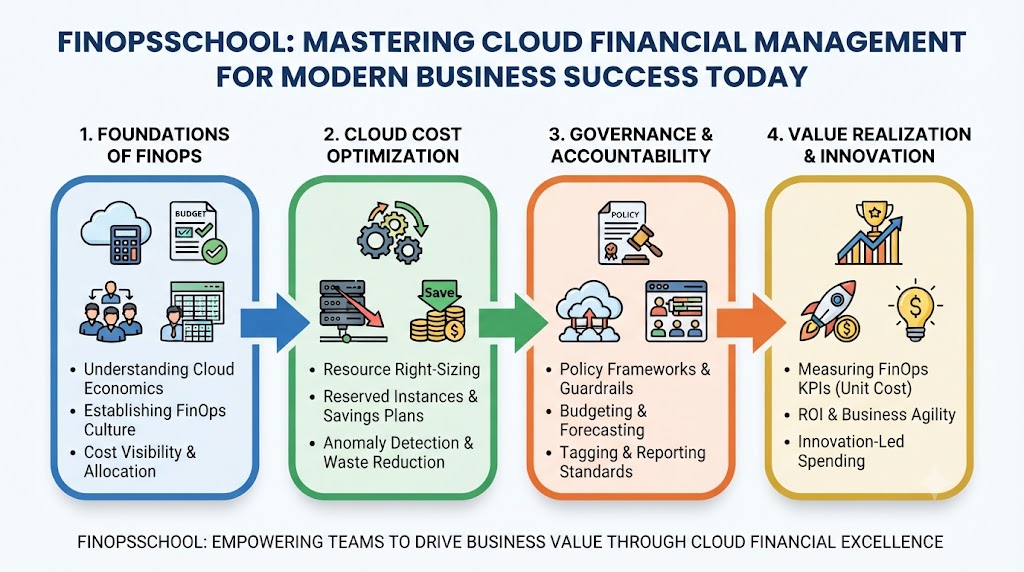
A high-quality educational program must cover a vast range of technical and financial capabilities to be effective. Our training structure includes essential modules that focus on unit economics, cloud budgeting, and real-time anomaly detection. We dive deep into the mechanics of cost allocation, teaching students how to tag resources effectively so that billing data is always traceable to specific business units. Additionally, we provide hands-on experience with forecasting, which allows organizations to predict future spend based on historical trends and upcoming project scaling. Participants also learn how to leverage Reserved Instances and Savings Plans to drastically reduce overhead. This comprehensive curriculum ensures that every graduate is prepared to handle the complexities of large-scale cloud governance.
Security in CI/CD Pipelines
Security and cost management are inherently linked when it comes to infrastructure efficiency. Integrating security checks within your CI/CD pipeline not only protects your data but also ensures that you are not paying for vulnerable or redundant workloads. By teaching security best practices alongside cost management, we help teams identify “zombie” resources or misconfigured security groups that inflate bills. A secure pipeline is also an efficient one; it reduces the time spent on manual patching and remediation. Our training emphasizes that automated security scanning is a cornerstone of a mature cloud environment. When security is baked into the development lifecycle, you minimize financial risk while maximizing the utility of every cloud dollar invested.
Policy as Code
Policy as Code is the practice of managing and automating your governance rules using the same version-controlled workflows as your application code. This is a game-changer for businesses struggling with decentralized cloud usage. Through our FinOps Online Training, professionals learn how to define guardrails that automatically prevent over-provisioning or unauthorized resource deployment. Instead of manually auditing thousands of resources, teams can write scripts that enforce tagging policies and limit instance sizes globally. This automated approach ensures consistency across development, staging, and production environments. By treating governance as code, organizations can scale rapidly while maintaining strict financial discipline, ensuring that cloud policies are not just suggestions, but automated requirements for every deployed service.
Kubernetes Security
Kubernetes has become the standard for container orchestration, yet it introduces significant complexities regarding cost transparency and security. Managing cost in a cluster requires a deep understanding of resource requests, limits, and idle capacity. Our FinOps Engineer Training covers the nuances of right-sizing pods and namespaces to ensure that compute resources are utilized effectively. Simultaneously, we address the security aspects, such as managing secrets, network policies, and container image scanning. Balancing these two worlds—security and cost—is the mark of an expert Kubernetes operator. By attending our sessions, you will learn how to optimize your clusters to ensure you aren’t paying for wasted overhead while maintaining a hardened, secure production environment.
Cloud Security and FinOpsSchool
Cloud security is not just about perimeter defense; it is about managing the financial impact of security incidents and compliance breaches. A single misconfiguration can lead to massive data leaks and astronomical unexpected costs. We integrate security training into our core curriculum because a secure cloud is almost always a more efficient one. By understanding how security threats evolve, professionals can build resilient systems that require fewer emergency resources and less reactive spending. Our case studies often highlight how proactive security measures prevent the “financial fire drills” that plague many unprepared engineering organizations. This holistic view ensures that your team is prepared to defend against threats while keeping the monthly cloud bill stable and predictable.
Vulnerability Management
Vulnerability management is a continuous process of identifying, prioritizing, and mitigating risks within your software stack. In a FinOps context, this means ensuring that your vulnerability patching process is efficient enough to avoid long-term technical debt. When vulnerabilities are left unaddressed, they often lead to expensive, last-minute architectural reworks. Our Cloud Cost Optimization Training includes strategies for streamlining the patch management lifecycle. By automating the deployment of secure images and utilizing Infrastructure as Code, teams can reduce the overhead of constant updates. This leads to a more predictable resource consumption pattern, which is vital for maintaining accurate cloud budgets and forecasting future capacity needs accurately.
Compliance Automation
Staying compliant with industry regulations like SOC2, GDPR, or HIPAA is often a manual, time-consuming burden. Compliance automation turns this process into a continuous monitor, drastically reducing the effort required to pass audits. In our programs, we teach students how to map compliance controls to automated alerts and dashboards. This visibility allows teams to maintain a state of “always-on” compliance, which prevents the costly fines and reputational damage associated with violations. Furthermore, automated compliance reports provide insights into resource usage, helping teams align their infrastructure with legal requirements without over-provisioning or neglecting essential security configurations. It is about creating a baseline of trust that supports rapid business innovation.
Building a FinOpsSchool Culture
Creating a culture of financial accountability requires more than just tools; it requires a shift in how teams view their work. When everyone from junior developers to C-suite executives understands the cost of their choices, the organization reaches a new level of maturity. We emphasize cross-functional collaboration, where finance teams speak the language of engineering and vice versa. By breaking down silos, organizations can share success stories where specific teams reduced their costs by optimizing their architecture. Celebrating these wins encourages a culture of ownership. Our training focuses on the communication strategies needed to bridge these gaps, ensuring that financial goals are treated as a shared responsibility rather than a burden placed solely on the finance department.
Common FinOpsSchool Mistakes
Many organizations fail in their FinOps journey because they focus too much on tools and not enough on people or processes. One common mistake is “tagging fatigue,” where teams try to track everything at once without a clear strategy, leading to unusable data. Another error is neglecting unit economics, focusing solely on total spend rather than the cost per customer or transaction. We also see teams attempt to optimize resources without proper historical data, which can lead to performance degradation. Our training programs highlight these common pitfalls and provide a roadmap to avoid them. By focusing on simple, repeatable processes and gradual improvements, teams can navigate the complexities of cloud spend without burning out their engineers.
How FinOpsSchool Training Can Help
Our training provides the framework needed to turn chaos into a streamlined, automated, and efficient operation. By enrolling in FinOps Training in India or through our global online sessions, you gain access to proven methodologies used by top-tier enterprises. We provide you with the tools to perform detailed cost analysis, identify hidden waste, and negotiate better commitment deals with cloud providers. More importantly, we teach you how to maintain these gains over time. Whether you need to fix a specific budgeting issue or want to build a long-term FinOps strategy from scratch, our practical modules give you the confidence to lead your organization toward financial maturity and operational excellence in the cloud.
Who Can Benefit From FinOpsSchool Learning?
Our programs are designed for a wide range of professionals, as cloud financial management is a multi-disciplinary effort. The following roles gain the most significant impact from our specialized training:
| Role | Benefit from Training |
| Cloud Engineers | Learn to optimize architectures for both cost and performance. |
| DevOps Professionals | Master automation techniques for governance and tagging. |
| Finance Teams | Understand cloud billing data and forecasting models. |
| Tech Leaders | Align cloud strategy with overall business profitability goals. |
| Procurement Specialists | Gain insights for negotiating better cloud commitments. |
FinOpsSchool Online Training
Our FinOps Online Training is built for busy professionals who need flexibility without compromising on depth. We provide instructor-led sessions that mimic a live classroom experience, including interactive exercises and real-world case studies. Because the cloud landscape changes daily, our digital curriculum is updated frequently to reflect new services and industry trends. You will work with diverse cohorts, sharing experiences and learning from the challenges faced by other organizations. This collaborative environment ensures that you don’t just learn the theory; you see how others have solved similar problems in their own environments, making the learning experience highly applicable to your daily professional life.
FinOpsSchool Training in India
We are proud to provide specialized FinOps Training in India, a hub for global cloud operations and innovation. As more organizations transition to multi-cloud environments, the demand for skilled professionals who can manage AWS, Azure, and Google Cloud expenditure has skyrocketed. Our localized training programs help professionals navigate regional market challenges while adhering to global FinOps standards. By developing these specialized skills, graduates are positioning themselves as leaders in the Indian technology sector. Our alumni have successfully implemented cost-optimization cultures in startups and massive enterprises alike, proving that the right training is the key to managing cloud growth effectively in a competitive market.
FinOpsSchool Engineer Certification
The path to becoming a recognized expert is through our rigorous FinOps Engineer Training and certification process. This path is designed for those who want to be “in the weeds” of cloud operations, managing the technical configurations that lead to efficiency. You will learn to use CLI tools, build dashboards, and write automation scripts that enforce financial policies across your infrastructure. Achieving this certification validates your ability to manage high-complexity environments and makes you an invaluable asset to any engineering organization. It demonstrates that you possess both the technical skill set to build robust systems and the financial awareness to ensure those systems contribute positively to the company’s bottom line.
Becoming a Certified FinOpsSchool Professional
To become a certified professional, you must master both the soft skills of cross-functional communication and the hard skills of cloud cost analytics. The journey involves a series of assessments that test your ability to handle real-world scenarios, from optimizing a struggling database to forecasting for a major product launch. We believe that certification should represent real capability, which is why our exams are scenario-based rather than rote memorization. Once certified, you join a global community of experts who are dedicated to advancing the practice of FinOps. This credential not only boosts your career prospects but also provides you with the networking opportunities needed to solve complex problems as they arise in your career.
Choosing the Right FinOpsSchool Learning Program
Choosing the right program depends on your current role and your long-term career goals. For those just starting, our FinOps Practitioner Training provides a solid foundation in the core principles and vocabulary of the field. If you are a technical lead, you might prefer our engineering-focused paths that delve into Kubernetes and automation. We recommend evaluating your current cloud maturity—do you need help with basic visibility, or are you ready for advanced architectural optimization? Our advisors are always available to help you select a path that aligns with your professional background, ensuring that every hour you spend in our programs directly contributes to your ability to solve your organization’s most pressing cloud challenges.
FinOpsSchool’s Practical Learning Approach
We reject the “theory-only” style of education. Our methodology is rooted in the E-E-A-T framework, ensuring that all our instructors have actual, hands-on experience in the field. Every module includes a tutorial or a workshop where you apply concepts to live cloud environments. We provide original insights into why certain strategies work in some industries and fail in others, giving you a competitive edge. Our case studies are sourced from real-world success stories, showing you exactly how teams shifted from wasteful spending to efficient scaling. This practical approach ensures that you leave our programs not just with a certificate, but with a toolkit of methodologies and scripts you can use immediately on your next workday.
Frequently Asked Questions About FinOpsSchool
What is the primary benefit of enrolling in FinOps training?
The primary benefit is learning how to bridge the gap between engineering efficiency and financial accountability, which allows organizations to maximize the business value of their cloud investments.
Who should consider getting a FinOps certification?
Cloud engineers, DevOps professionals, finance analysts, procurement specialists, and technology leaders who want to master cloud cost optimization and governance should pursue this certification.
Is prior cloud experience necessary for the FinOps course?
While basic cloud knowledge is helpful, our courses are structured to support both beginners and experienced professionals, providing a logical progression from core concepts to advanced engineering techniques.
How does this training help with multi-cloud environments?
Our program teaches universal FinOps principles that apply across AWS, Azure, and Google Cloud, ensuring you can manage costs regardless of which specific provider or toolset your organization uses.
Does the training cover Kubernetes cost management?
Yes, we provide specialized modules on Kubernetes that cover pod right-sizing, resource requests, and container cost monitoring to help you manage costs in containerized environments.
How does FinOps help with cloud security?
By integrating security into the development lifecycle, FinOps helps identify misconfigurations and redundant resources, which improves security posture while simultaneously reducing unnecessary cloud expenses.
What is the difference between FinOps and traditional IT budgeting?
Traditional budgeting is often static and siloed, whereas FinOps is a dynamic, collaborative practice that encourages real-time data analysis and ongoing optimization throughout the software development lifecycle.
Are the training materials updated for new cloud features?
Yes, our curriculum is consistently updated to reflect the latest advancements in cloud services, ensuring that students are always learning the most modern and effective cost-management techniques.
Can this training be customized for corporate teams?
Absolutely, we offer customized corporate training programs designed to address the specific challenges and cloud architecture of your organization, ensuring high relevance and immediate impact.
How does FinOps contribute to a company’s overall profitability?
By optimizing cloud spend and eliminating waste, FinOps increases profit margins and frees up capital that can be reinvested into product innovation and growth initiatives.
Final Thoughts
Embarking on a journey to master Cloud Financial Management is one of the most rewarding steps you can take for your career. As businesses continue to rely on the cloud for scaling, the ability to manage that infrastructure with financial precision will remain a highly sought-after skill. At FinOpsSchool, we are dedicated to providing the knowledge, tools, and community support you need to succeed. By focusing on practical application, collaborative culture, and continuous improvement, you will be well-equipped to handle the challenges of modern cloud environments. We invite you to join our growing community of professionals and start your path toward becoming a leader in the FinOps movement today.

