
Modern IT environments are no longer simple, static systems. They are distributed, cloud-native, microservices-driven, and continuously evolving. With this complexity comes a massive challenge: thousands of alerts, fragmented monitoring data, slow incident response, and difficulty identifying root causes quickly.
This is where Artificial Intelligence for IT Operations (AIOps) becomes essential. AIOps uses machine learning, data analytics, and automation to transform traditional IT operations into intelligent, self-healing, and predictive systems.
This guide explains AIOps in a practical way and gives you a complete roadmap covering training, tools, certification paths, and career progression.
What is Artificial Intelligence for IT Operations (AIOps)?
AIOps is the application of artificial intelligence and machine learning techniques to IT operations processes such as monitoring, incident management, performance analysis, and automation.
Instead of relying on manual troubleshooting and reactive monitoring, AIOps systems:
- Collect data from logs, metrics, traces, and events
- Detect anomalies in real time
- Correlate related alerts across systems
- Identify root causes automatically
- Trigger automated remediation workflows
In simple terms, AIOps helps IT teams move from:
Reactive support → Predictive and automated operations
Why AIOps is Transforming IT Operations
Modern infrastructure environments generate massive volumes of operational data. Without AI-driven systems, teams face:
- Alert fatigue due to excessive notifications
- Slow root cause identification
- Downtime caused by delayed responses
- Lack of visibility across distributed systems
- High operational costs
AIOps solves these challenges by introducing intelligence into every layer of IT operations.
Key Benefits of AIOps
- Faster incident detection and resolution
- Reduced downtime and service disruption
- Improved system reliability and performance
- Automated root cause analysis
- Better visibility across hybrid and multi-cloud systems
- Reduced dependency on manual monitoring
Core Components of AIOps Architecture
Understanding AIOps requires knowing its foundational layers.
1. Data Collection Layer
This layer gathers operational data from:
- Application logs
- Infrastructure metrics
- Network telemetry
- Event management systems
2. Data Processing Layer
Here, raw data is cleaned, normalized, and structured for analysis.
3. AI and Machine Learning Layer
This is the intelligence core where systems:
- Detect anomalies
- Perform pattern recognition
- Correlate events
- Predict failures
4. Automation Layer
Once insights are generated, automated workflows:
- Trigger alerts
- Execute remediation scripts
- Open incident tickets
- Scale or restart services
5. Visualization Layer
Dashboards and observability tools present insights in real time.
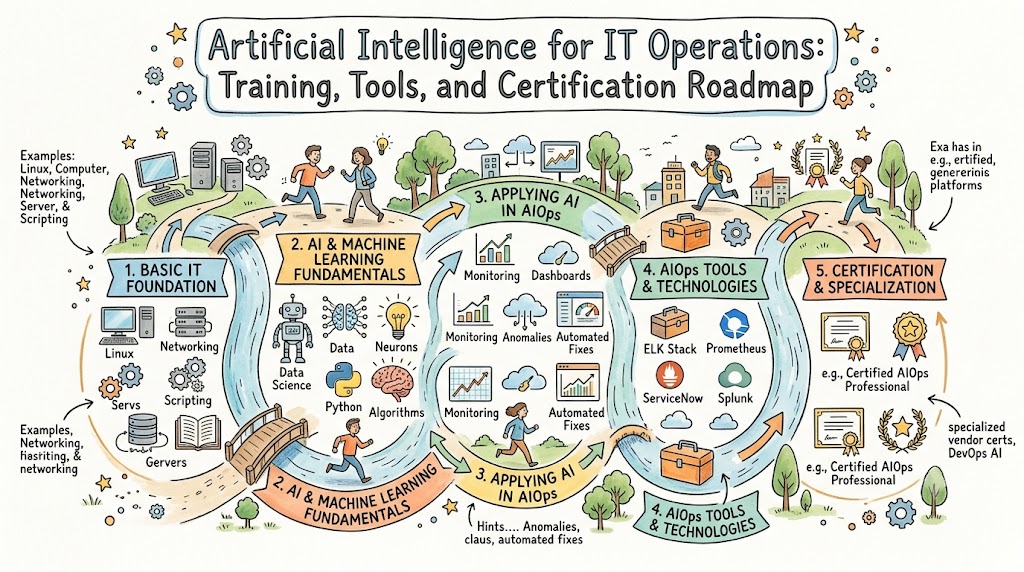
AIOps Training Roadmap (Step-by-Step)
A structured learning path is essential for mastering AIOps effectively.
Step 1: IT Operations Fundamentals
Before learning AIOps, you must understand core IT concepts:
- Operating systems (Linux/Windows)
- Networking fundamentals
- Cloud computing basics
- Virtualization and containers
Step 2: Observability Concepts
Observability is the backbone of AIOps.
Focus areas include:
- Logs
- Metrics
- Traces
- Monitoring systems
- Dashboards
Step 3: DevOps and Automation Basics
AIOps integrates deeply with DevOps workflows.
Key skills:
- CI/CD pipelines
- Infrastructure as Code
- Automation scripting (Python, Bash)
- Configuration management
Step 4: Data and AI Fundamentals
You don’t need to be a data scientist, but you must understand:
- Machine learning basics
- Data preprocessing
- Anomaly detection concepts
- Time-series analysis
Step 5: AIOps Tools and Platforms
Hands-on exposure is critical. Learn how tools:
- Aggregate logs and metrics
- Correlate incidents
- Provide predictive alerts
- Automate remediation
Step 6: Real-World Projects
Practical experience may include:
- Building an alert correlation system
- Setting up anomaly detection pipelines
- Creating automated incident response workflows
- Simulating production incident scenarios
Skills Required for AIOps Professionals
AIOps professionals typically combine multiple skill sets:
Technical Skills
- Cloud platforms (AWS, Azure, GCP)
- Observability tools
- Scripting and automation
- Data analysis
Analytical Skills
- Pattern recognition
- Root cause analysis thinking
- Incident prioritization
AI/ML Awareness
- Basic model understanding
- Data-driven decision making
- Predictive analytics concepts
DevOps Alignment
- CI/CD pipelines
- Infrastructure automation
- Container orchestration
AIOps Tools Ecosystem
AIOps tools fall into several categories based on their function.
1. Monitoring and Observability Tools
These tools collect system data and provide visibility into infrastructure and applications.
2. Event Management Tools
They aggregate and manage alerts from multiple systems.
3. AI-Based Analytics Platforms
These platforms apply machine learning for:
- Anomaly detection
- Pattern recognition
- Predictive insights
4. Automation Tools
Used for:
- Incident response
- Self-healing systems
- Workflow automation
5. Integrated AIOps Platforms
End-to-end platforms that combine monitoring, AI, and automation in one system.
AIOps Certification Roadmap
Certification helps validate skills and improve career opportunities in IT operations and DevOps roles.
Beginner Level
Focus areas:
- IT operations basics
- Monitoring fundamentals
- Introduction to AIOps concepts
Intermediate Level
Focus areas:
- AIOps architecture
- Tool-based learning
- Event correlation and anomaly detection
Advanced Level
Focus areas:
- AI-driven automation
- Predictive operations
- Enterprise-scale AIOps implementation
Training platforms like AIOpsSchool.com help learners build structured knowledge from fundamentals to advanced enterprise applications.
Career Opportunities in AIOps
AIOps skills open doors to several high-demand roles:
1. AIOps Engineer
Responsible for building intelligent monitoring and automation systems.
2. Site Reliability Engineer (SRE)
Focuses on system reliability and automated incident response.
3. DevOps Engineer
Integrates AIOps into CI/CD pipelines and infrastructure automation.
4. Cloud Operations Engineer
Manages cloud infrastructure using AI-driven insights.
5. IT Operations Analyst
Analyzes system performance and improves operational efficiency.
Real-World AIOps Use Cases
AIOps is widely used across industries:
Incident Management
Automatically detects and prioritizes critical incidents.
Root Cause Analysis
Identifies the origin of system failures faster than manual methods.
Performance Optimization
Improves application and infrastructure performance using predictive analytics.
Security Monitoring
Detects unusual patterns and potential security threats.
Cloud Cost Optimization
Analyzes resource usage and recommends optimization strategies.
Implementation Roadmap for Organizations
Adopting AIOps requires a structured approach:
Phase 1: Assessment
- Evaluate current IT operations maturity
- Identify monitoring gaps
- Define business goals
Phase 2: Tool Selection
- Choose monitoring and AIOps platforms
- Ensure integration compatibility
Phase 3: Data Integration
- Centralize logs and metrics
- Build unified data pipelines
Phase 4: AI Model Deployment
- Implement anomaly detection
- Enable event correlation
Phase 5: Automation Enablement
- Define remediation workflows
- Implement self-healing mechanisms
Phase 6: Continuous Optimization
- Improve models over time
- Reduce false positives
- Enhance prediction accuracy
Common Challenges in AIOps Adoption
Despite its benefits, AIOps implementation comes with challenges:
- Poor data quality and inconsistency
- Integration complexity across legacy systems
- Lack of skilled professionals
- High initial setup complexity
- Resistance to automation adoption
Overcoming these challenges requires strong planning and gradual implementation.
Future of AIOps
AIOps is rapidly evolving toward:
- Fully autonomous IT operations
- AI-driven self-healing systems
- Predictive infrastructure scaling
- Zero-downtime architectures
- Deep integration with DevSecOps
The future IT landscape will be heavily driven by intelligent automation.
Conclusion
Artificial Intelligence for IT Operations is fundamentally reshaping how modern IT systems are managed. By combining machine learning, automation, and observability, AIOps enables organizations to move from reactive troubleshooting to proactive and predictive operations. A structured learning path that includes IT fundamentals, observability, DevOps, AI concepts, and hands-on tools is essential for success. Certifications and guided training platforms like AIOpsSchool.com help professionals accelerate their career growth in this rapidly expanding field.

