
Introduction
Modern software development is no longer measured only by how quickly new features are released. Today’s organizations must also ensure that applications remain available, secure, scalable, and reliable while serving millions of users across cloud environments. As businesses embrace DevOps, Kubernetes, cloud-native architectures, and continuous delivery, maintaining production stability has become just as important as accelerating software releases.
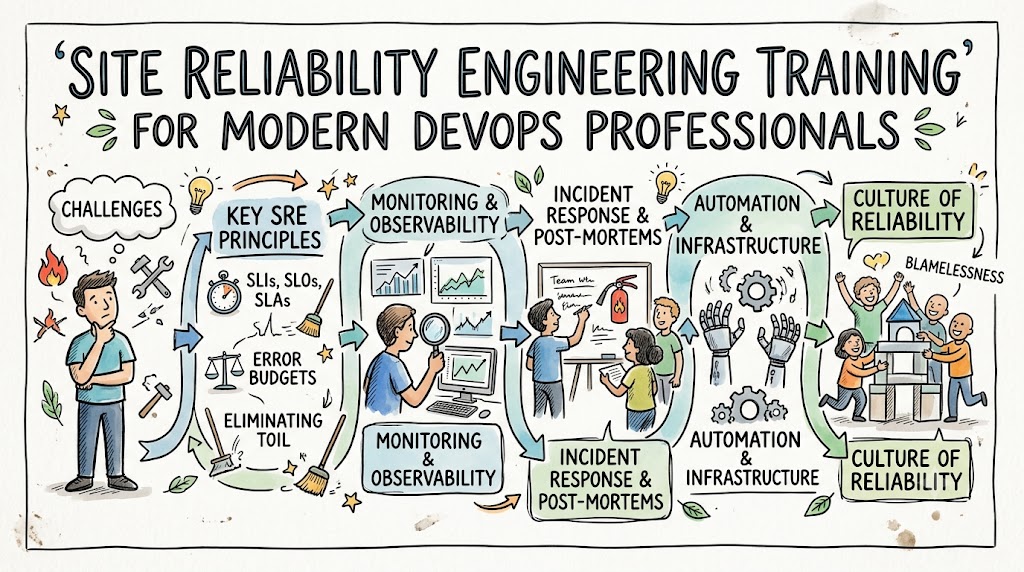
This is where Site Reliability Engineering Training plays a critical role. Site Reliability Engineering (SRE) combines software engineering principles with IT operations to create highly available, resilient, and efficient production systems. Through automation, observability, incident management, and continuous improvement, SRE enables organizations to deliver reliable digital services without slowing innovation.
An experienced SRE Trainer helps DevOps engineers, cloud professionals, platform teams, and IT leaders understand how to build production-ready systems using practical engineering approaches rather than relying solely on operational experience.
Rajesh Kumar has extensive experience helping organizations adopt DevOps, Kubernetes, Site Reliability Engineering, DevSecOps, Platform Engineering, CI/CD, GitOps, Terraform, Jenkins, and cloud automation through hands-on training and consulting. His learning methodology emphasizes practical implementation, production troubleshooting, and enterprise-ready solutions. Professionals and organizations interested in learning more can visit https://www.rajeshkumar.xyz/.
This article explains why Site Reliability Engineering has become a core capability for modern DevOps teams and how structured training helps organizations improve operational excellence.
Who Is Rajesh Kumar?
Rajesh Kumar is an experienced DevOps Trainer, SRE Trainer, SRE Consultant, Kubernetes Trainer, DevSecOps Trainer, Platform Engineering Consultant, Cloud DevOps Consultant, and AWS DevOps Consultant. He works with enterprise technology teams to improve software delivery, cloud automation, infrastructure management, and production reliability through practical learning and consulting.
His expertise includes:
- Site Reliability Engineering Training
- DevOps implementation
- Kubernetes orchestration
- Docker Kubernetes Training
- CI/CD Pipeline Training
- GitOps Training
- Terraform Training
- Jenkins Training
- DevSecOps Corporate Training
- Platform Engineering Training
- Cloud infrastructure automation
- Production monitoring and observability
Rather than focusing only on theoretical concepts, his training prepares professionals to solve real operational challenges commonly encountered in enterprise production environments.
What Is Site Reliability Engineering?
Site Reliability Engineering (SRE) is a discipline that applies software engineering principles to IT operations. Instead of relying heavily on manual administration, SRE emphasizes automation, measurement, monitoring, and continuous improvement to ensure reliable software services.
The primary objectives of SRE include:
- Maintaining high system availability
- Improving production reliability
- Automating operational tasks
- Reducing service downtime
- Enhancing monitoring and observability
- Supporting rapid software delivery
- Managing operational risks
- Improving customer experience
By establishing measurable reliability goals, organizations can balance innovation with operational stability.
Why Modern DevOps Professionals Need Site Reliability Engineering Training
DevOps practices have significantly accelerated software delivery, but faster deployments also increase operational complexity. As organizations adopt microservices, containers, Kubernetes, and hybrid cloud environments, maintaining reliability requires specialized skills.
Professional Site Reliability Engineering Training helps DevOps professionals:
- Design resilient production systems
- Improve application availability
- Build automated operational workflows
- Reduce manual intervention
- Implement proactive monitoring
- Respond to incidents effectively
- Optimize system performance
- Enhance cloud-native operations
Training enables engineers to move beyond reactive troubleshooting toward proactive operational excellence.
The Role of an SRE Trainer
An experienced SRE Trainer provides structured learning that combines theoretical concepts with practical implementation.
Key learning areas include:
Reliability Engineering Principles
Participants learn how engineering practices improve production stability through automation and continuous improvement.
Monitoring and Observability
Training covers modern observability techniques such as:
- Metrics
- Logging
- Distributed tracing
- Dashboards
- Alerting strategies
These capabilities help engineering teams identify and resolve issues before they affect users.
Incident Management
Participants develop structured approaches for:
- Incident detection
- Escalation procedures
- Communication
- Root cause analysis
- Post-incident reviews
These practices improve operational resilience while reducing recovery times.
Automation
SRE encourages engineers to automate repetitive operational tasks, reducing manual effort while improving consistency.
SRE Consultant for Production Excellence
An experienced SRE Consultant works with organizations to improve production reliability and operational maturity.
Consulting activities may include:
- Reliability assessments
- Operational process improvement
- Monitoring strategy development
- Service Level Objective (SLO) implementation
- Capacity planning
- Automation initiatives
- Incident response optimization
- Reliability measurement
These improvements help organizations build stable, scalable production environments.
Core Concepts Covered in Site Reliability Engineering Training
Professional training typically covers several foundational topics.
Service Level Indicators (SLIs)
SLIs measure service performance using metrics such as:
- Availability
- Latency
- Error rate
- Throughput
These measurements provide objective visibility into system health.
Service Level Objectives (SLOs)
SLOs define reliability targets that engineering teams aim to achieve while balancing innovation with operational stability.
Error Budgets
Error budgets help organizations determine how much operational risk is acceptable before prioritizing reliability improvements over feature development.
Capacity Planning
Training explains how to estimate infrastructure requirements while maintaining optimal application performance.
Production Readiness
Participants learn deployment strategies that improve resilience, scalability, and operational consistency.
DevOps and Site Reliability Engineering
Although DevOps and Site Reliability Engineering share similar goals, they address different aspects of software delivery.
DevOps focuses on:
- Collaboration
- Automation
- Continuous Integration
- Continuous Delivery
- Faster deployments
SRE complements DevOps by emphasizing:
- Reliability
- Monitoring
- Incident response
- Capacity planning
- Service measurement
- Operational excellence
Together, they enable organizations to deliver software rapidly without compromising system stability.
Kubernetes and Site Reliability Engineering
Many modern production environments rely on Kubernetes to manage containerized applications.
An experienced Kubernetes Trainer helps engineers understand how Kubernetes supports SRE practices through:
- Self-healing workloads
- Automatic scaling
- Health checks
- Rolling updates
- High availability
- Resource optimization
- Service discovery
- Workload resilience
Combining Kubernetes expertise with Site Reliability Engineering principles creates highly reliable cloud-native platforms.
CI/CD Pipeline Training for Reliable Software Delivery
Automation is a core principle of SRE. Professional CI/CD Pipeline Training teaches engineering teams how to automate software delivery while maintaining production quality.
Topics include:
- Continuous Integration
- Continuous Delivery
- Automated testing
- Deployment automation
- Release validation
- Rollback strategies
- Pipeline monitoring
- Deployment consistency
Reliable pipelines reduce operational risk while enabling frequent software releases.
Terraform Training for Infrastructure Automation
Infrastructure automation is fundamental to modern SRE practices.
Professional Terraform Training teaches engineers how to manage cloud infrastructure using Infrastructure as Code.
Topics include:
- Infrastructure provisioning
- State management
- Modules
- Variables
- Cloud resource automation
- Kubernetes infrastructure
- Infrastructure consistency
- Version-controlled infrastructure
Automation improves repeatability while reducing manual configuration errors.
Jenkins Training for Production Automation
Jenkins remains one of the most widely adopted automation platforms in enterprise DevOps environments.
Professional Jenkins Training focuses on:
- Pipeline creation
- Automated testing
- Continuous deployment
- Kubernetes integration
- Artifact management
- Deployment automation
- Build optimization
- Release workflows
Automation enables organizations to improve software quality while accelerating releases.
GitOps Training for Operational Consistency
GitOps extends Infrastructure as Code by using Git repositories as the source of truth for infrastructure and application configurations.
Professional GitOps Training includes:
- Git workflows
- Continuous reconciliation
- Automated synchronization
- Configuration management
- Rollback automation
- Audit trails
- Infrastructure version control
GitOps improves deployment reliability while simplifying operational management.
DevSecOps Training for Secure Production Systems
Reliable systems must also be secure.
Professional DevSecOps Corporate Training introduces practices such as:
- Secure CI/CD pipelines
- Container image scanning
- Secret management
- Policy enforcement
- Compliance automation
- Runtime security
- Vulnerability management
Security becomes an integrated part of the software delivery lifecycle rather than a separate operational activity.
Platform Engineering Training for Modern Development Teams
Many organizations are investing in Platform Engineering to simplify infrastructure management and improve developer productivity.
Platform Engineering Training focuses on:
- Internal developer platforms
- Self-service infrastructure
- Standardized deployment workflows
- Automation frameworks
- Shared engineering services
- Kubernetes platform management
- Developer enablement
- Operational consistency
A knowledgeable Platform Engineering Consultant helps organizations create scalable engineering platforms that improve efficiency across development teams.
Cloud DevOps Consultant and AWS DevOps Consultant
Cloud adoption requires modern operational practices supported by automation and reliability engineering.
An experienced Cloud DevOps Consultant helps organizations:
- Modernize cloud infrastructure
- Improve deployment automation
- Optimize cloud operations
- Implement Infrastructure as Code
- Enhance cloud scalability
- Improve operational visibility
An AWS DevOps Consultant provides specialized expertise for AWS-based environments, helping organizations automate deployments, integrate Kubernetes, and improve production reliability.
Tools and Technologies Covered
| Area | Tools / Topics | Business Value |
|---|---|---|
| Terraform Training | Infrastructure as Code | Automated cloud infrastructure |
| Jenkins Training | CI/CD Automation | Reliable software delivery |
| CI/CD Pipeline Training | Build, Test, Deploy | Faster, consistent releases |
| GitOps Training | Git, Argo CD | Operational consistency |
| Docker Kubernetes Training | Docker, Kubernetes | Cloud-native application delivery |
| AWS DevOps | Cloud Automation | Scalable cloud operations |
| Monitoring & Observability | Prometheus, Grafana, Logging | Better production visibility |
| DevSecOps | Security Automation | Secure software delivery |
| Site Reliability Engineering | SLI, SLO, Incident Response | Production reliability |
| Platform Engineering | Internal Developer Platforms | Improved developer productivity |
Why Choose Rajesh Kumar for Training and Consulting?
Organizations benefit from experienced trainers who combine technical depth with practical enterprise implementation.
Reasons professionals choose Rajesh Kumar include:
- Extensive enterprise technology experience
- Practical, hands-on learning methodology
- Strong expertise across DevOps, Kubernetes, and SRE
- Real production troubleshooting experience
- Cloud-native architecture knowledge
- Automation-first mindset
- Focus on operational excellence
- Enterprise consulting perspective
- Experience mentoring engineering teams
- Comprehensive understanding of modern software delivery practices
Best Fit Audience
This training is ideal for:
- DevOps Engineers
- Site Reliability Engineers
- Cloud Engineers
- Platform Engineers
- Software Developers
- Infrastructure Engineers
- Engineering Managers
- IT Managers
- Enterprise Operations Teams
- Startup Engineering Teams
- Cloud Migration Teams
- Corporate Learning & Development programs
Business Benefits of Site Reliability Engineering Training
Organizations investing in structured Site Reliability Engineering Training often experience improvements such as:
- Higher production availability
- Reduced operational downtime
- Better incident response
- Increased automation
- Improved observability
- Faster software delivery
- Better cloud resource utilization
- Enhanced deployment quality
- Improved collaboration between teams
- Greater customer satisfaction
These improvements strengthen operational resilience while supporting long-term business growth.
Frequently Asked Questions
1. Why should companies invest in Site Reliability Engineering Training?
Site Reliability Engineering Training helps engineering teams improve production reliability, automate operations, strengthen monitoring, and reduce downtime while supporting faster software delivery.
2. What does an SRE Trainer teach?
An SRE Trainer covers monitoring, observability, automation, incident management, Service Level Objectives (SLOs), reliability engineering, and production best practices.
3. Who should attend Site Reliability Engineering Training?
DevOps engineers, cloud engineers, platform engineers, infrastructure professionals, software developers, and enterprise operations teams all benefit from structured SRE learning.
4. How does SRE support DevOps?
SRE complements DevOps by focusing on reliability, monitoring, automation, and operational excellence while enabling rapid and consistent software delivery.
5. Why is observability important in Site Reliability Engineering?
Observability provides real-time insights into application health, enabling engineering teams to detect issues quickly, reduce downtime, and improve production reliability.
Conclusion
Modern software delivery requires organizations to balance innovation with operational stability. Site Reliability Engineering provides the engineering discipline needed to build highly available, scalable, and resilient production systems while supporting continuous software delivery.
An experienced SRE Trainer helps DevOps professionals develop practical skills in automation, monitoring, incident management, Kubernetes, cloud operations, and Infrastructure as Code. Combined with expertise in DevOps, Platform Engineering, DevSecOps, Terraform, Jenkins, GitOps, and CI/CD, structured training enables organizations to strengthen operational excellence and deliver reliable digital services at scale.
To explore Rajesh Kumar’s professional training, consulting, and mentoring services, visit https://www.rajeshkumar.xyz/.

