
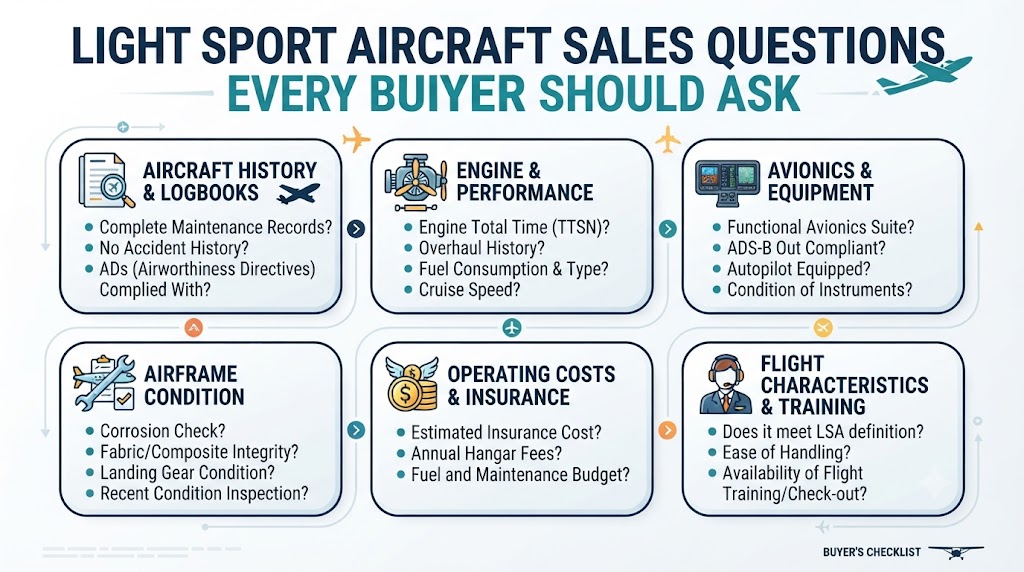
Buying a light sport aircraft can be an exciting step for a pilot who wants more flexibility and personal control over flying. However, choosing an aircraft should involve much more than comparing photographs, features, or asking prices.
A smart buyer should investigate the aircraft’s history, maintenance records, engine, equipment, documentation, operating costs, and overall condition. Asking the right questions before purchasing can help uncover important information and make the buying process more organized.
Why Should You Ask Questions Before Buying a Light Sport Aircraft?
A light sport aircraft can represent a significant investment, so buyers should understand exactly what they are considering.
Before committing to a purchase, it is useful to evaluate:
- Aircraft history
- Ownership records
- Airframe condition
- Engine condition
- Propeller condition
- Maintenance history
- Inspection records
- Avionics and equipment
- Modifications
- Operating expenses
- Documentation
- Intended use
A careful evaluation can help buyers distinguish between an aircraft that simply looks attractive and one that fits their actual needs.
1. What Is the Aircraft’s Complete History?
One of the first questions to ask is about the aircraft’s history.
Try to understand how the aircraft has been used and maintained throughout its ownership.
Ask about:
- Previous owners
- Length of ownership
- Flight usage
- Major repairs
- Significant maintenance
- Modifications
- Known incidents or accidents
- Storage history where relevant
A detailed history gives buyers useful context about the aircraft’s current condition.
2. Are Complete Maintenance Records Available?
Maintenance records are among the most valuable documents when evaluating a used aircraft.
Ask the seller whether records are available for:
- Routine maintenance
- Inspections
- Repairs
- Engine work
- Propeller work
- Component replacement
- Avionics installation
- Modifications
Reviewing records can help establish how consistently the aircraft has been maintained.
If important records are missing, ask the seller to explain why and consider obtaining professional advice before proceeding.
3. What Is the Current Condition of the Airframe?
A clean exterior does not necessarily tell you everything about an aircraft’s condition.
Ask questions about the airframe and have the aircraft appropriately inspected.
Areas that may warrant attention include:
- Fuselage
- Wings
- Control surfaces
- Landing gear
- Structural components
- Fasteners
- Corrosion
- Signs of previous repairs
A qualified aviation professional can help identify conditions that may not be obvious to an inexperienced buyer.
4. What Is the Engine’s History?
The engine deserves careful attention because it is one of the most important components of the aircraft.
Ask the seller about:
- Engine model
- Operating history
- Maintenance history
- Major repairs
- Overhaul information where applicable
- Recent inspections
- Known issues
- Oil or other relevant maintenance records
Do not rely solely on the seller’s verbal description. Where possible, compare the information with available maintenance documentation.
5. What Is the Propeller Condition?
The propeller is another component that should be evaluated carefully.
Ask about:
- Propeller model
- Maintenance history
- Previous repairs
- Damage history
- Inspection records
- Current condition
The appropriate inspection requirements depend on the specific aircraft and propeller, so buyers should rely on applicable manufacturer and maintenance information.
6. Has the Aircraft Been Independently Inspected?
One of the most useful questions a buyer can ask is whether an independent professional can inspect the aircraft before purchase.
A seller’s description can provide useful information, but an independent evaluation offers another perspective.
A pre-purchase inspection may help identify:
- Maintenance concerns
- Structural issues
- Component wear
- Documentation inconsistencies
- Equipment problems
- Areas requiring further investigation
The inspection should be performed by an appropriately qualified aviation professional familiar with the aircraft or its relevant systems.
7. What Inspection History Is Available?
Ask to review the aircraft’s applicable inspection history.
Depending on the aircraft and operating category, relevant records may include inspections, maintenance entries, and other required documentation.
Important questions include:
- When was the aircraft last inspected?
- What work was performed?
- Were any issues identified?
- Were those issues addressed?
- Are inspection records available?
Do not assume that an aircraft is properly maintained simply because it has been regularly flown.
8. What Avionics Are Installed?
Modern avionics can significantly influence how an aircraft is used and operated.
Ask about installed equipment such as:
- Flight instruments
- Communication radios
- Navigation equipment
- GPS systems
- Transponder
- ADS-B equipment where applicable
- Electronic flight displays
- Other installed avionics
Also ask whether the equipment is included in the sale and whether documentation for installations and modifications is available.
9. Are the Avionics and Modifications Properly Documented?
Upgraded avionics or other modifications can add value, but buyers should understand exactly what has been changed.
Ask for information about:
- Installation records
- Applicable documentation
- Modification details
- Maintenance records
- Equipment manuals
- Relevant approvals or supporting documents where applicable
A modification should not be evaluated solely because it appears attractive or modern.
Proper documentation is an important part of understanding the aircraft’s history.
10. What Is Included in the Sale?
Before agreeing to purchase, establish exactly what is included.
The aircraft sale may or may not include items such as:
- Avionics
- Headsets
- Covers
- Tie-down equipment
- Tools
- Spare parts
- Manuals
- Logbooks
- Additional equipment
Ask for a clear description of the included items so there is no confusion during the final transaction.
11. What Are the Aircraft’s Operating Costs?
The purchase price is only one part of aircraft ownership.
Buyers should consider ongoing expenses such as:
- Fuel
- Maintenance
- Inspections
- Storage
- Insurance
- Replacement parts
- Repairs
- Avionics maintenance
Actual costs can vary considerably based on the aircraft, usage, location, condition, and ownership arrangements.
Instead of relying on general estimates, buyers should develop a realistic ownership budget based on the specific aircraft they are considering.
12. Is the Aircraft Suitable for My Intended Use?
Not every aircraft is suitable for every mission.
Before buying, clearly define how you intend to use the aircraft.
Your requirements might involve:
- Recreational flying
- Local flights
- Flight training
- Touring
- Personal transportation
- Short trips
- Passenger flying
Then compare those requirements with the aircraft’s documented capabilities and limitations.
The best aircraft is not necessarily the one with the most equipment. It is the one that appropriately matches your intended use.
13. What Are the Aircraft’s Performance Characteristics?
Buyers should review aircraft-specific performance information rather than relying on general assumptions about light sport aircraft.
Depending on the aircraft, relevant information may include:
- Useful load
- Fuel capacity
- Range
- Cruise characteristics
- Takeoff and landing considerations
- Operating limitations
Always use manufacturer-provided information for the specific aircraft model and configuration.
Performance can vary based on factors such as weight, weather, configuration, and operating conditions.
14. Has the Aircraft Been Modified?
Ask whether the aircraft has undergone any significant modifications.
These may include changes involving:
- Engine
- Propeller
- Avionics
- Electrical systems
- Interior
- Paint
- Structural components
- Other aircraft systems
For each important modification, ask:
- Who performed the work?
- When was it completed?
- Why was it performed?
- Is documentation available?
- Does the current configuration match the relevant aircraft documentation?
Properly understanding modifications can help buyers evaluate the aircraft more accurately.
15. Why Is the Aircraft Being Sold?
It is reasonable to ask the seller why they have decided to sell the aircraft.
The answer may provide useful context about:
- Ownership changes
- Usage patterns
- Maintenance
- Personal circumstances
- Aircraft suitability
However, a particular reason for selling does not automatically indicate either a good or bad aircraft.
Use the answer as one piece of information within a broader evaluation.
16. How Has the Aircraft Been Stored?
Storage conditions can influence an aircraft’s condition.
Ask whether the aircraft has generally been:
- Hangared
- Stored outdoors
- Regularly flown
- Infrequently operated
- Stored for extended periods
If the aircraft has spent significant time unused or outdoors, discuss whether additional inspection or maintenance considerations may apply.
17. Are There Any Known Issues?
Ask the seller directly whether there are known mechanical, electrical, structural, or equipment-related issues.
Questions could include:
- Are there any current problems?
- Are there recurring maintenance concerns?
- Are there components that need attention?
- Are there known limitations?
- Is any work currently pending?
A straightforward conversation about known issues can help buyers decide what additional information or inspection may be necessary.
18. What Documentation Should I Review?
Before purchasing, organize and review the available aircraft documentation.
Depending on the aircraft, relevant records may include:
- Aircraft records
- Maintenance logs
- Inspection records
- Engine records
- Propeller records
- Avionics documentation
- Modification records
- Manuals
- Registration documents
- Other applicable paperwork
Documentation should be consistent with the aircraft’s current configuration as far as applicable.
Light Sport Aircraft Buying Checklist
Before completing a purchase, review the following:
- Confirm the aircraft’s history.
- Review ownership information.
- Examine maintenance records.
- Review inspection history.
- Evaluate airframe condition.
- Review engine history.
- Check propeller information.
- Review avionics and installed equipment.
- Investigate modifications.
- Confirm available documentation.
- Consider operating costs.
- Define your intended use.
- Review aircraft-specific performance information.
- Ask about known issues.
- Arrange an appropriate pre-purchase inspection.
- Confirm what is included in the sale.
- Review the purchase agreement carefully.
Common Light Sport Aircraft Buying Mistakes
Buying Based Only on Appearance
A polished exterior can make an aircraft attractive, but appearance does not provide a complete picture of its mechanical or structural condition.
Focusing Only on the Asking Price
The purchase price should be considered alongside maintenance, storage, insurance, fuel, inspections, and other ownership expenses.
Skipping an Independent Inspection
Relying entirely on a seller’s description can leave important questions unanswered.
Ignoring Maintenance Records
Records provide valuable information about the aircraft’s history and maintenance.
Overlooking Modifications
Buyers should understand what has been changed and whether supporting documentation exists.
Failing to Consider Intended Use
An aircraft that is excellent for one type of flying may not be appropriate for another.
Forgetting Future Ownership Costs
The financial commitment does not end when the purchase is completed.
Rushing the Decision
Aircraft purchases deserve careful evaluation. If important questions remain unanswered, take the time to investigate them before proceeding.
How to Evaluate a Light Sport Aircraft Before Buying
A structured evaluation can make the process easier.
Step 1: Define Your Requirements
Determine what you want to do with the aircraft and what features are genuinely important.
Step 2: Review the Aircraft History
Understand its ownership, usage, maintenance, and modification history.
Step 3: Examine the Records
Look for complete and consistent documentation.
Step 4: Evaluate the Aircraft
Inspect the airframe, engine, propeller, avionics, and other relevant systems.
Step 5: Arrange Professional Inspection
Use an appropriately qualified aviation professional for a pre-purchase evaluation.
Step 6: Calculate Ownership Costs
Consider the expected costs beyond the initial purchase.
Step 7: Review the Complete Transaction
Confirm what is included, understand the terms, and make sure important questions have been answered before completing the purchase.
Questions to Ask the Seller
Before moving forward, consider asking:
- How long have you owned the aircraft?
- Why are you selling it?
- How has the aircraft been used?
- Are complete maintenance records available?
- What recent maintenance has been performed?
- Have there been significant repairs?
- Has the aircraft been involved in any known accidents or incidents?
- What engine is installed?
- What is the engine’s maintenance history?
- What avionics are installed?
- Have any significant modifications been made?
- Are there any known current issues?
- How has the aircraft been stored?
- What equipment is included?
- Can I arrange an independent pre-purchase inspection?
These questions can provide a useful starting point for a deeper evaluation.
Frequently Asked Questions
Q1. What should I ask before buying a light sport aircraft?
Ask about the aircraft’s history, maintenance records, engine, propeller, avionics, modifications, inspection history, documentation, operating costs, and current condition.
Q2. Why are maintenance records important?
Maintenance records help buyers understand how the aircraft has been maintained and what work has been performed throughout its history.
Q3. Should I get a pre-purchase inspection?
An independent pre-purchase inspection can provide valuable information about the aircraft’s condition and help identify issues that may not be obvious to a prospective buyer.
Q4. What should I check on the engine?
Review the engine’s model, operating history, maintenance records, major repairs, applicable inspection information, and any known concerns.
Q5. How can I evaluate aircraft ownership costs?
Consider fuel, maintenance, inspections, storage, insurance, replacement parts, and potential repairs. Actual expenses depend on the specific aircraft and how it is operated.
Q6. What documents should I review before purchasing?
Review the aircraft’s available maintenance, inspection, engine, propeller, avionics, modification, registration, and other applicable records.
Q7. How do I know whether an aircraft is suitable for my needs?
Start with your intended mission and compare it with the aircraft’s documented capabilities, configuration, limitations, passenger requirements, and operating characteristics.
Conclusion
Buying a light sport aircraft requires careful research rather than a quick decision based on appearance or asking price. Buyers should investigate the aircraft’s history, maintenance records, engine, propeller, avionics, modifications, documentation, and overall condition.
A professional pre-purchase inspection can provide another important layer of evaluation, while a realistic ownership budget helps buyers understand the financial commitment beyond the purchase itself.
Most importantly, ask questions, verify the available information, and make sure the aircraft matches your intended use. A thorough buying process can help you approach aircraft ownership with greater confidence and a clearer understanding of what you are purchasing.

