
Introduction
Sport pilot training is one of the most accessible and exciting ways to enter aviation. It allows beginners to learn flying in a structured, practical, and relatively simplified environment compared to traditional pilot training paths. However, many students underestimate the learning curve involved in aviation. Even small mistakes during training can slow progress, increase costs, and impact overall safety awareness.
Most beginners struggle not because flying is too difficult, but because they miss important fundamentals like ground school preparation, communication discipline, and consistent practice. Recognizing these common mistakes early helps students build stronger habits, improve performance, and become safer, more confident pilots.
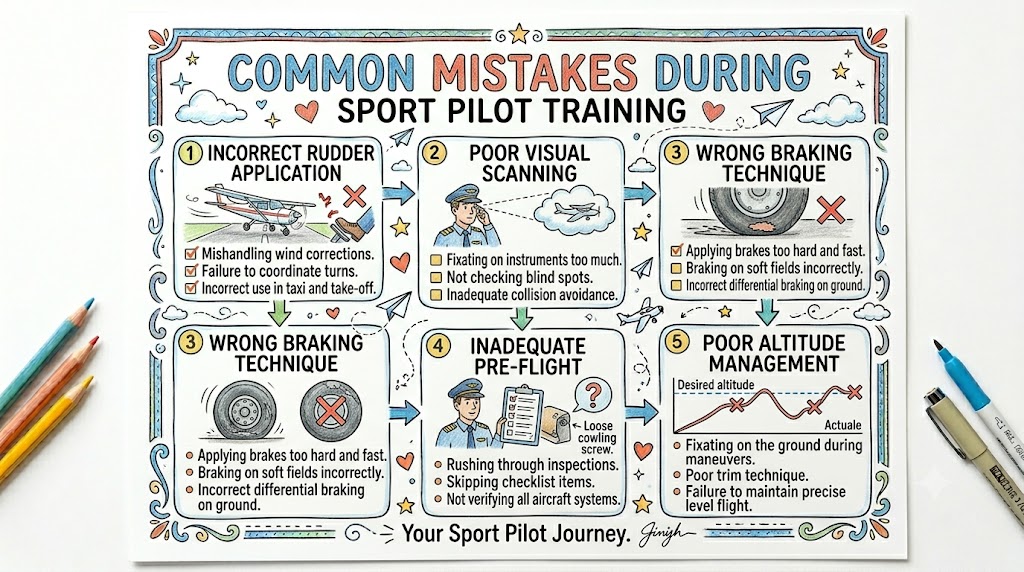
This guide highlights the most common mistakes during sport pilot training and how to avoid them effectively.
Real-world Use Cases
A beginner struggling with first solo flight readiness often lacks confidence due to inconsistent practice and weak fundamentals.
A student missing ground school basics finds it difficult to understand navigation and weather concepts during flight lessons.
A trainee making radio communication mistakes struggles to interact properly with air traffic control.
A learner ignoring weather conditions before flying risks unsafe flight decisions and delays.
A student skipping logbook entries loses track of training progress and certification requirements.
A pilot rushing through maneuvers makes repeated errors that delay skill development.
A student failing FAA knowledge preparation struggles with theory exams and delays certification progress.
Evaluation Criteria for Safe Sport Pilot Training Progress
Students should evaluate their training readiness based on:
- Ground school completion and understanding
- Flight training consistency
- Communication skills with instructors and ATC
- Weather awareness and decision-making
- Logbook accuracy and tracking discipline
- Aircraft handling fundamentals
- Situational awareness development
- Safety mindset and discipline
- Solo flight readiness indicators
- FAA knowledge exam preparation
- Instructor feedback consistency
- Pre-flight inspection knowledge
These criteria help ensure structured and safe learning progression.
Skipping Ground School Preparation
Many students focus only on flying and ignore theory.
For example, a student who skips weather lessons may misjudge flight conditions.
Best practice: Study ground school alongside flight lessons for balanced learning.
Inconsistent Flight Training Schedule
Irregular training slows skill development.
For example, long gaps between lessons cause students to forget basic maneuvers.
Best practice: Maintain a consistent weekly flying schedule.
Poor Radio Communication with ATC
Clear communication is essential for flight safety.
For example, incorrect radio calls can cause confusion in controlled airspace.
Best practice: Practice standard aviation phraseology regularly.
Ignoring Weather Conditions
Weather awareness is critical for safe flying.
For example, flying into unexpected turbulence can increase risk.
Best practice: Always check weather briefings before each flight.
Weak Pre-flight Inspection Habits
Skipping inspections can lead to missed safety issues.
For example, unnoticed fuel issues can affect engine performance.
Best practice: Follow a structured pre-flight checklist every time.
Not Maintaining a Proper Logbook
Logbooks track training progress and certification eligibility.
For example, missing entries can delay solo flight approval.
Best practice: Update logbook after every flight.
Over-Reliance on Instructor
Dependence on instructors slows independence.
For example, students may hesitate during solo readiness checks.
Best practice: Practice decision-making independently during training.
Poor Aircraft Handling Fundamentals
Weak basics lead to unstable flying skills.
For example, incorrect control inputs can affect landing accuracy.
Best practice: Focus on smooth and controlled maneuvers.
Ignoring Weight and Balance Calculations
Incorrect weight distribution affects flight stability.
For example, overloaded aircraft may have poor takeoff performance.
Best practice: Always calculate weight and balance before flight.
Inadequate Airspace Knowledge
Understanding airspace rules is essential.
For example, entering restricted zones without clearance is unsafe.
Best practice: Study airspace maps and regulations thoroughly.
Rushing Through Flight Maneuvers
Speeding through training leads to poor skill retention.
For example, rushed landings often result in unstable approaches.
Best practice: Focus on accuracy over speed.
Not Asking Enough Questions
Silence slows learning progress.
For example, unclear doubts can lead to repeated mistakes.
Best practice: Ask instructors questions after every lesson.
Poor Cockpit Focus
Distraction in the cockpit reduces safety.
For example, missing instrument readings can affect flight control.
Best practice: Maintain full attention during procedures.
Lack of Situational Awareness
Pilots must always understand their environment.
For example, failing to track nearby aircraft increases risk.
Best practice: Continuously scan instruments and surroundings.
Ignoring FAA Safety Guidelines
Rules exist to ensure safe aviation practices.
For example, skipping safety procedures can lead to compliance issues.
Best practice: Follow FAA training guidelines strictly.
Poor Instructor Communication
Miscommunication delays learning progress.
For example, unclear feedback leads to repeated errors.
Best practice: Communicate clearly and confirm instructions.
Underestimating Simulator Training
Simulators improve real-flight performance.
For example, practicing landings in simulation builds confidence.
Best practice: Use simulator training regularly.
Not Reviewing Flight Mistakes
Failing to learn from errors slows progress.
For example, repeating the same landing mistake delays improvement.
Best practice: Review every lesson with your instructor.
Disciplined Student vs Undisciplined Student
| Factor | Disciplined Student | Undisciplined Student |
|---|---|---|
| Progress Speed | Fast | Slow |
| Safety Awareness | High | Low |
| Confidence | Strong | Weak |
| Error Rate | Low | High |
Ground School vs No Preparation
| Factor | With Ground School | Without Ground School |
| Knowledge | Strong | Weak |
| Flight Understanding | Clear | Confusing |
| Exam Performance | High | Low |
Consistent vs Irregular Training
| Factor | Consistent Training | Irregular Training |
| Skill Retention | High | Low |
| Confidence | Strong | Weak |
| Progress Speed | Fast | Slow |
Good vs Poor ATC Communication
| Factor | Good Communication | Poor Communication |
| Safety | High | Risky |
| Clarity | Clear | Confusing |
| Efficiency | High | Low |
Safe vs Rushed Decisions
| Factor | Safe Decision Making | Rushed Decisions |
| Risk Level | Low | High |
| Accuracy | High | Low |
| Training Outcome | Positive | Negative |
Benefits of Avoiding Training Mistakes
Avoiding mistakes helps students:
- Improve flight safety
- Build confidence faster
- Reduce training costs
- Enhance learning efficiency
- Strengthen communication skills
- Improve situational awareness
- Achieve solo readiness faster
- Reduce instructor corrections
- Perform better in FAA exams
- Ensure smoother training progression
Practical Tips for Students
- Follow a consistent training schedule
- Focus on ground school fundamentals
- Practice radio communication daily
- Maintain an updated logbook
- Review every lesson carefully
- Always check weather before flying
- Ask instructors for feedback regularly
Common Mistakes to Avoid
- Skipping theory preparation
- Irregular flight practice
- Ignoring weather checks
- Poor communication habits
- Rushing flight maneuvers
- Not reviewing errors
FAQs
1. What are common sport pilot training mistakes?
They include poor communication, inconsistent training, and weak ground school preparation.
2. How can I improve flight training performance?
Stay consistent, practice regularly, and follow instructor feedback.
3. Why is ground school important?
It builds the theoretical foundation for safe and effective flying.
4. Why is radio communication important?
It ensures safe coordination with air traffic control.
5. How does weather affect training?
Bad weather can delay flights and increase safety risks.
6. Why is logbook important?
It tracks training progress and certification eligibility.
7. How do I prepare for solo flight?
Gain confidence through consistent practice and instructor approval.
8. What are FAA training requirements?
They include flight hours, theory knowledge, and skill demonstrations.
9. How often should I fly?
Regular weekly flying is recommended for steady progress.
10. What is the best beginner tip?
Stay disciplined, consistent, and always prioritize safety.
Conclusion
Avoiding common mistakes during sport pilot training is essential for becoming a safe, confident, and skilled pilot. Many beginners struggle not because of difficulty, but due to inconsistent habits, weak preparation, and lack of discipline. By focusing on ground school, communication, weather awareness, and consistent practice, students can significantly improve their learning outcomes. A structured and disciplined approach ensures smoother progression toward solo flight and certification while building strong aviation fundamentals for the future.

