
Introduction
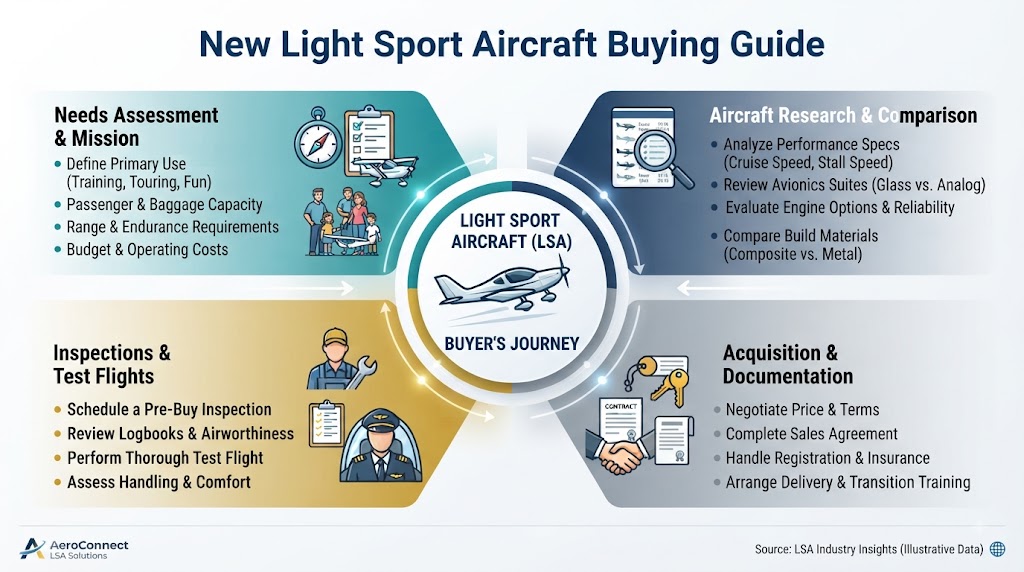
Buying a new Light Sport Aircraft is an exciting step for pilots who want greater flexibility, personal transportation, recreational flying, or a dedicated aircraft for training and local operations. However, choosing the right aircraft requires more than comparing appearance, advertised performance, or purchase price. Buyers need to consider the aircraft’s intended mission, useful load, range, engine, avionics, maintenance requirements, operating expenses, storage, insurance, and manufacturer support. A well-selected aircraft should match the pilot’s experience, flying goals, and realistic ownership budget. The right choice is not necessarily the fastest or most highly equipped aircraft, but the one that provides the best overall fit for the way it will actually be used.
What Is a Light Sport Aircraft?
A Light Sport Aircraft, commonly referred to as an LSA, is a category of relatively lightweight aircraft intended for specific types of general aviation operations.
These aircraft can appeal to pilots interested in:
- Recreational flying
- Local sightseeing
- Personal aviation
- Flight training
- Short-distance travel
- Weekend flying
- Aircraft ownership with a simpler operating mission
Light Sport Aircraft can differ significantly in their construction, cockpit equipment, engine configuration, performance, and operating characteristics.
It is also important to understand that aviation regulations are jurisdiction-specific. Pilot privileges, aircraft classifications, operating limitations, certification requirements, and medical requirements can vary depending on the country and applicable aviation authority.
Therefore, buyers should always verify the rules that apply to their specific location and intended operation.
Why Buy a New Light Sport Aircraft?
Buying a new aircraft can offer several advantages compared with purchasing a previously owned aircraft.
One major benefit is knowing that the aircraft begins its service life with the new owner. This can reduce some uncertainty associated with previous use, modifications, maintenance history, and unknown operating conditions.
Other potential advantages include:
- New aircraft components
- Modern avionics
- Current cockpit technology
- Manufacturer warranty considerations
- Greater customization opportunities
- New engine and propulsion components
- Access to current manufacturer documentation
- Potentially stronger factory support
However, buying new also has disadvantages.
The initial purchase price is generally higher than that of a comparable used aircraft. Buyers also need to consider depreciation, insurance, storage, maintenance, financing, and other ownership costs.
A new aircraft is therefore not automatically the best financial choice.
The decision should depend on the buyer’s priorities, expected usage, and long-term ownership plans.
New vs Used Light Sport Aircraft
| Factor | New Light Sport Aircraft | Used Light Sport Aircraft |
|---|---|---|
| Purchase price | Generally higher | Often lower |
| Aircraft history | Starts with new owner | Requires careful review |
| Warranty | May be available | Depends on aircraft and seller |
| Customization | Often greater | Limited by existing configuration |
| Maintenance history | Minimal operating history | Requires detailed records |
| Technology | Generally newer | May require upgrades |
| Depreciation | Initial depreciation may be higher | Depends on age and market |
| Condition | New components | Varies with aircraft history |
| Delivery | May require a waiting period | May be available sooner |
| Ownership uncertainty | Generally lower regarding prior use | Depends heavily on records and inspection |
Both options can make sense.
The right choice depends on the buyer’s priorities rather than simply whether the aircraft is new or used.
How to Choose the Right Light Sport Aircraft
The most important part of choosing an aircraft is understanding your mission.
Before comparing aircraft models, ask yourself:
- What type of flying will I do?
- How frequently will I fly?
- Will I usually fly alone?
- Will I regularly carry a passenger?
- How much baggage do I need?
- Will I primarily fly locally?
- Do I plan to make longer cross-country trips?
- Will the aircraft be used for training?
- What airports will I normally use?
- What weather conditions will I encounter?
- What level of cockpit technology do I actually need?
These questions can eliminate unsuitable aircraft before the buying process becomes complicated.
An aircraft designed primarily for recreational flying may not be the ideal choice for someone who frequently carries passengers and baggage on longer trips.
Similarly, an aircraft equipped with advanced avionics may not provide meaningful additional value to a pilot whose primary mission consists of simple local flying.
Key Factors to Consider Before Buying a New Light Sport Aircraft
1. Intended Mission
Your mission should be the starting point for the entire purchasing process.
Think about how the aircraft will actually be used after the excitement of ownership wears off.
A recreational pilot may prioritize:
- Simple operation
- Comfortable handling
- Visibility
- Affordable operating costs
- Easy maintenance
A pilot interested in longer trips may place greater importance on:
- Range
- Useful load
- Navigation equipment
- Weather planning capabilities
- Passenger comfort
Flight schools may have different requirements again, particularly regarding durability, training suitability, maintenance access, and operating economics.
The aircraft should be selected around the mission rather than forcing the mission to fit the aircraft.
2. Aircraft Performance
Performance is an important part of aircraft selection, but published numbers should always be interpreted carefully.
Buyers may want to evaluate:
- Cruise performance
- Takeoff characteristics
- Climb capability
- Range
- Endurance
- Stall characteristics
- Useful load
Published performance can vary according to aircraft weight, atmospheric conditions, altitude, configuration, fuel load, and other factors.
Therefore, buyers should avoid comparing a single performance figure without understanding the conditions under which it was measured.
An aircraft with impressive published performance may not necessarily be the best option for a pilot’s actual operating environment.
3. Payload and Useful Load
Useful load is one of the most important considerations for a practical aircraft purchase.
Useful load generally determines how much weight is available for occupants, fuel, baggage, and other allowable items after accounting for the aircraft’s empty weight.
Consider a typical flight involving:
- Pilot
- Passenger
- Fuel
- Baggage
- Additional equipment
An aircraft that appears suitable on paper may become less practical if the available useful load is restrictive.
This is especially important for buyers who regularly plan to carry a passenger.
Do not evaluate useful load in isolation. Consider it alongside fuel capacity, typical trip distance, passenger requirements, and operating limitations.
4. Range and Fuel Capacity
Range is another major consideration.
Think about the distance you realistically expect to fly rather than simply looking at the maximum published range.
Important considerations include:
- Typical trip distance
- Fuel reserves
- Weather
- Alternate airport planning
- Passenger requirements
- Payload
- Wind conditions
Published range is not necessarily the same as practical nonstop travel distance for every flight.
A buyer should evaluate whether the aircraft’s real-world capabilities align with the intended mission.
5. Engine and Propulsion System
The engine is one of the most important components of an aircraft.
When comparing new Light Sport Aircraft, investigate:
- Engine type
- Fuel requirements
- Maintenance requirements
- Parts availability
- Service support
- Reliability history
- Operating costs
- Manufacturer support
An engine should not be evaluated only on power output.
Long-term support and availability of qualified maintenance resources can be equally important.
A modern aircraft with an engine that is difficult to support in your region may create ownership challenges later.
6. Avionics and Cockpit Technology
Modern Light Sport Aircraft can be equipped with sophisticated cockpit systems.
Depending on the aircraft, buyers may encounter:
- Electronic flight displays
- Navigation equipment
- Communication radios
- Engine monitoring
- Transponders
- Traffic awareness systems
- Electronic flight instruments
More technology is not automatically better.
The best avionics package is the one that matches the pilot’s mission, training, experience, and operating environment.
Buyers should also consider the cost of future maintenance, upgrades, software support, and replacement components.
7. Safety Equipment and Features
Safety should be considered throughout the buying process.
Review features and systems such as:
- Restraint systems
- Visibility
- Lighting
- Emergency equipment
- Flight instrumentation
- Communication equipment
- Situational awareness systems
- Structural design
The presence of a particular safety feature does not guarantee a safe outcome.
Pilot training, aircraft condition, weather decisions, maintenance, operational discipline, and appropriate decision-making remain essential.
8. Aircraft Construction and Materials
Light Sport Aircraft can use different construction methods.
These may include:
- Composite construction
- Metal construction
- Tubular structures
- Fabric-covered designs
Each approach has different characteristics and maintenance considerations.
Composite aircraft, for example, may require specialized inspection and repair knowledge.
Metal aircraft can also require careful attention to corrosion, fasteners, structural condition, and surface protection.
The question should not simply be which material is “best.”
Instead, buyers should understand how the aircraft’s construction affects maintenance, durability, repair support, and ownership requirements.
9. Maintenance Requirements
Maintenance should be considered before purchasing an aircraft rather than after ownership begins.
Investigate:
- Scheduled maintenance
- Inspection requirements
- Engine servicing
- Propeller inspection
- Airframe inspection
- Consumables
- Replacement components
- Specialized maintenance requirements
Also determine whether qualified maintenance resources are available near your location.
An aircraft can be attractive on paper but inconvenient to own if routine maintenance requires significant travel or specialized support.
10. Parts Availability
Parts availability has a direct effect on long-term aircraft ownership.
Before buying, investigate the availability of:
- Engine components
- Propeller components
- Airframe parts
- Avionics
- Consumables
- Hardware
- Replacement components
Ask how parts are ordered and whether support is available through the manufacturer, dealer network, or other appropriate sources.
Long-term parts support can be just as important as the initial aircraft specification.
11. Manufacturer and Dealer Support
A new aircraft purchase often creates a long-term relationship with the manufacturer and supporting organizations.
Research:
- Technical support
- Warranty
- Service network
- Documentation
- Parts availability
- Training resources
- Software support
- Maintenance information
Strong manufacturer support can make ownership easier, especially for first-time aircraft buyers.
12. Storage and Hangar Requirements
Aircraft storage is another cost that is sometimes overlooked during the purchasing process.
Before buying, determine whether you have access to suitable:
- Hangar space
- Tie-down facilities
- Security
- Maintenance access
- Weather protection
Consider the aircraft’s dimensions and storage requirements.
If a hangar is unavailable, understand the potential effects of outdoor storage on maintenance and aircraft condition.
Understanding the Total Cost of Ownership
The purchase price is only one part of aircraft ownership.
A realistic ownership budget may include:
- Aircraft purchase
- Financing
- Insurance
- Hangar or storage
- Fuel
- Scheduled maintenance
- Unscheduled maintenance
- Engine expenses
- Propeller maintenance
- Avionics
- Inspection costs
- Registration or regulatory expenses where applicable
- Training
- Replacement parts
These costs can vary significantly based on aircraft type, operating location, flight hours, fuel prices, maintenance requirements, insurance, and storage arrangements.
A useful approach is to calculate expected ownership expenses over several years rather than focusing only on the initial purchase price.
Aircraft Insurance Considerations
Insurance should be researched before completing an aircraft purchase.
Insurance requirements and premiums can vary based on factors such as:
- Pilot experience
- Aircraft type
- Intended use
- Location
- Training
- Coverage requirements
A new aircraft may have different insurance considerations from an older aircraft or a different aircraft category.
Buyers should obtain appropriate insurance information early enough to include it in the ownership budget.
Pilot Training and Aircraft Transition
Owning a new Light Sport Aircraft does not automatically mean a pilot will be immediately comfortable with every aircraft system.
Transition or familiarization training can be valuable, particularly when moving from one aircraft type to another.
Training may address:
- Aircraft systems
- Cockpit layout
- Avionics
- Normal procedures
- Emergency procedures
- Aircraft handling
- Performance characteristics
The appropriate training depends on the pilot, aircraft, and applicable regulations.
Buyers should understand the training expectations before taking delivery of the aircraft.
Pre-Purchase Research for a New Aircraft
A new aircraft may have no previous owner, but that does not mean the buyer should skip due diligence.
Review:
- Aircraft documentation
- Operating information
- Maintenance information
- Warranty terms
- Equipment list
- Optional equipment
- Manufacturer support
- Parts availability
- Insurance requirements
- Delivery process
- Service arrangements
The buyer should also understand exactly what is included in the advertised aircraft configuration.
Optional equipment can significantly affect the final price.
Questions to Ask the Manufacturer or Dealer
Before placing an order, consider asking:
- What is included in the base aircraft price?
- Which features are optional?
- What warranty is provided?
- What maintenance documentation is supplied?
- Where can the aircraft be serviced?
- How are replacement parts obtained?
- What engine support is available?
- What avionics support is available?
- What training resources are offered?
- What are the expected delivery arrangements?
- What documentation comes with the aircraft?
- What ownership considerations should a new buyer understand?
Getting clear answers before purchase can prevent misunderstandings later.
Common Mistakes When Buying a New Light Sport Aircraft
1. Choosing Based Only on Appearance
A visually attractive aircraft may not be the best match for your mission.
2. Focusing Only on Purchase Price
A lower purchase price does not necessarily mean lower total ownership costs.
3. Ignoring Useful Load
An aircraft may seem suitable until passenger, fuel, and baggage requirements are considered.
4. Overlooking Operating Costs
Fuel, insurance, maintenance, storage, and parts can become significant long-term expenses.
5. Buying More Avionics Than Necessary
Advanced equipment can increase purchase and maintenance costs without providing meaningful value for every pilot.
6. Ignoring Maintenance Support
A new aircraft still needs appropriate maintenance and inspection resources.
7. Not Researching Parts Availability
Difficulty obtaining replacement components can make long-term ownership more complicated.
8. Failing to Evaluate Insurance Requirements
Insurance should be included in the ownership budget before the purchase decision is finalized.
9. Choosing an Aircraft That Does Not Match the Mission
An aircraft designed for local recreational flights may not be the ideal choice for frequent longer trips.
10. Neglecting Transition Training
Learning the aircraft’s systems and handling characteristics can be an important part of becoming a confident and responsible owner.
Practical New Light Sport Aircraft Buying Checklist
Use this checklist when comparing aircraft:
- Intended mission
- Passenger requirements
- Performance
- Useful load
- Range
- Fuel requirements
- Engine
- Propeller
- Avionics
- Safety equipment
- Aircraft construction
- Maintenance requirements
- Parts availability
- Manufacturer support
- Warranty
- Insurance
- Hangar or storage
- Fuel costs
- Training
- Financing
- Total ownership cost
- Aircraft documentation
A checklist can help buyers compare aircraft objectively instead of making decisions based on appearance or individual specifications.
Light Sport Aircraft Evaluation Scorecard
A simple scoring system can help organize the buying process.
| Category | Suggested Weight |
|---|---|
| Mission suitability | 20% |
| Safety and aircraft systems | 15% |
| Performance | 15% |
| Useful load and practicality | 10% |
| Avionics | 10% |
| Maintenance and support | 10% |
| Operating costs | 10% |
| Purchase value | 10% |
These weights are only a starting point.
A buyer who primarily wants recreational flying may give greater importance to operating costs and handling.
Someone interested in longer travel may give greater weight to range and useful load.
The goal is to create a comparison that reflects your actual priorities.
New Light Sport Aircraft Buying Process
Step 1: Define Your Mission
Determine exactly how you expect to use the aircraft.
Step 2: Establish a Realistic Budget
Include both the purchase price and ongoing ownership expenses.
Step 3: Research Suitable Aircraft
Create a shortlist based on your mission rather than appearance.
Step 4: Compare Performance
Review published performance information and understand the conditions behind the figures.
Step 5: Evaluate Equipment
Compare engines, propellers, avionics, safety equipment, and available options.
Step 6: Research Support
Investigate manufacturer support, maintenance resources, parts availability, and warranty arrangements.
Step 7: Review Ownership Costs
Estimate fuel, insurance, storage, maintenance, training, and other recurring expenses.
Step 8: Plan Training
Determine what aircraft-specific familiarization or transition training may be appropriate.
Step 9: Review Documentation
Understand the aircraft documentation, operating information, warranty terms, and applicable regulatory requirements.
Step 10: Make the Purchase Decision
Choose the aircraft that best matches your mission, budget, experience, and long-term ownership expectations.
Role of LIGHTSPORTWEST.COM
Research is an important part of buying a new Light Sport Aircraft.
Prospective owners need reliable information when comparing aircraft characteristics, ownership considerations, components, maintenance requirements, and aviation resources.
LIGHTSPORTWEST.COM can serve as a relevant resource for readers researching Light Sport Aircraft and related aviation information.
Before purchasing any aircraft, buyers should independently verify specifications, pricing, availability, regulatory requirements, warranty details, and support arrangements applicable to the specific aircraft and location.
Frequently Asked Questions
1. What should I consider when buying a new Light Sport Aircraft?
Start with your intended mission, then evaluate useful load, range, performance, engine, avionics, maintenance, operating costs, storage, insurance, training, and manufacturer support.
2. Is buying a new Light Sport Aircraft better than buying used?
Not necessarily. A new aircraft may provide newer equipment, warranty considerations, and less uncertainty about previous use, while a used aircraft may offer a lower purchase price. The right choice depends on your priorities.
3. How much does a new Light Sport Aircraft cost?
Prices vary significantly depending on the aircraft, equipment, engine, avionics, options, market, and location. Buyers should obtain current pricing for the specific aircraft they are considering and calculate the complete ownership cost.
4. What is the importance of useful load?
Useful load determines how much capacity is available for occupants, fuel, baggage, and other allowable items. It is essential for determining whether an aircraft can realistically perform your typical missions.
5. How important is aircraft range when buying an LSA?
Range is important if you plan to travel beyond local flying. Buyers should consider practical range, fuel reserves, weather, payload, and alternate airport planning rather than relying only on a published maximum figure.
6. What avionics should I consider?
Choose avionics based on your mission, experience, navigation needs, communication requirements, situational awareness, and budget. More advanced equipment is not automatically necessary for every pilot.
7. What engine factors should buyers evaluate?
Consider engine type, fuel requirements, maintenance needs, parts availability, service support, reliability information, operating costs, and manufacturer support.
8. How much does it cost to own a Light Sport Aircraft?
Ownership costs can include financing, insurance, storage, fuel, maintenance, inspections, training, engine expenses, parts, and avionics. Actual costs vary according to aircraft type, location, and usage.
9. Do I need transition training for a new Light Sport Aircraft?
Aircraft-specific familiarization or transition training can be valuable when moving into a new aircraft type. The appropriate training depends on the aircraft, pilot experience, and applicable regulations.
10. What should I ask before purchasing a new Light Sport Aircraft?
Ask about the total price, optional equipment, warranty, maintenance requirements, parts availability, manufacturer support, training, documentation, delivery, and long-term ownership considerations.
Final Thoughts
Buying a new Light Sport Aircraft is a significant decision that should begin with a clear understanding of how the aircraft will actually be used. Performance and appearance are important, but they should be considered alongside useful load, range, engine requirements, avionics, maintenance, operating expenses, storage, insurance, and support.
A well-chosen aircraft should match the pilot’s experience, mission, budget, and long-term ownership plans. Buyers should also look beyond the initial purchase price and understand the recurring costs associated with operating and maintaining the aircraft.

