
Introduction
The share market can look confusing for beginners because it includes many new terms, price movements, news updates, and different opinions. Many people want to start investing or trading but do not know where to begin. Some follow tips, some copy others, and some invest without understanding risk.
Learning share market basics is the first step toward responsible financial decision-making. When beginners understand how stocks work, what investing means, how trading is different, and why research matters, they can avoid many common mistakes.
Platforms like StocksMantra.com help beginners learn stock market education, investing basics, trading concepts, IPO learning, and market research in simple language.
What Is the Share Market?
The share market is a place where shares of publicly listed companies are bought and sold. When you buy a share, you become a small owner of that company.
Companies list their shares in the market to raise money for growth, expansion, debt repayment, or business development. Investors buy shares with the hope that the company may grow over time, but stock prices can also fall, so risk is always involved.
What Is a Stock?
A stock represents ownership in a company. For example, if a company has many shares and you buy some of them, you own a small part of that company.
Stock prices move because of:
- Company performance
- Investor demand
- Market news
- Economic conditions
- Sector trends
- Global events
- Market sentiment
What Is a Demat Account?
A Demat account stores your shares electronically. Earlier, shares were held in paper form, but today they are stored digitally.
To invest or trade, beginners usually need:
- Demat account
- Trading account
- Bank account
- Basic market knowledge
A Demat account helps keep shares safe and easy to manage.
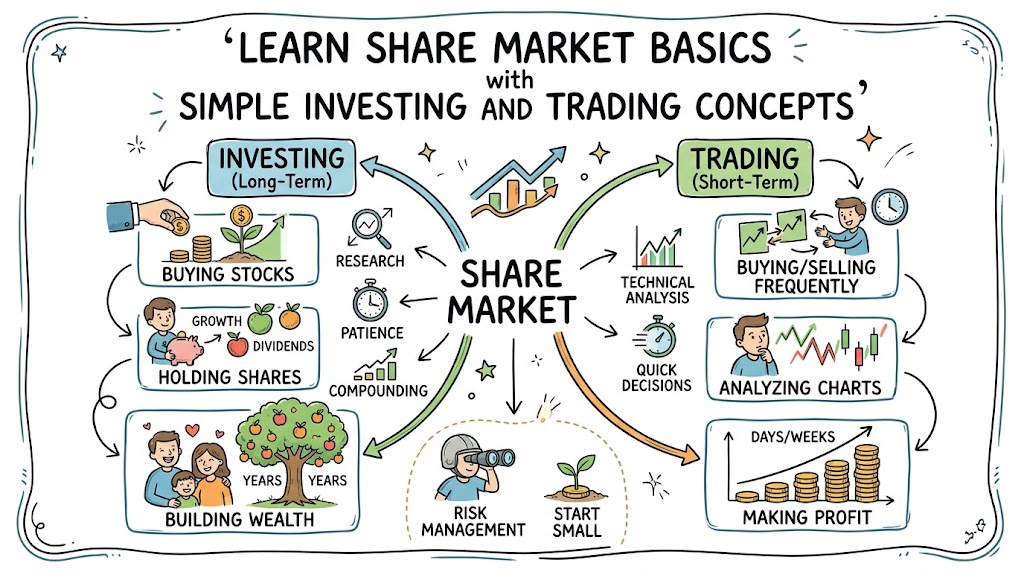
Investing vs Trading
Investing and trading are both part of the share market, but they are different approaches.
| Point | Investing | Trading |
|---|---|---|
| Time Period | Long term | Short term |
| Focus | Company growth | Price movement |
| Research | Fundamental analysis | Technical analysis |
| Risk Level | Moderate | Higher |
| Decision Style | Patient | Quick |
| Suitable For | Long-term learners | Active market participants |
Beginners should understand both concepts before deciding which approach matches their goals, time, and risk capacity.
What Is Investing?
Investing means buying shares or financial assets with a long-term view. Investors usually study the company’s business, financial performance, management, debt, profit, and growth potential.
Investing requires:
- Patience
- Research
- Long-term thinking
- Risk management
- Discipline
Investing is not about quick money. It is about learning businesses and making informed decisions over time.
What Is Trading?
Trading means buying and selling stocks over shorter periods to benefit from price movements. Traders often use charts, volume, price trends, support, resistance, and indicators.
Trading requires:
- Chart reading
- Risk control
- Emotional discipline
- Market awareness
- Clear entry and exit plans
Trading can be risky for beginners if they do not understand market behavior properly.
Important Share Market Terms for Beginners
| Term | Simple Meaning |
|---|---|
| Equity | Ownership in a company |
| Dividend | Part of profit shared with shareholders |
| Bull Market | Market moving upward |
| Bear Market | Market moving downward |
| IPO | First public share sale by a company |
| Portfolio | Collection of investments |
| Market Cap | Total market value of a company |
| Volume | Number of shares traded |
| Risk | Chance of losing money |
| Diversification | Spreading investment across assets |
Why Share Market Education Is Important
Share market education helps beginners make decisions based on knowledge instead of emotions or rumors.
It helps you:
- Understand risk before investing
- Avoid blind tips
- Learn company research
- Compare investing and trading
- Build financial discipline
- Manage emotions during volatility
- Make informed decisions
- Avoid unrealistic expectations
Education does not remove risk, but it helps you understand and manage it better.
Basic Investing Concepts Beginners Should Know
1. Company Research
Before investing, understand what the company does, how it earns money, and whether its business has long-term demand.
2. Financial Performance
Check revenue, profit, cash flow, debt, and margins to understand financial health.
3. Valuation
Valuation helps you understand whether a stock price looks reasonable compared with earnings, growth, and industry peers.
4. Diversification
Do not put all money into one stock or sector. Diversification helps reduce risk.
5. Long-Term Thinking
Stock prices may move daily, but long-term investing focuses on business performance over time.
Basic Trading Concepts Beginners Should Know
1. Price Trend
A trend shows whether the stock price is moving upward, downward, or sideways.
2. Support
Support is a price level where buying interest may increase.
3. Resistance
Resistance is a price level where selling pressure may increase.
4. Volume
Volume shows how many shares are traded and helps confirm market activity.
5. Stop-Loss
A stop-loss is a risk management tool used to limit potential losses in trading.
Step-by-Step Roadmap to Learn Share Market Basics
- Learn basic share market terms.
- Understand how stocks and exchanges work.
- Learn the difference between investing and trading.
- Understand risk and diversification.
- Study company fundamentals.
- Learn basic chart reading.
- Follow market news carefully.
- Understand IPO basics.
- Practice research before investing.
- Build patience and discipline.
Common Mistakes Beginners Should Avoid
- Following tips blindly
- Investing without research
- Trading without a plan
- Expecting quick profits
- Ignoring risk
- Investing borrowed money
- Panic selling
- Overtrading
- Not understanding the company
- Putting all money in one stock
How StocksMantra.com Helps Beginners
StocksMantra.com helps market learners understand share market basics, investing concepts, trading education, IPO learning, stock research, and financial awareness in simple language.
It can support beginners who want to learn:
- Stock market education
- Share market basics
- Investing principles
- Trading concepts
- Fundamental analysis
- Technical analysis
- IPO analysis
- Market research
- Sector insights
- Risk management
This type of learning helps beginners move from confusion to clarity.
Best Practices for New Investors and Traders
- Learn before investing real money.
- Start with simple concepts.
- Avoid emotional decisions.
- Research every investment.
- Understand your risk capacity.
- Keep expectations realistic.
- Review your learning regularly.
- Use trading only after understanding risk.
- Diversify investments.
- Consult a qualified advisor when needed.
Expert Tips
- Focus on education before profit.
- Understand the business behind every stock.
- Do not copy others’ trades or investments.
- Use charts as learning tools, not guarantees.
- Keep risk management as your first priority.
- Avoid investing money needed for short-term expenses.
- Track mistakes and learn from them.
- Be patient and consistent.
FAQs
1. What is the share market?
The share market is a platform where shares of listed companies are bought and sold by investors and traders.
2. How can beginners learn share market basics?
Beginners can start by learning stock terms, investing concepts, trading basics, risk management, and market research.
3. What is the difference between investing and trading?
Investing is long-term and focuses on company growth, while trading is short-term and focuses on price movements.
4. Is share market investing risky?
Yes. Share market investing involves risk, including the possible loss of capital.
5. What is a Demat account?
A Demat account stores shares electronically and is required for holding stocks in digital form.
6. Should beginners start with investing or trading?
Many beginners find investing easier to understand first because it focuses on company research and long-term thinking.
7. What is diversification?
Diversification means spreading investments across different stocks or sectors to reduce overall risk.
8. Can trading guarantee profits?
No. Trading cannot guarantee profits and may involve higher risk, especially for beginners.
9. Why is research important before investing?
Research helps investors understand company quality, financial performance, valuation, and risk before making decisions.
10. Where can beginners learn share market basics?
Beginners can explore StocksMantra.com for simple content on share market basics, investing, trading, IPOs, and market research.
Conclusion
Learning share market basics is important for every beginner who wants to invest or trade responsibly. Before making any financial decision, it is necessary to understand stocks, Demat accounts, investing, trading, risk, research, and market behavior. A strong learning foundation helps beginners avoid common mistakes and make better-informed decisions. Platforms like StocksMantra.com can support this journey by offering simple stock market education, investing concepts, trading basics, IPO learning, and financial awareness for market learners.

