
Introduction
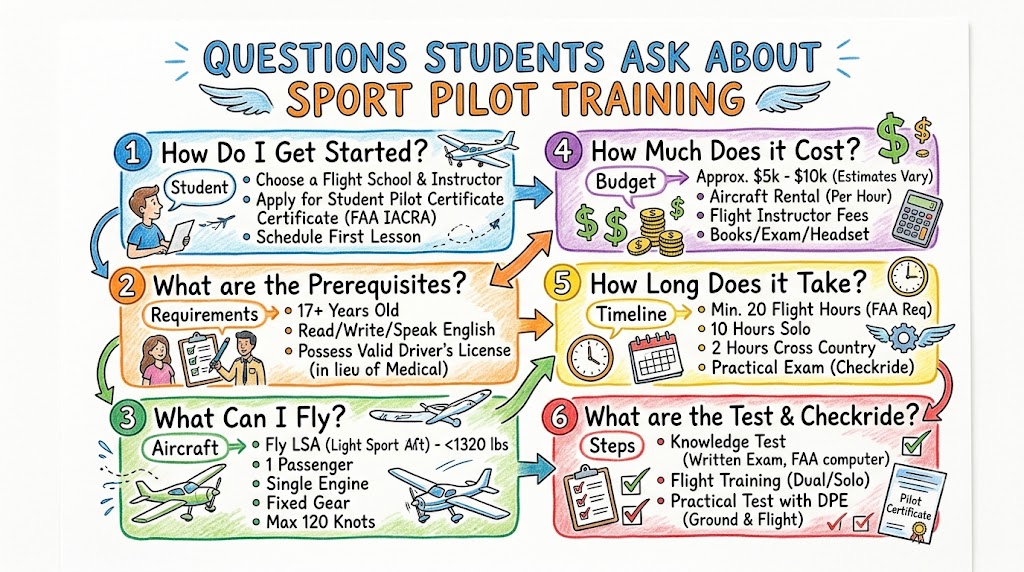
Learning to fly is an exciting goal, but most students have many questions before booking their first lesson. They may wonder whether they are eligible, whether they need a medical certificate, how much training is required, what kind of aircraft they can fly, and what limitations apply after earning a certificate.
Sport pilot training can provide an accessible route into recreational aviation. It introduces students to aircraft control, navigation, weather, airport operations, radio communication, safety procedures, and responsible decision-making. However, it is still regulated flight training that requires commitment, preparation, and demonstrated proficiency.
Current FAA rules set requirements for sport pilot eligibility, aeronautical knowledge, flight proficiency, experience, testing, endorsements, privileges, and operating limitations. These rules also allow sport pilots to operate certain qualifying aircraft that meet specific performance and design requirements.
What Is Sport Pilot Training?
Sport pilot training is a structured program that prepares a student to earn an FAA sport pilot certificate. The certificate is mainly designed for people who want to fly recreationally rather than pursue commercial aviation work.
Training normally combines two major areas:
- Ground instruction
- Practical flight instruction
Ground instruction teaches the knowledge needed to plan and conduct a safe flight. Students study regulations, aircraft systems, aerodynamics, airspace, weather, navigation, airport operations, aircraft performance, and emergency procedures.
Flight instruction teaches students how to inspect an aircraft, use checklists, operate the controls, communicate with air traffic services when required, perform takeoffs and landings, navigate between airports, recognize hazardous situations, and manage emergencies.
A student must eventually pass both an FAA knowledge test and a practical test. An instructor must provide the required endorsements confirming that the student is prepared for each test.
What Is a Sport Pilot Certificate?
A sport pilot certificate is an FAA pilot certificate that permits its holder to act as pilot in command of qualifying aircraft while following sport pilot privileges, endorsements, and limitations.
It is sometimes informally called a sport pilot license, but the FAA generally uses the term certificate.
The sport pilot certificate is suitable for recreational pilots who want a focused route into aviation. It requires less minimum flight experience than a private pilot certificate for many aircraft categories, but it also comes with more operating restrictions.
Sport pilots must understand that receiving the certificate is not permission to fly every aircraft in every condition. The pilot must be properly trained and endorsed for the category, class, aircraft characteristics, airspace, and type of operation involved.
Who Can Begin Sport Pilot Training?
Many people can begin introductory flight lessons before meeting every requirement for certification. However, additional requirements apply before a student may fly solo or receive the final certificate.
To qualify for a sport pilot certificate, a person must generally:
- Meet the applicable minimum age
- Be able to read, speak, write, and understand English
- Receive the required ground and flight training
- Log the required aeronautical experience
- Receive instructor endorsements
- Pass the knowledge test
- Pass the practical test
- Meet the applicable medical qualification
- Demonstrate safe judgment and flight proficiency
A student does not need previous aviation experience before beginning training. Sport pilot courses are commonly designed for complete beginners.
What Is the Minimum Age for a Sport Pilot Certificate?
A person must generally be at least 17 years old to receive a sport pilot certificate.
Applicants seeking privileges for a glider or balloon may qualify at 16. Students may begin learning earlier, but they cannot receive the certificate until they meet the applicable minimum age requirement.
Age alone does not determine whether someone will become a successful student. Preparation, maturity, judgment, communication, consistency, and willingness to follow procedures are equally important.
FAA regulations also require applicants to be able to read, speak, write, and understand English, although limitations may be considered when a medical reason affects one of these abilities.
Do I Need Previous Flying Experience?
No previous flying experience is normally required.
A beginner may start with a discovery flight or introductory lesson. During this experience, an instructor usually explains the aircraft, introduces basic controls, reviews important safety procedures, and may allow the student to handle the controls under supervision.
Early lessons are designed to build familiarity and confidence gradually. Students are not expected to understand every instrument, radio call, checklist item, or maneuver during their first flight.
A responsible instructor introduces new skills in manageable stages and reviews them until the student can perform them safely.
Do I Need a Student Pilot Certificate?
A student pilot certificate is generally needed before a student can conduct a solo flight.
It is not usually required simply to take an introductory lesson with an instructor because the instructor remains the responsible pilot during dual instruction. However, the application process should not be left until the last moment if the student is progressing toward solo flight.
The student pilot certificate can generally be requested through the FAA’s electronic airman certification application system or through the appropriate paper application process. An authorized individual, such as a certificated flight instructor or designated examiner, can verify the application and identity documents.
Students should ask their flight school when to begin this process.
Do Sport Pilot Students Need an FAA Medical Certificate?
One reason many students consider sport pilot training is its medical qualification structure.
For many daytime sport pilot operations in powered aircraft, an eligible pilot may use either:
- A valid FAA medical certificate
- A current and valid United States driver’s license
Using a driver’s license does not mean medical fitness can be ignored. A person using this option must comply with restrictions on the driver’s license and must not know or have reason to know of a condition that would make aircraft operation unsafe.
Additional restrictions may apply when a person has previously applied for an FAA medical certificate. For example, an unresolved denial, suspension, revocation, or withdrawn special issuance can affect eligibility to rely on a driver’s license.
Students who have medical concerns or a complicated aviation medical history should obtain qualified guidance before submitting an application or assuming that the driver’s-license option applies to them.
Can I Fly When I Am Sick or Medically Unfit?
No pilot should fly when a medical condition, medication, illness, fatigue, stress, or physical limitation could make the flight unsafe.
This principle applies even when the pilot is not required to hold a traditional FAA medical certificate.
Common temporary concerns can include:
- Fever or infection
- Severe congestion
- Dizziness
- Fatigue
- Dehydration
- Uncontrolled pain
- Vision problems
- Medication side effects
- Emotional distress
- Lack of sleep
- Impaired concentration
Students should tell their instructor when they are not feeling well. Canceling or rescheduling a lesson is better than flying with reduced awareness or judgment.
How Many Flight Hours Are Required?
For a sport pilot certificate with airplane single-engine privileges, current regulations specify at least 20 hours of flight time.
That minimum generally includes at least:
- 15 hours of flight training from an authorized instructor
- 5 hours of solo flight training
- Required cross-country training
- Required takeoff and landing experience
- Preparation for the practical test
The exact experience requirements vary by aircraft category and class. For example, requirements for airplanes may differ from those for gliders, powered parachutes, balloons, gyroplanes, helicopters with qualifying controls, or weight-shift-control aircraft.
The regulatory minimum is not a promise that every student will be ready at exactly that number. A student must be able to perform every required task safely and consistently before receiving an instructor’s recommendation for the practical test.
Why Do Some Students Need More Than the Minimum Hours?
Students learn at different rates. Requiring more than the minimum number of hours is common and should not be treated as failure.
Training time may increase because of:
- Irregular lesson scheduling
- Weather cancellations
- Aircraft maintenance
- Instructor availability
- Difficulty with landings
- Radio communication challenges
- Limited study between lessons
- Long gaps in training
- Changing instructors or aircraft
- Additional time needed for judgment and confidence
- Local airport traffic or airspace complexity
A student who trains consistently often retains skills more effectively than someone who leaves long gaps between lessons.
The aim is not to finish in the fewest possible hours. The aim is to become a safe, competent, and responsible pilot.
How Long Does Sport Pilot Training Take?
There is no single completion timeline for every student.
A student who flies several times each week, studies regularly, experiences favorable weather, and has dependable access to an instructor and aircraft may progress efficiently. A student who flies only occasionally may require more review because flying skills can weaken between lessons.
The total duration depends on:
- Training frequency
- Weather
- Student preparation
- Aircraft availability
- Instructor availability
- Learning speed
- Airport conditions
- Knowledge-test preparation
- Practical-test scheduling
Before enrolling, ask the school how frequently lessons can realistically be scheduled and whether its aircraft and instructors are available consistently.
What Subjects Are Covered in Sport Pilot Ground School?
Ground school provides the knowledge required to plan flights, make informed decisions, and understand the environment in which the aircraft operates.
Important subjects commonly include:
Aviation Regulations
Students learn the rules governing certification, aircraft operation, airspace, weather minimums, right-of-way, documents, pilot responsibilities, and sport pilot limitations.
Aerodynamics
Students study how lift, weight, thrust, and drag affect an aircraft. They also learn how angle of attack, airspeed, configuration, and control inputs influence flight.
Aircraft Systems
Instruction may cover the engine, fuel system, electrical system, flight controls, instruments, landing gear, propeller, brakes, and aircraft-specific equipment.
Aviation Weather
Students learn how to obtain and interpret weather reports and forecasts. They also study clouds, wind, turbulence, visibility, thunderstorms, temperature, pressure, and dangerous weather conditions.
Airspace
Training explains different airspace classes, entry requirements, communication procedures, weather minimums, and operational restrictions.
Navigation
Students learn pilotage, dead reckoning, chart use, headings, time calculations, fuel planning, route selection, and the appropriate use of navigation equipment.
Aircraft Performance
Students learn how runway length, aircraft weight, temperature, altitude, wind, and surface conditions affect takeoff, climb, cruise, and landing performance.
Weight and Balance
Students must understand how loading affects stability, controllability, performance, and safety.
Human Factors
Training covers fatigue, stress, distraction, hazardous attitudes, decision-making, situational awareness, and risk management.
Emergency Planning
Students learn how to respond to engine problems, equipment failures, unexpected weather, navigation difficulties, and other abnormal situations.
The FAA requires sport pilot applicants to receive and log training or complete an approved form of home study covering the applicable aeronautical knowledge areas.
What Practical Skills Are Taught During Flight Lessons?
Practical training develops the physical control skills and judgment needed to operate an aircraft safely.
Lessons may include:
- Preflight planning
- Aircraft inspection
- Cockpit organization
- Checklist use
- Engine starting
- Taxiing
- Airport signs and markings
- Radio communication
- Normal takeoffs
- Crosswind takeoffs
- Straight-and-level flight
- Climbs and descents
- Level turns
- Slow flight
- Stall recognition and recovery
- Ground-reference maneuvers
- Traffic-pattern operations
- Normal landings
- Crosswind landings
- Short-field procedures
- Go-arounds
- Navigation
- Diversion planning
- Emergency approaches
- Simulated equipment failures
- Post-flight procedures
The student must learn not only how to move the controls but also when to discontinue an approach, divert to another airport, delay a departure, or cancel a flight.
Is the FAA Knowledge Test Difficult?
The knowledge test is manageable when the student understands the material and studies consistently.
Memorizing practice questions without understanding the concepts is not a strong preparation strategy. A student must later use the same knowledge during flight planning, oral questioning, weather decisions, and practical flying.
A good study plan includes:
- Reading assigned materials
- Attending ground instruction
- Reviewing weak subjects
- Practising calculations
- Learning chart interpretation
- Studying weather information
- Completing realistic practice tests
- Asking the instructor for clarification
Before taking the test, the student must receive an instructor endorsement confirming readiness.
What Happens During the Practical Test?
The practical test is commonly called a checkride.
It is conducted by an authorized examiner and normally includes:
- An eligibility and document review
- An oral examination
- Flight planning discussion
- Aircraft inspection
- A practical flight evaluation
- Demonstration of required maneuvers
- Risk-management evaluation
- Emergency-procedure evaluation
- Post-flight discussion
The examiner evaluates whether the applicant meets the required testing standards. The applicant is expected to demonstrate sound judgment as well as aircraft-control skills.
The objective is not perfection. However, the applicant must remain within the required standards, recognize developing problems, make safe decisions, and demonstrate appropriate correction when necessary.
What Aircraft Can a Sport Pilot Fly?
Sport pilot operating privileges are based on aircraft performance and design requirements, as well as the pilot’s training and endorsements.
Students may still hear the term light-sport aircraft used frequently. However, current regulations are broader than the older assumption that a sport pilot may fly only an aircraft labeled as a light-sport aircraft. A qualifying aircraft must satisfy the applicable performance limits and design requirements in the regulations.
Possible aircraft categories can include qualifying:
- Airplanes
- Gliders
- Gyroplanes
- Powered parachutes
- Weight-shift-control aircraft
- Balloons
- Airships
- Helicopters with simplified flight controls
A pilot cannot select an aircraft based only on its appearance, weight, number of seats, or marketing description. The aircraft must meet the current regulatory criteria, and the pilot must hold the appropriate privileges and endorsements.
The flight school should clearly explain which aircraft it uses and whether that aircraft qualifies for the intended sport pilot operation.
Can a Sport Pilot Fly a Four-Seat Airplane?
Some qualifying airplanes may have a maximum seating capacity of four people. However, that does not mean a sport pilot may fill every seat.
A sport pilot acting under sport pilot privileges may carry only one passenger. Therefore, even when the qualifying airplane has four seats, additional seats must remain unoccupied.
Students should distinguish between:
- The seating capacity permitted for a qualifying airplane
- The number of occupants permitted under sport pilot privileges
Current FAA guidance clearly states that the one-passenger limitation remains in effect.
Can a Sport Pilot Carry Passengers?
Yes. A sport pilot may generally carry one passenger after earning the certificate and meeting all applicable currency, endorsement, aircraft, and operating requirements.
The pilot is responsible for:
- Confirming the aircraft is legal and airworthy
- Checking weather and airport conditions
- Calculating weight and balance
- Confirming sufficient fuel
- Providing an appropriate passenger briefing
- Following all certificate limitations
- Avoiding conditions beyond personal ability
- Maintaining recent experience when required
A newly certificated pilot should consider gaining additional solo experience before carrying a passenger, especially in unfamiliar aircraft, changing weather, or busy airspace.
Can Sport Pilots Fly at Night?
Night flying may be permitted under current rules, but it is not automatic.
To act as pilot in command at night using sport pilot privileges, the pilot must complete the required night training, receive the appropriate instructor endorsement, and meet the additional medical qualification.
The required night training includes specific experience, such as night takeoffs, full-stop landings, and an applicable night cross-country flight.
For night operations, a pilot must generally hold at least an appropriate FAA medical certificate or qualify under the applicable BasicMed conditions. A driver’s license by itself is not sufficient for optional night privileges.
Students should receive guidance from an instructor who is qualified to provide the required night training and endorsement.
Can a Sport Pilot Fly in Clouds?
Sport pilot operations are generally conducted under visual flight rules.
A sport pilot cannot fly under instrument flight rules merely because the aircraft contains advanced instruments. Flying into clouds or conditions without sufficient outside visual reference can quickly become dangerous for a pilot without appropriate instrument qualifications.
Students must learn to evaluate:
- Visibility
- Cloud height
- Cloud clearance
- Precipitation
- Wind
- Turbulence
- Thunderstorm activity
- Temperature
- Route conditions
- Daylight or night conditions
- Personal capability
Legal weather is not always safe weather. A cautious pilot may decide not to fly even when reported conditions technically meet regulatory minimums.
Can Sport Pilots Use Controlled Airports?
Yes, but additional training and an instructor endorsement may be required before operating in certain controlled airspace or at airports with operating control towers.
Training for these privileges may cover:
- Radio communication
- Air traffic control instructions
- Airport surface movement
- Traffic sequencing
- Airspace boundaries
- Clearance requirements
- Entry and departure procedures
- Wake turbulence awareness
The instructor must determine that the pilot is proficient before providing the required endorsement.
Students training at a quieter airport may benefit from supervised experience at controlled airports before flying there independently.
Can a Sport Pilot Fly Across State Lines?
Sport pilot privileges are not automatically limited to the pilot’s home state.
A properly qualified sport pilot may conduct cross-country flights while complying with airspace requirements, aircraft limitations, weather minimums, endorsements, and all other applicable regulations.
However, longer flights require careful planning. A pilot must consider:
- Weather changes
- Fuel availability
- Aircraft range
- Alternate airports
- Terrain
- Airspace
- Temporary flight restrictions
- Maintenance support
- Daylight or night limitations
- Personal endurance
Cross-country privileges should be exercised gradually. A newly certificated pilot may begin with familiar routes before attempting longer or more complex trips.
Can Sport Pilots Fly for Compensation?
A sport pilot generally cannot act as pilot in command while carrying passengers or property for compensation or hire or while operating in furtherance of a business.
The certificate is primarily intended for personal and recreational aviation.
A sport pilot should not assume that accepting fuel money, promoting a business, transporting business property, offering sightseeing flights, or performing aerial services is permitted. Compensation and business-purpose rules can be complex.
Anyone considering an operation involving payment, reimbursement, employment, promotion, or business activity should obtain qualified regulatory guidance before flying.
Flight instructors with the appropriate sport pilot instructor qualifications may receive compensation for providing authorized flight training, but that is a separate instructor privilege.
Can Sport Pilot Training Lead to a Private Pilot Certificate?
Yes. Sport pilot training can create a useful foundation for later private pilot training.
Skills such as aircraft control, navigation, radio communication, weather evaluation, flight planning, checklist use, and aeronautical decision-making can support future progress.
However, students should not assume that every training hour will automatically satisfy every requirement for a higher certificate. Credit can depend on factors including:
- The instructor’s certification
- The aircraft used
- How the training was logged
- The category and class
- The specific experience requirement
- Current regulations
Students who already expect to pursue a private pilot certificate should discuss that goal with the school before beginning. The school can help structure the training appropriately.
Is Sport Pilot Training Suitable for Older Students?
There is no standard maximum age for learning to fly.
Many adults begin flight training later in life. Older students may bring patience, discipline, planning ability, and strong safety awareness to the cockpit.
Suitability depends more on the individual’s:
- Medical fitness
- Mobility
- Vision and hearing
- Coordination
- Ability to manage workload
- Learning habits
- Judgment
- Comfort in the training aircraft
A discovery flight can help determine whether the cockpit, controls, visibility, and physical demands are comfortable.
Students with health concerns should speak with an appropriate medical professional and obtain reliable aviation medical guidance before making major financial commitments.
How Much Does Sport Pilot Training Cost?
There is no universal price for sport pilot training.
The total cost can depend on:
- Aircraft rental rate
- Instructor rate
- Fuel policy
- Ground instruction
- Training frequency
- Number of flight hours required
- Aircraft availability
- Local weather
- Insurance requirements
- Study materials
- Headset and equipment
- Knowledge-test fees
- Examiner fees
- Aircraft rental for the practical test
- Additional training before the checkride
Schools may advertise packages based on minimum requirements. Students should ask what the advertised amount includes and what happens when additional training is needed.
A transparent estimate should explain:
- The hourly aircraft rate
- Whether fuel is included
- The instructor’s flight rate
- The instructor’s ground rate
- Common additional charges
- Refund and cancellation policies
- Payment requirements
- Likely testing expenses
The cheapest hourly rate does not always produce the lowest total cost. Reliable scheduling, good instruction, maintained aircraft, and consistent training can provide greater value.
How Often Should I Take Flight Lessons?
For many students, two or three lessons per week can support steady progress.
Frequent lessons reduce the amount of time spent relearning previous skills. However, the best schedule depends on the student’s budget, availability, energy, weather, and school capacity.
Each lesson should include time for:
- Preparation
- Preflight briefing
- Aircraft inspection
- Flight
- Post-flight review
- Logbook entries
- Study assignments
Students should arrive prepared rather than expecting every lesson to begin with a complete review of material that could have been studied independently.
What Causes Students to Struggle During Training?
Common difficulties include:
Inconsistent Scheduling
Long gaps can weaken motor skills and procedural memory.
Rushing
Trying to reach solo flight or the checkride too quickly can create unnecessary pressure.
Weak Ground Knowledge
A student who does not understand weather, airspace, or aircraft systems may struggle to make safe decisions in flight.
Poor Checklist Discipline
Skipping steps can create serious safety risks.
Fixation
Students may focus too heavily on one instrument, one radio call, or one mistake while ignoring the overall flight situation.
Fear of Asking Questions
Students should ask for clarification whenever they do not understand a procedure or decision.
Comparing Progress
Every student develops at a different pace. Comparing hours with another learner can reduce confidence and encourage unsafe rushing.
Irregular Preparation
Flight lessons are more productive when the student reviews maneuvers, procedures, and objectives before arriving.
How Should I Choose a Sport Pilot Flight School?
Choosing the right school can have a major effect on safety, learning quality, cost, and enjoyment.
Evaluate the following areas carefully.
Instructor Experience
Ask whether the instructor is authorized and experienced in the aircraft and sport pilot training path being offered.
Aircraft Availability
A school with one frequently unavailable aircraft may struggle to maintain a consistent schedule.
Aircraft Condition
Training aircraft do not need to look new, but they should appear professionally maintained, organized, and properly documented.
Safety Culture
Observe whether instructors use checklists, discuss weather risks, conduct briefings, and encourage conservative decision-making.
Pricing Transparency
The school should explain rental rates, instructor charges, testing expenses, cancellation fees, and other expected costs.
Training Structure
Ask whether the school follows a syllabus and tracks student progress.
Instructor Continuity
Frequent instructor changes may slow training, although occasional lessons with another instructor can provide a useful second perspective.
Airport Environment
A quiet airport may allow more maneuver practice, while a controlled airport may provide valuable communication experience. Each environment has advantages.
Student Support
The school should be willing to answer questions about certification, medical eligibility, scheduling, equipment, and testing.
Questions to Ask Before Enrolling
Before paying for a large training package, ask the school:
- Which aircraft will I use?
- Does the aircraft qualify for sport pilot operations?
- How many training aircraft are available?
- How often can I realistically schedule lessons?
- Which instructors provide sport pilot training?
- What is included in the hourly rental rate?
- Is fuel included?
- How is instructor ground time charged?
- What expenses are not included in the estimate?
- Is there a written training syllabus?
- How is student progress recorded?
- What happens when weather cancels a lesson?
- What are the cancellation and refund policies?
- Can I complete a discovery flight before enrolling?
- Does the school help with the student pilot application?
- Which medical qualification applies to my planned operations?
- Does the school offer controlled-airspace training?
- Is night training available when appropriate?
- How are maintenance interruptions handled?
- What is the school’s recent practical-test preparation process?
Clear answers can help students compare schools fairly and avoid unexpected expenses.
What Should I Expect During a Discovery Flight?
A discovery flight is an introductory aviation experience rather than a complete training course.
It may include:
- Meeting the instructor
- Discussing goals
- Reviewing basic safety procedures
- Seeing the aircraft controls
- Completing a brief preflight inspection
- Observing engine start and taxi
- Handling the controls under supervision
- Experiencing basic climbs, turns, and descents
- Returning for landing
- Discussing future training
A discovery flight gives the student an opportunity to evaluate the aircraft, instructor, school environment, and personal comfort.
Students should wear comfortable clothing, eat a light meal, stay hydrated, and tell the instructor about concerns related to motion sickness or anxiety.
Tips for Succeeding in Sport Pilot Training
Train Consistently
Schedule lessons close enough together to maintain skills and confidence.
Study Between Flights
Review procedures, regulations, weather, maneuvers, and instructor feedback.
Prepare Before Arriving
Know the lesson objective and complete assigned reading.
Use Checklists
Do not depend entirely on memory for safety-critical procedures.
Keep Notes
Write down errors, improvements, questions, and instructor recommendations after each lesson.
Practise Chair Flying
Mentally rehearse cockpit flows, radio calls, traffic patterns, and emergency procedures while safely on the ground.
Accept Constructive Feedback
Corrections are a normal part of aviation training.
Avoid Rushing
A delayed solo or checkride is better than being unprepared.
Make Conservative Decisions
Good pilots do not prove skill by accepting unnecessary risk.
Build Personal Minimums
Develop limits for wind, visibility, weather, runway conditions, and fatigue that may be more conservative than legal minimums.
Frequently Asked Questions About Sport Pilot Training
1. Is sport pilot training easier than private pilot training?
Sport pilot training has a lower minimum flight-experience requirement for common airplane privileges, but it should not be considered effortless. Students must still learn aircraft control, regulations, navigation, weather, communication, emergency procedures, and risk management. They must also pass a knowledge test and practical test. The training may be more focused, but the required safety standards remain important.
2. Can I begin training before deciding whether to pursue sport or private pilot certification?
Yes. Introductory lessons can help you understand your interests and abilities. However, you should discuss your long-term goals with the instructor early. The type of aircraft, instructor qualifications, medical pathway, and manner in which training is logged may affect how efficiently your experience can be applied toward a later certificate.
3. Do I have to buy an aircraft for training?
No. Most students rent a training aircraft from a flight school or flying organization. Rental charges are commonly based on operating time. Before enrolling, ask whether fuel is included, how time is measured, whether insurance requirements apply, and whether the aircraft is regularly available.
4. When can I fly solo?
You may fly solo only after meeting the applicable requirements and receiving the necessary instructor endorsements. Your instructor must determine that you can safely perform the required procedures and maneuvers. Solo authorization is based on demonstrated readiness rather than the number of lessons completed.
5. Can I carry two or three passengers in a four-seat airplane?
Not while exercising sport pilot privileges. Current rules may allow operation of certain qualifying airplanes with up to four seats, but the sport pilot may carry only one passenger. The aircraft’s seating capacity and the pilot’s passenger privilege are separate limitations.
6. Can I rent an aircraft after earning my certificate?
Potentially, but rental companies and flight schools may impose their own checkout, experience, insurance, and currency requirements. You may need to complete a flight review with an instructor in the specific aircraft before renting it independently. These company requirements can be more restrictive than the basic regulatory minimums.
7. What happens if I fail the knowledge test or practical test?
An unsuccessful result does not automatically end your training. You will normally receive information about the areas that need improvement. After receiving additional instruction and the required endorsement, you may be able to retake the test. Your instructor can create a focused plan to correct the identified weaknesses.
8. Is sport pilot training useful if I only want to fly occasionally?
Yes, but occasional pilots must actively maintain proficiency. Skills can decline when flights are separated by long periods. Regulatory currency alone may not mean a pilot is truly prepared for demanding wind, weather, airspace, or airport conditions. Periodic instruction and conservative personal limits can help occasional pilots remain safe.
9. Can I travel to other airports with a sport pilot certificate?
Yes, provided you meet all applicable training, endorsement, aircraft, airspace, medical, weather, and operating requirements. Cross-country flying is part of the training process for many sport pilot privileges. Begin with manageable routes and gradually increase complexity as your experience develops.
10. Is sport pilot training worth it?
Sport pilot training can be worthwhile for people whose main goal is personal and recreational flying. It may offer a focused certification route and flexible medical options for qualifying daytime operations. However, students should understand passenger, compensation, aircraft, weather, airspace, and endorsement limitations before enrolling. The right choice depends on your goals, health circumstances, budget, aircraft access, and future aviation plans.
Conclusion
Sport pilot training can introduce beginners to the freedom, responsibility, and discipline of recreational aviation. It provides structured instruction in aircraft control, weather, navigation, communication, regulations, emergency procedures, and aeronautical decision-making.
Before enrolling, students should understand that minimum flight hours do not guarantee completion, a driver’s license does not remove the responsibility to be medically fit, and earning a certificate does not authorize every aircraft or type of operation. Aircraft qualifications, endorsements, passenger restrictions, airspace rules, weather conditions, and personal proficiency must all be considered before each flight.

